The tradition & historical record
6 min read · 2 sourcesKalīla wa-Dimna (Arabic: كليلة ودمنة) or Kelileh o Demneh (Persian: کلیله و دمنه) is a collection of interconnected animal fables that combine moral instruction and political lessons with entertainment. The work derives from the ancient Indian Panchatantra (4th-6th centuries CE), but it became known throughout the Middle East and beyond through a long process of translation, adaptation, and retelling. Traditional accounts describe its creation by the philosopher Bidpai for the Indian king Dabshalim and its later transmission to Sasanian Iran through the physician Borzuya, who is said to have obtained and translated the text. The fables are presented through a larger narrative frame in which personified animal rulers and advisors discuss questions about good behavior, decision making, and the consequences of good and bad choices. A remarkable animal character is the lion, who plays the role of the king, while the two jackals of the title, Kalila and Dimna, appear both as narrators and as protagonists. Their contrasting personalities and interactions with other animals create one of the central moral tensions of the collection. The work has been translated into many languages. The most influential version is the eighth-century Arabic translation by Ibn al Muqaffa, who helped shape the structure of the book. 1
Origins
The work’s origins can be traced via introductions added by its many translators, many of whom were writing in Persian. According to the preface by Ali ibn al-Shah Farisi, added in 1330, which appears in some Arabic versions, the book was brought during the reign of Sasanian King Khosrow I (r. 531–579). According to tradition, it was created by Bidpai, a Brahman philosopher advising the cruel King of India, Dabshalim, on how to rule as a moderate, merciful king. Bidpai made fourteen chapters, each with a moral guide. News of Bidpai’s book reached the court of Khosrow I, who dispatched the learned physician Borzuya to India to procure a copy for Iran and translate it. As a reward, Borzuya requested a brief biography of his life be written and inserted into the book. 1
This legendary origin is likely a combination of fact and fiction. The work appears to have been translated into Middle Persian around 570 by Borzuya; the Sanskrit and Middle Persian texts are lost, and the Old Syriac version is unreliable. The Sanskrit version contained five stories from the original Indian Panchatantra; the Middle Persian version added three from the Mahabharata, together with four or five tales from other Indian sources. The popular known version was translated into Arabic by the Persian Ibn al-Muqaffa in 750 CE. Al-Muqaffa also added the chapter on Dimna’s trial and wrote an introduction. Although the tales often appear simple, the direct style makes complex ethical dilemmas easy to understand. 1
Synopsis
The King Dabschelim is visited by the philosopher Bidpai who tells him a collection of stories of anthropomorphised animals with important morals for a King. The stories are in response to requests of parables from Dabschelim and they follow a Russian doll format, with stories interwoven and nested to some depth. There are fifteen main stories, acting as frame stories with many more stories within them. The two jackals, Kalila and Dimna, feature both as narrators of the stories and as protagonists within them. They work in the court of the king, Bankala the lion. Kalila is happy with his lot, whereas Dimna constantly struggles to gain fame. The stories are allegories set in a human social and political context, and in the manner of fables illustrate human life. Because of this focus on statecraft, justice, and the relationship between a ruler and his advisors, the book was used for centuries as a foundational text in the "Mirror for Princes" genre, serving as a manual on governance for royalty and the political elite. 1
Contents
According to the text of the arabic edition of De Sacy and its English translation by Wyndham Knatchbull in 1819, the book has 18 chapters: 1
Chap. I. Preface of Ali the son of Alschah Faresi. Chap. II. The mission of Barzouyeh to India in search of the Book called Kalila and Dimna. Chap. III. The subject-matter of the Book of Kalila and Dimna, from the pen of Almokaffa. Chap. IV. The History of Barzouyeh the Physician composed by Buzurdjmihr the son of Bakhtgai Chap. V. The Lion and the Bull, or the emblem two friends whom a liar contrives to disunite. Chap. VI. Investigation of the conduct together with the defence of Dimna. Chap. VII. The Ring-dove, or the emblem of sincere friends. Chap. VIII. The Owls and the Crows, or the danger of being deceived by an enemy. Chap. IX. The Monkey and the Tortoise, or the emblem of a person who having obtained what he wanted loses it again. Chap. X. The Monk and the Weasel, or the danger of haste in an affair with which we are but imperfectly acquainted. Chap. XI The Rat and the Cat, or the emblem of a person who has a great many enemies. Chap XII. The King and the Bird, or the emblem of revengeful persons who are unworthy of trust. Chap. XIII. The Lion and the Jackal, or the emblem of a man who wishes to be reconciled with one whom he has ill treated. Chap. XIV. The History of Iladh, Beladh, Irakht, and the wise Kibarioun. Chap. XV. The Lioness and the Horseman, or the emblem of a man who abstains from injuring another on account of the evil consequences to himself. Chap. XVI. The Monk and his Guest, or the emblem of a man who forsakes one condition of life in order to embrace another. Chap. XVII. The Traveller and the Goldsmith, the emblem of a man who bestows his favours in an unworthy object. Chap. XVIII. 1
Chapter summaries
Source: Below is a summary of the major chapters. Both the chapters and the illustrations are sometimes known by other names, as are the characters. 1
Nasr Allah’s Prologue
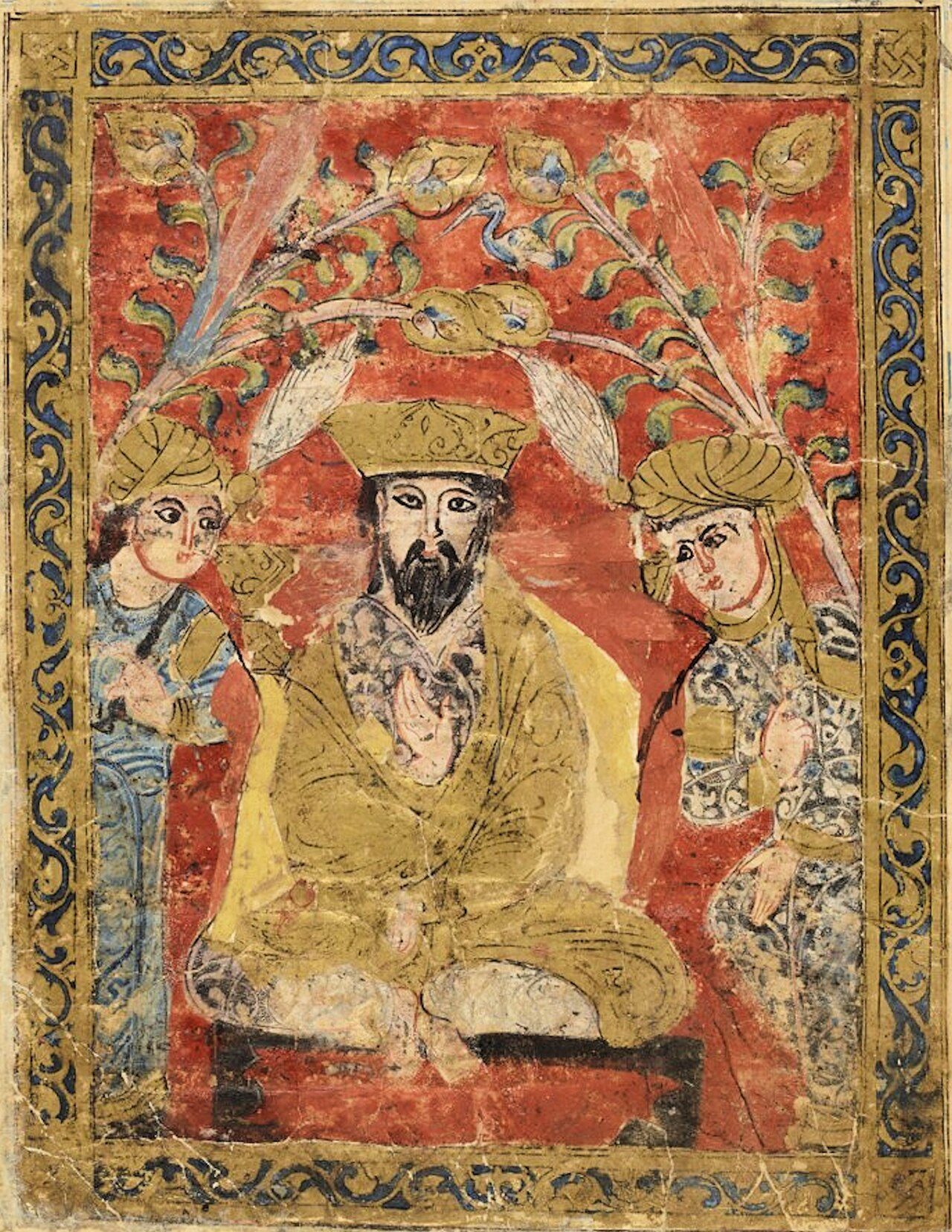
The first painting illustrates Bahram Shah, twelfth-century Ghaznavid ruler who commissioned the Persian text for the cycle featured in Cowen’s book. This chapter explores the similarities between past and present. 1
The text above is adapted from the Wikipedia article “Kalīla wa-Dimna”, available under the Creative Commons Attribution-ShareAlike 4.0 licence. 1
Kalila and Demna is collection of fables, according to the structured record cited below. This entry was generated automatically from that record and has not yet been reviewed by a person familiar with the tradition. 2
The source record links this tradition to 10 external registers, which can be verified through the citation. 2