The tradition & historical record
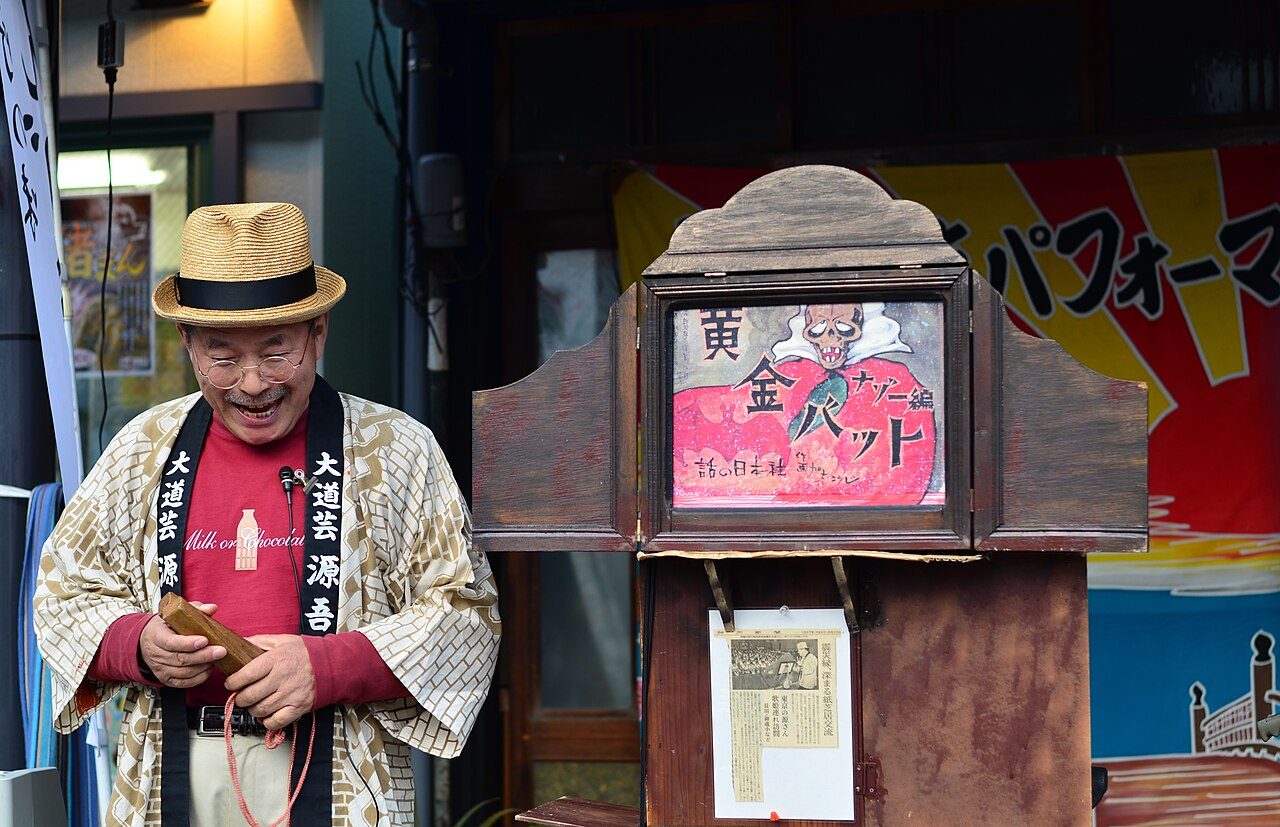
6 min read · 2 sourcesKamishibai (紙芝居, "paper play") is a form of Japanese street theater and storytelling that was popular during the Great Depression of the 1930s and the postwar period in Japan until the advent of television during the mid-20th century. Kamishibai were performed by a kamishibaiya ("kamishibai narrator") who travelled to street corners with sets of illustrated boards that they placed in a miniature stage-like device and narrated the story by changing each image. Kamishibai has its earliest origins in Japanese Buddhist temples, where Buddhist monks from the 8th century onward used emakimono ("picture scrolls") as pictorial aids for recounting their history of the monasteries, an early combination of picture and text to convey a story. 1
Origins
The exact origins of kamishibai during the 20th century are unknown, appearing "like the wind on a street corner" in the Shitamachi section of Tokyo around 1930. It is believed, however, that kamishibai has deep roots in Japan's etoki ("pictorial storytelling") art history, which can be traced back to the 12th-century emaki scrolls, such as the Chōjū giga ("Frolicking Critters"), attributed to the priest Toba Sōjō (1053–1140). The scroll depicts anthropomorphised animal caricatures that satirise society during this period but has no text, making it a pictorial aid to a story. It can therefore be considered a direct precursor of kamishibai. During the Edo period (1603–1868), visual and performing arts flourished, particularly through the proliferation of ukiyo-e ("pictures of the floating world"). Etoki once again became popular during the later 18th century as storytellers began to set up on street corners with an unrolled scroll hanging from a pole. In the Meiji period (1868–1912), tachi-e ("stand-up pictures"), similar to those in the Edo period, were told by performers who manipulated flat paper cutouts of figures mounted on wooden poles (similar to the shadow puppets of Indonesia and Malaysia). The Zen priest Nishimura is also credited to have used these pictures during sermons to entertain children. Another form of etoki was the Japanese-modified stereoscope imported from the Netherlands. Much smaller in size, six engravings of landscapes and everyday scenes would be placed one behind the other on top of the device and lowered when required so that the viewer, who looked at them through a lens, could experience the illusion of space created by this device. 1
Golden age
Kamishibai, cartoons, and comics became substantially popular during the Great Depression of the 1930s and after the Japanese surrender to the Allied Forces in August 1945 at the end of the Second World War. This period is known as the "Golden Age" of kamishibai in Japan. Kamishibai produced and narrated over this period give insight into the minds of the people who lived through such a tumultuous period in history. Contrary to the hardships imposed by the Depression, in 1933 there were 2,500 kamishibaiya in Tokyo alone, who performed ten times a day for audiences of up to thirty children, equalling a total of one million children a day. The Depression years were the most prosperous and vibrant for kamishibai: with 1.5 million unemployed in Tokyo in 1930, it provided a great job opportunity for many people. As kamishibai gained popularity in the 1930s, concerns emerged among educators and parents about its lack of educational value and its association with vulgar or grotesque content. However, some progressive educators recognized its potential as a teaching tool. Figures such as Christian educator Imai Yone advocated for kamishibai to deliver moral lessons to urban and rural children, particularly those from impoverished backgrounds. In 1938, the Nippon Kyōiku Kamishibai Kyōkai (National Association for Educational Kamishibai) was established, producing storycards with progressive, often rural-focused themes emphasizing the sincerity of the working classes. One notable example is Uzura ("The Quails"), which depicted a selfless girl in famine-stricken Tōhoku. During the 1930s and 1940s, the Japanese government co-opted kamishibai for wartime propaganda. Its accessibility and performative nature made it a powerful medium for mobilizing both urban and rural populations. 1
Decline
The popularity of kamishibai declined at the end of the Allied Occupation and the introduction of television, known originally as denki kamishibai ("electric kamishibai") in 1953. With television bringing larger access to a variety of entertainment, many kamishibai artists and narrators lost their work, with the former turning to drawing gekiga, bringing new talent and narrative to this growing genre. 1
Impact on manga and anime
Although this Japanese art form has largely disappeared, its significance and contributions have allowed kamishibai to be attributed as an origin for manga. Many prolific manga artists, like Shigeru Mizuki and Sanpei Shirato, were once kamishibai artists before the medium went out of vogue in 1953. A number of manga and anime have been produced that borrow from or call back to kamishibai tropes and presentation. These include Shōjo Tsubaki, an ero guro manga by Suehiro Maruo based around the titular kamishibai character archetype, and Yamishibai, an anime that uses a kamishibai style to tell myths and urban legends. Additionally, some older works that would later become popular manga or anime, such as GeGeGe no Kitaro, originally started as kamishibai programs. 1
Modern usage
As part of the Toyota Production System, kamishibai boards are used as a visual control for performing audits within a manufacturing process. A series of cards are placed on a board and selected at random or according to schedule by supervisors and managers of the area. This ensures safety and cleanliness of the workplace is maintained and that quality checks are being performed. As of 2013, kamishibai storytelling was being conducted as part of an ongoing campaign to promote world peace. Maki Saji (a Buddhist nun) created a kamishibai based on the story of one of the many children, Sadako Sasaki, who suffered as a result of the atomic bomb raid on Hiroshima in 1945. In May 2010, she was a delegate at a Meeting of the Treaty on the Non-Proliferation of Nuclear Weapons at the United Nations in New York, where she performed to promote a world in harmony and free of nuclear arms. 1
The text above is adapted from the Wikipedia article “Kamishibai”, available under the Creative Commons Attribution-ShareAlike 4.0 licence. 1
Kamishibai is form of Japanese street theatre and storytelling, according to the structured record cited below. This entry was generated automatically from that record and has not yet been reviewed by a person familiar with the tradition. 2
The source record links this tradition to 14 external registers, which can be verified through the citation. 2