The tradition & historical record
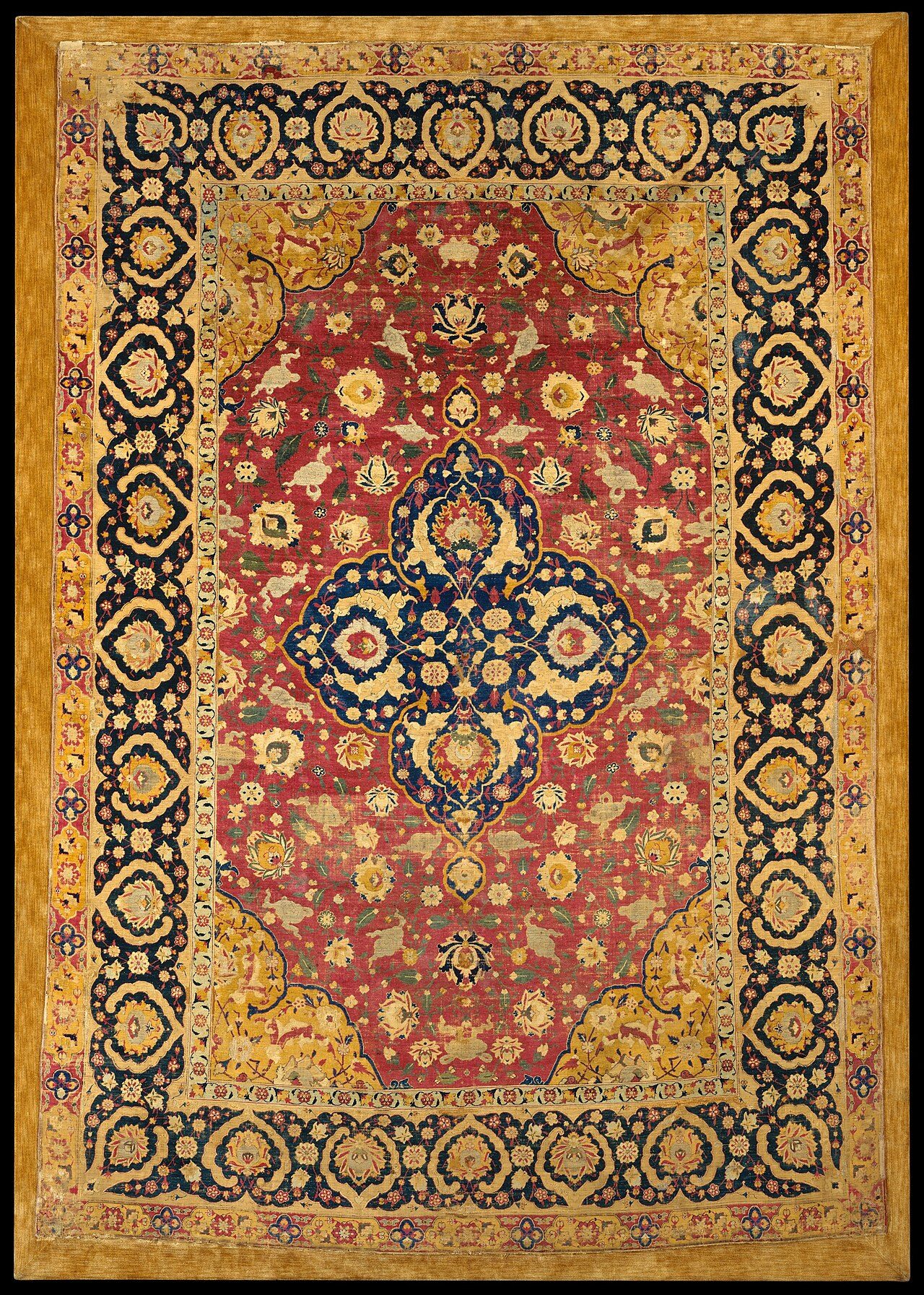
6 min read · 2 sourcesA Persian carpet (Persian: فرش ایرانی, romanized: farš-e irâni [ˈfærʃe ʔiː.ɹɒː.níː]), Persian rug (Persian: قالی ایرانی, romanized: qâli-ye irâni [ɢɒːˈliːje ʔiː.ɹɒː.níː]), or Iranian carpet is a heavy textile made for a wide variety of utilitarian and symbolic purposes and produced in Iran (historically known as Persia), for home use, local sale, and export. Carpet weaving is an essential part of Persian culture and Iranian art. It is one of the group of Oriental rugs produced by the countries of the "rug belt". Persian rugs and carpets of various types were woven in parallel by nomadic tribes in village and town workshops, and by royal court manufactories alike. As such, they represent miscellaneous, simultaneous lines of tradition, and reflect the history of Iran, also in the Ottoman empire, and its various peoples. The carpets woven in the Safavid court manufactories of Isfahan during the sixteenth century are famous for their elaborate colours and artistic design, and are treasured in museums and private collections all over the world today. Their patterns and designs have set an artistic tradition for court manufactories which was kept alive during the entire duration of the Persian Empire up to the last royal dynasty of Iran. Carpets woven in towns and regional centers like Tabriz, Kerman, Ravar, Neyshabour, Mashhad, Kashan, Isfahan, Nain and Qom are characterized by their specific weaving techniques and use of high-quality materials, colours and patterns. 1
History
The beginning of carpet weaving remains unknown, as carpets are subject to use, deterioration, and destruction by insects and rodents. Woven rugs probably developed from earlier floor coverings, made of felt, or a technique known as "flat weaving". Flat-woven rugs are made by tightly interweaving the warp and weft strands of the weave to produce a flat surface with no pile. The technique of weaving carpets further developed into a technique known as loop weaving. Loop weaving is done by pulling the weft strings over a gauge rod, creating loops of thread facing the weaver. The rod is then either removed, leaving the loops closed, or the loops are cut over the protecting rod, resulting in a rug very similar to a genuine pile rug. Hand-woven pile rugs are produced by knotting strings of thread individually into the warps, cutting the thread after each single knot. 1
Pazyryk carpet
The Pazyryk carpet was excavated in 1949 from the grave of a Scythian nobleman in the Pazyryk Valley of the Altai Mountains in Siberia. Radiocarbon testing indicated that the Pazyryk carpet was woven in the 5th century BC. This carpet is 183 by 200 centimetres (72 by 79 inches) and has 36 symmetrical knots per cm2 (232 per inch2). The advanced technique used in the Pazyryk carpet indicates a long history of evolution and experience in weaving. It is considered the oldest known carpet in the world. Its central field is a deep red colour and it has two animal frieze borders proceeding in opposite directions accompanied by guard stripes. The inner main border depicts a procession of deer, the outer men on horses, and men leading horses. The horse saddlecloths are woven in different designs. The inner field contains 4 × 6 identical square frames arranged in rows on a red ground, each filled by identical, star-shaped ornaments made up by centrally overlapping x- and cross-shaped patterns. The design of the carpet already shows the basic arrangement of what was to become the standard oriental carpet design: a field with repeating patterns, framed by a main border in elaborate design, and several secondary borders. The discoverer of the Pazyryk carpet, Sergei Rudenko, assumed it to be a product of the contemporary Achaemenids. Whether it was produced in the region where it was found, or is a product of Achaemenid manufacture, remains subject to debate. Its fine weaving and elaborate pictorial design hint at an advanced state of the art of carpet weaving at the time of its production. 1
Early fragments
There are documentary records of carpets being used by the ancient Greeks. In Odyssey Book VII and X "carpets" are mentioned. Pliny the Elder wrote (nat. VIII, 48) that carpets ("polymita") were invented in Alexandria. It is unknown whether these were flat-weaves or pile weaves, as no detailed technical information is provided in the Greek and Latin texts. Flat-woven kilims dating to at least the fourth or fifth century AD were found in Turfan, Hotan prefecture, East Turkestan, China, an area which still produces carpets today. Rug fragments were also found in the Lop Nur area, and are woven in symmetrical knots, with 5–7 interwoven wefts after each row of knots, with a striped design, and various colours. They are now in the Victoria and Albert Museum, London. Other fragments woven in symmetrical as well as asymmetrical knots have been found in Dura-Europos in Syria, and from the At-Tar caves in Iraq, dated to the first centuries AD. These rare findings demonstrate that all the skills and techniques of dyeing and carpet weaving were already known in western Asia before the first century AD. 1
Early history
Persian carpets were first mentioned around 400 BC, by the Greek author Xenophon in his book "Anabasis": 1
"αὖθις δὲ Τιμασίωνι τῷ Δαρδανεῖ προσελθών, ἐπεὶ ἤκουσεν αὐτῷ εἶναι καὶ ἐκπώματα καὶ τάπιδας βαρβαρικάς", (Xen. anab. VII.3.18) Next he went to Timasion the Dardanian, for he heard that he had some Persian drinking cups and carpets. "καὶ Τιμασίων προπίνων ἐδωρήσατο φιάλην τε ἀργυρᾶν καὶ τάπιδα ἀξίαν δέκα μνῶν." [Xen. anab. VII.3.27] 1
Timasion also drank his health and presented him with a silver bowl and a carpet worth ten mines. Xenophon describes Persian carpets as precious, and worthy to be used as diplomatic gifts. It is unknown if these carpets were pile-woven, or produced by another technique, e.g., flat-weaving or embroidery, but it is interesting that the very first reference to Persian carpets in the world literature already puts them into a context of luxury, prestige, and diplomacy. There are no surviving Persian carpets from the Achaemenid (553–330 BC), Seleucid (312–129 BC), and Parthian (ca. 170 BC – 226 AD) eras. 1
Sasanian Empire
The Sasanian Empire, which succeeded the Parthian Empire, was recognized as one of the leading powers of its time, alongside its neighbouring Byzantine Empire, for a period of more than 400 years. The Sasanids established their empire roughly within the borders set by the Achaemenids, with the capital at Ctesiphon. This last Persian dynasty before the arrival of Islam adopted Zoroastrianism as the state religion. When and how exactly the Persians started weaving pile carpets is currently unknown, but the knowledge of carpet weaving, and of suitable designs for floor coverings, was certainly available in the area covering Byzance, Anatolia, and Persia: Anatolia, located between Byzance and Persia, was ruled by the Roman Empire since 133 BCE. 1
The text above is adapted from the Wikipedia article “Persian carpet”, available under the Creative Commons Attribution-ShareAlike 4.0 licence. 1
Kashan rug is type of rug, according to the structured record cited below. This entry was generated automatically from that record and has not yet been reviewed by a person familiar with the tradition. 2
The source record links this tradition to 3 external registers, which can be verified through the citation. 2