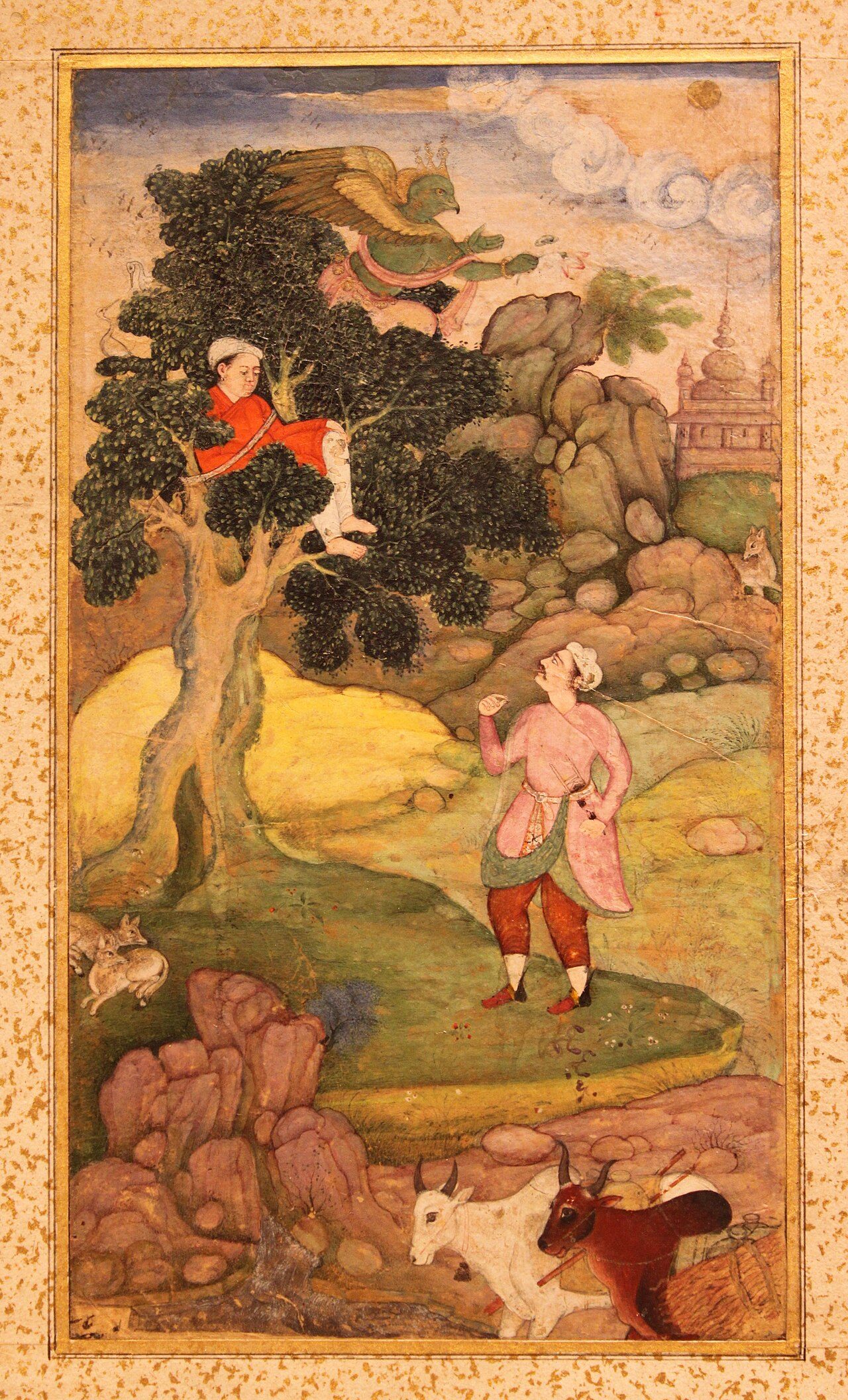
The tradition & historical record
6 min read · 2 sourcesThe Kathāsaritsāgara ("Ocean of the Streams of Stories") (Devanagari: कथासरित्सागर) is a famous 11th-century collection of Indian legends and folk tales as retold in Sanskrit by the Shaivite Somadeva from Kashmir. Kathāsaritsāgara contains multiple layers of story within a story and is said to have been adopted from Guṇāḍhya's Bṛhatkathā ("the Great Narrative"), which was written in a poorly understood language known as Paiśāchī. The Bṛhatkathā is no longer extant, but several later adaptations still exist—the Kathāsaritsāgara, Bṛhatkathamanjari and Bṛhatkathāślokasaṃgraha. However, none of these recensions necessarily derives directly from Gunadhya, and each may have intermediate versions. Scholars compare Guṇāḍhya with Vyasa and Valmiki even though he did not write the now long-lost Bṛhatkathā in Sanskrit. Presently available are its two Sanskrit recensions, the Bṛhatkathamanjari by Kṣemendra and the Kathāsaritsāgara by Somadeva. 1
Author and structure
The author of Kathasaritsagara, or rather its compiler, was Somadeva, the son of Rāma, a Śaiva Brāhman of Kashmir. He tells us that his magnum opus was written (sometime between 1063–1081 CE) for the amusement of Sūryavatī, wife of King Ananta of Kashmir, at whose court Somadeva was a poet. The tragic history of Kashmir at this period—Ananta's two sons, Kalaśa and Harṣa, the worthless degenerate life of the former, the brilliant but ruthless life of the latter, the suicide of Ananta himself, the self-immolation of Sūryavatī on his funeral pyre, and the resulting chaos—forms as a dark and grim background for the setting of Somadeva's tales. The frame story is the narrative of the adventures of Naravahanadatta, son of the legendary king Udayana, his romances with damsels of great beauty and wars with enemies. As many as 350 tales are built around this central story, making it the largest existing collection of Indian tales. Somadeva declares that his work is a faithful though abridged translation of a much larger collection of stories known as the Bṛhatkathā, or Great Tale written in the lost Paisaci dialect by Guṇāḍhya. But the Kashmirian (or "Northwestern") Bṛhatkathā that Somadeva adapted may be quite different from the Paisaci ur-text, as at least 5 apparent descendants of Guṇāḍhya's work exist—all quite different in form and content, the best-known (after the Kathāsaritsāgara itself) probably being the Bṛhatkathāślokasaṃgraha of Budhasvamin from Nepal. Like the Panchatantra, tales from the Kathāsaritsāgara (or its related versions) travelled to many parts of the world. Kathāsaritsāgara consists of 18 lambhakas ("books") of 124 taramgas (chapters called as "waves") and approximately 22,000 ślokas (distichs) in addition to prose sections. 1
Synopsis
The Kathāsaritsāgara is a large work. Each book comprises a number of stories loosely strung together, by being narrated for the recreation or information of the same individuals, or arising out of their adventures. These are Udayana, king of Kosambi, and his son Naravahanadatta. The marriage of the latter with various damsels of terrestrial or celestial origin, and his elevation to the rank of king of the Vidyadharas, a class of heavenly spirits, are the leading topics of most of the books; but they merely constitute the skeleton of the composition, the substance being made up of stories growing out of these circumstances, or springing from one another with an ingenuity of intricacy which is one of the great charms of all such collections. 1
Book 1
The first book (Kathapitha) is introductory, and refers to the origin of the tales contained in the collection to Shiva, who, it is said, related them in private conversation with his wife, Parvati, for her entertainment. One of the attendants of the deity, Pushpadanta, took the liberty of listening, and he repeated them, under the seal of secrecy, to his wife, Jaya, a sort of lady's maid to the goddess. Jaya takes an opportunity of intimating to her mistress that she is acquainted with the stories narrated by Shiva to the great mortification of Parvati who had flattered herself that they had been communicated to her alone. She accordingly complains to Shiva of his having deceived her, and he vindicates himself by discovering the truth. Parvati thereupon pronounces an imprecation upon Pushpadanta, condemning him to be born upon the earth as a man; and she sentences his friend Malyavan, who had ventured to intercede for him, to a like destination. Parvati tells the culprits that they shall resume their celestial condition when Pushpadanta, encountering a yaksha, a follower of Kubera, the god of wealth, doomed for a certain time to walk the earth, as a pishacha or goblin, shall recollect his own former state, and shall repeat to the pishacha the stories he overheard from Shiva; and when Malyavan, falling in with the Pisacha, shall hear from him again the stories that his friend Pushpadanta had narrated. The recitation of the stories also forms the limit of the pishacha's sojourn amongst mortals. The two demigods, Pushpadanta and Malyavan, are born as two Brahmins, named Vararuchi and Gunadhya, and their adventures as mortals constitute the subject of several tales. 1
Books 2 to 5
The second book (Kathamukha) commences that part of the original narrative which was supposedly not consumed, and records the adventures of Udayana, king of Kosambi, a prince of great fame in Sanskrit plays and poems, and his marriage with Vasavadatta, princess of Ujjain. The major sub-stories include the tales of Sridatta, Devasmita and Lohajangha. The third book (Lavanaka) describes his marriage to the second wife, Padmavati, princess of Magadha and his subsequent conquests. This book is especially rich in mythological sub-stories like Durvasa and Kunti, Urvashi and Pururavas, Indra and Ahalya, Sunda and Upasunda &c. The fourth book (Naravahanadattajanana) narrates the birth of the son of Udayana, by Vasavadatta, Naravahanadatta; at the same time sons are born to the chief ministers of Udayana, and they become the companions and councilors of the young prince. The book contains the famous story of Jimutavahana. The fifth book (Caturdarika) records the adventures of Saktivega who became king of the heavenly beings termed Vidyadharas, a class of spirits who reside upon the loftiest peaks of the Himalaya mountains. While a mortal, he possessed superhuman longevity and faculties, including clairvoyance and extrasensory perception. Naravahanadatta, is prophecised to be a king of the Vidyadharas. 1
Book 6
The main focus of the sixth book (Madanamanchuka) is the marriage of the young prince Naravahanadatta with Madanamanchuka the daughter of Kalingasena, a princess whose mother is a celestial nymph. Kalingasena had been enamoured of Udayana, and desired to wed him. Udayana wants to marry her, but as he has two wives already, his chief minister argues against it. 1
The text above is adapted from the Wikipedia article “Kathasaritsagara”, available under the Creative Commons Attribution-ShareAlike 4.0 licence. 1
Kathasaritsagara is Sanskrit 11th-century collection of Indian legends, fairy tales and folk tales, according to the structured record cited below. This entry was generated automatically from that record and has not yet been reviewed by a person familiar with the tradition. 2
The source record links this tradition to 14 external registers, which can be verified through the citation. 2