The tradition & historical record
6 min read · 2 sourcesThe Khalili Collection of Enamels of the World is a private collection of enamel artworks from the period 1700 to 2000, assembled by the British scholar, collector and philanthropist Nasser D. Khalili. It is one of the eight Khalili Collections, each of which is considered among the most important in its field. 1
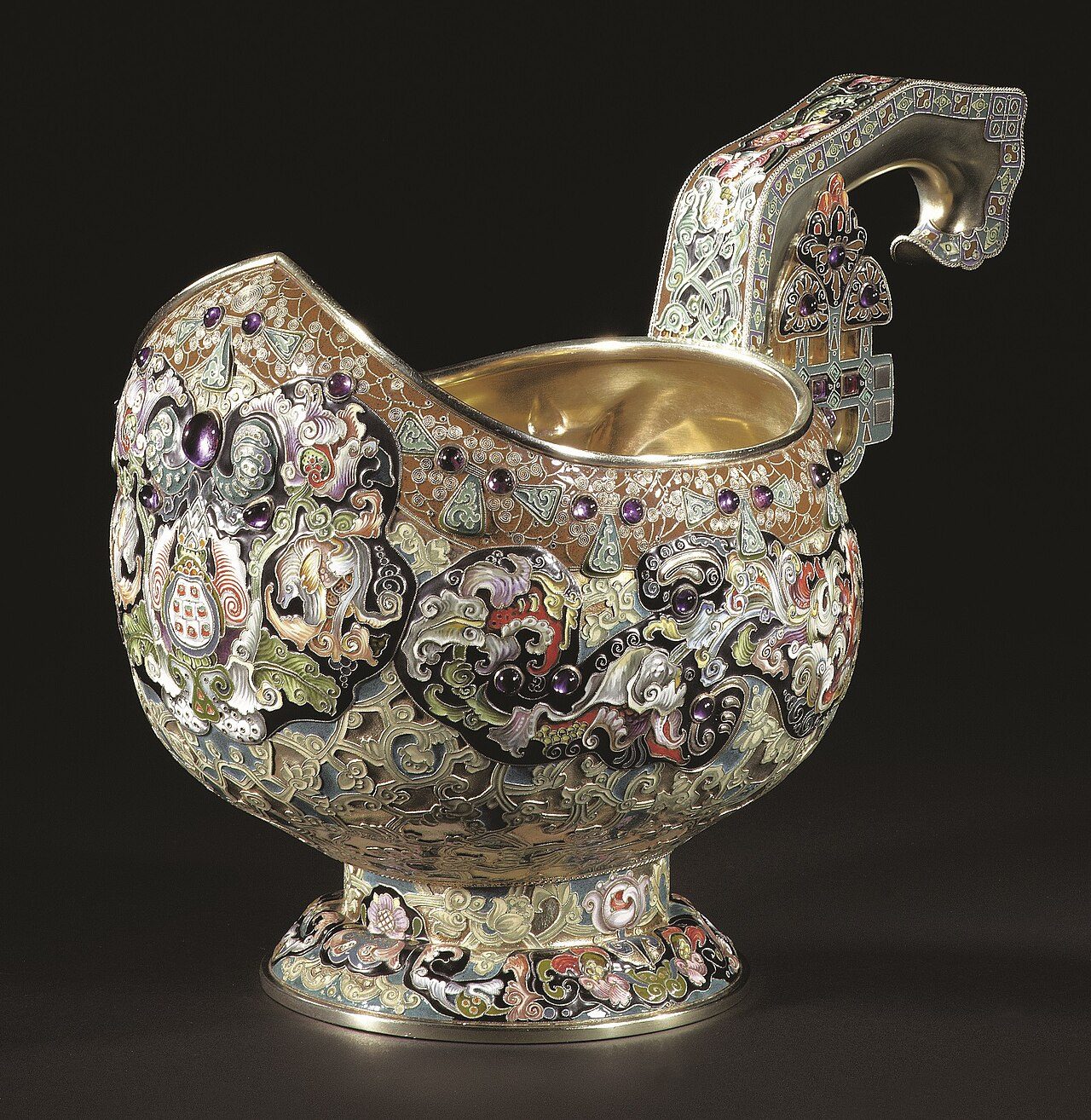
The most extensive private collection of its kind, it consists of over 1,300 pieces and showcases the evolution of enamelling over a 300-year period. By including objects from Western Europe, Russia, Islamic countries, China, Japan, and America, it shows how these centres of enamel production influenced each other's styles. The best-known European enamellists are represented, including Peter Carl Fabergé, Cartier, and René Lalique, along with the Meiji-era Japanese artists who perfected the firing process. The collection illustrates the role of patronage in enamelling as many of its objects were created for royal or imperial households. These include the enamelled chariot belonging to Bhavsinhji II, Maharaja of Bhavnagar and a painted enamel throne table with the seal mark of the 18th century Chinese Qianlong emperor. Other objects include presentation chargers, jewellery, miniatures and ornamental pieces. The collection was the basis for a 2010 exhibition at the Hermitage Museum. 1
The collection
The collection is one of eight assembled, conserved, published and exhibited by Khalili, each of which is considered among the most important in its field, according to UNESCO. Three of them contain enamels, the others being the Khalili Collection of Japanese Art and the Khalili Collection of Islamic Art. The enamels collection consists of over 1,300 pieces and showcases the evolution of enamelling over a 300-year period. It is the most comprehensive private collection of its kind. 1
European works
A range of enamelling techniques, including plique-à-jour, ronde-bosse, and basse-taille were used by European craftsmen from 1700 onwards. Watchmakers in Geneva and silver-workers in Augsburg integrated enamel decoration into their work. Limoges in France was a centre for painted enamel from the late 15th century onwards. French workshops developed polychrome techniques in the early 17th century, giving their works much greater realism, similar to watercolour and gouache portraits. Portraits on painted enamel, as a way of decorating small objects, became common until largely replaced by portrait photography. Other uses of enamel continued into the 20th century, with mass production used for many kinds of wares from the most mundane to award-winning artistic examples. The collection's European works come from Paris, Geneva, and Vienna, among other locations, and include decorative boxes, containers and other ornamental items by artists including René Lalique, Jean-Valentin Morel, and Adrien Vachette. A surtout de table by Lalique has two cast bronze peacocks, using enamel to colour their feathers and crests. One item from Paris is a decimal clock with one face showing normal twelve-hour time, a Moon phase indicator, and another face showing decimal time, which was promoted in the aftermath of the French Revolution. Works from early twentieth century Paris include some from the Cartier jewellery firm and its contemporaries. The Cartier items in the collection include timepieces and small cases. Other Parisian enamellers represented include Van Cleef & Arpels, Lacloche Paris, and Jean Schlumberger. A silver and gold timepiece by Maison Vever was exhibited at the Paris Exposition Universelle of 1889 as part of a display that won a Grand Prix for jewellery design. 1
Russian works
Some works in the collection bear the mark of Peter Carl Fabergé whose father had founded the House of Fabergé in Saint Petersburg. Fabergé acquired a reputation for enamel artworks of the highest quality and received commissions from the Russian Imperial family, as well as being awarded the titles of Master Goldsmith and Goldsmith by Special Appointment to the Imperial Crown. In the 1880s Fabergé greatly expanded the range of colours and patterns of enamel surfaces, machining repeating patterns onto the underlying metal. His employees included the enamel artists Henrik Wigström, Michael Perkhin, and Hjalmar Armfeldt who are represented in the collection. The collection's objects from the House of Fabergé include timepieces, cases, frames, and a fan combining lace and gauze with silver, gold, and painted enamel. An independent enameller who supplied filigree enamel to Fabergé was Feodor Rückert. Rückert's style changed dramatically during his career, at first imitating other artists then developing his own distinctive decorative style. The collection has works from before and after this change. A bread and salt-dish given to President Émile Loubet of France by the residents of Tsarskoye Selo in Russia in May 1902 bears the arms of Tsarskoye Selo and cypher of Empress Elizabeth I. 1
Islamic works
At the start of the Islamic calendar in 622 AD, artisans of the Byzantine Empire were already making high quality enamels. Byzantine emperors gave luxury items to Muslim rulers in the 10th and 11th centuries and these would often be decorated with cloisonné. The influence of Byzantine art is visible in objects from the Fatimid Caliphate, Egypt, Syria, and Muslim Iberia. The historian Jack Ogden has argued Iran was producing champlevé enamelwork by the 14th or 15th century, but very few examples survive. Champlevé enamel flourished in the Mughal Empire, especially during the reign of Shah Jahan in the 17th century, where it was used for personal jewellery, luxury objects and containers including hookahs. In the 19th century, Jaipur was known for enamels rivalling those of Europe or Iran, especially red transparent enamels, while Lucknow was known for blues and greens and Benares for painted enamels. Delhi and Calcutta also produced enamels but seem not to have had their own regional style. The Jaipur red enamel is exemplified in the collection by an ornamental dagger with scabbard and by a gold necklace. In the Mughal period, enamel was only used to decorate functional objects, but in the 19th century purely decorative enamel wares were produced. The collection includes both kinds of object. A silver Landau carriage in the collection was commissioned in 1915 by Bhavsinhji II, Maharaja of Bhavnagar and was kept by his family until 1968 for use in special events. Enamel production in Iran dates from at least the early Safavid period in the 14th century and flourished during the Qajar period (1785–1914), whose artisans had a strong preference for gold as a base. 1
Japanese works
Japanese artists did not start producing cloisonné enamel until the 1830s, coinciding with the sharp fall in the Shogun's power, and followed by the Meiji Revolution, but their techniques advanced quickly. By the 1870s, enamel art works were being exhibited at national exhibitions and at world's fairs. 1
The text above is adapted from the Wikipedia article “Khalili Collection of Enamels of the World”, available under the Creative Commons Attribution-ShareAlike 4.0 licence. 1
Khalili Collection: Enamels of the World is private art collection, according to the structured record cited below. This entry was generated automatically from that record and has not yet been reviewed by a person familiar with the tradition. 2
The source record links this tradition to 1 external register, which can be verified through the citation. 2