The tradition & historical record
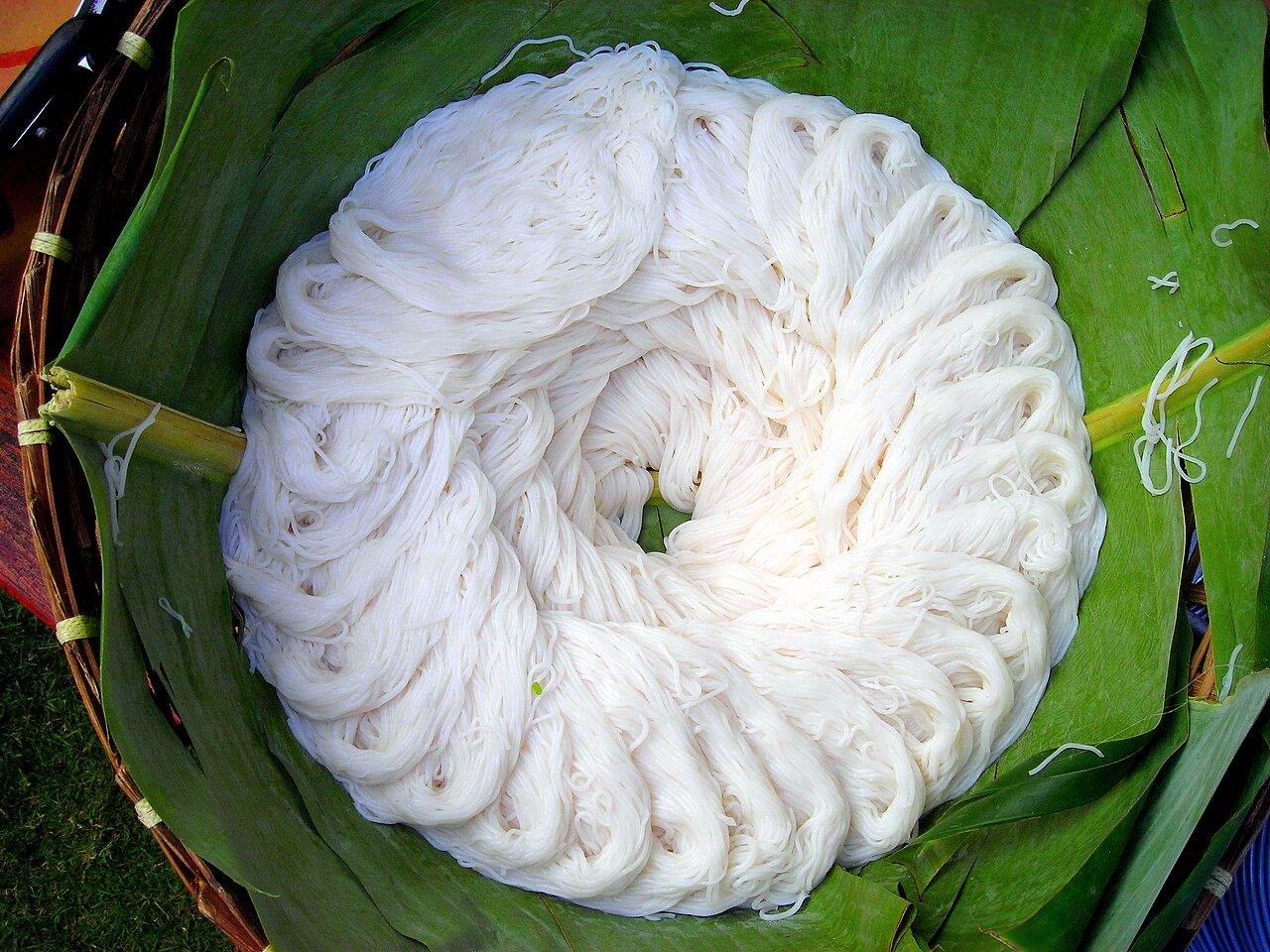
4 min read · 2 sourcesKhanom chin or khanom jeen are fresh, thin white rice noodles in Thai cuisine which are made from rice fermented for three days, boiled, and extruded through into boiling water through a sieve. Khanom chin is served with stocks including coconut milk, fish curry, and chilli. 1
Etymology and origin
Although chin means "Chinese" in Thai, this type of noodle originated from the Mon people. The word khanom chin is probably derived from the Mon words hanom cin (Mon: ခၞံစိန် lit. 'boiled noodles'). 1
Eating khanom chin
When khanom chin is served, the stock is added. Each locality has a different stock such as coconut stock, fish, curry sauce, chili sauce, and curry with coconut milk such as green curry, spicy pork sauce, and fish organ sour soup. Moreover, for children, there is also a sweet stock without spices combined with nuts. Khanom chin is eaten with fresh vegetables and pickles as condiments: in the north, pickled cabbage and raw sprouts are typical; in the central regions, banana blossoms, lentils, cucumbers, sprouts, raw papaya, basil, gotu kola, bitter melon and morning glory (other condiments can include half-boiled eggs and roasted peppers); in the northeast, fresh vegetables such as white popinac, climbing wattle and parsley; in the south, fresh vegetables such as parkia, white popinac, olives and pickles. Notable neighborhoods for khanom chin in Bangkok include Banglampoo in Phra Nakhon (with two eateries) and Wongwian Yai in Thonburi. 1
Variations
There are two types of khanom chin noodles: 1
Khanom chin noodles made with fermented flour, usually made in the northeast. The brown noodle is stickier than fresh flour and can keep for a long time. This is the ancient method of khanom chin making. Khanom chin noodles made with fresh flour. The noodles are bigger than fermented flour and softer too. Khanom chin noodle is white and easy to make. 1
These noodles are used as a staple food in a variety of Thai dishes. Some popular dishes are: 1
Khanom chin nam ya, served with a hot and spicy fish-based sauce Khanom chin nam phrik, served with a sweet peanut-based sauce Khanom chin kaeng kiao wan kai, served with green chicken curry Khanom chin nam ngiao, a northern Thai speciality, the sauce contains pork blood Khanom chin sao nam, a salad with coconut milk, ground sun-dried prawns, and fresh pineapple Khanom chin tai pla, a southern Thai spicy soup Khanom chin miang pla, noodles with deep fried fish and spicy chili sauce wrapped in a big salad leaf Another popular combination is to serve Thai papaya salad together with this noodle. 1
Khanom chin nam ya
Khanom chin nam ya (lit. 'noodles with fish curry') is spicy like many other dishes in Thai cuisine, such as Tomyamkung, Somtum, and yum. Nam ya (English: fish curry) originates from Central Thailand. The ingredients of khanom chin nam ya include khanom chin, boiled fish, fish ball, dried guinea pepper, salt, kha sliced, lemongrass sliced, garlic sliced, turmeric sliced, fingerroot, shrimp paste, shallots, undiluted coconut milk, diluted coconut milk, fish sauce, palm sugar, noodles, boiled egg and fresh vegetables. First, the dried guinea pepper, salt, kha, lemongrass, shallots, garlic, fingerroot and turmeric is pounded until it breaks, then boiled fish and shrimp paste are added and pounding is continued. Second, the coconut milk is boiled by using middle temperature, then the spices in the first step, when the coconut milk is boiling, then input fish ball and season. Lastly, khanom chin is added to the dish and fish curry is poured over the dish, it is eaten with boiled egg and fresh vegetables. 1
Khanom chin nam ngiao
Khanom chin nam ngiao is a noodle soup or curry of the cuisine of the Tai Yai people who live in the northeast of Myanmar, the southwest of Yunnan province, China, and in northern Thailand, mainly in Mae Hong Son Province. The dish has become famous through the northern Thai cuisine. Nam ngiao has a spicy and tangy flavor. 1
The text above is adapted from the Wikipedia article “Khanom chin”, available under the Creative Commons Attribution-ShareAlike 4.0 licence. 1
Khanom chin is Thai rice noodles, according to the structured record cited below. This entry was generated automatically from that record and has not yet been reviewed by a person familiar with the tradition. 2
The source record links this tradition to 1 external register, which can be verified through the citation. 2