The tradition & historical record
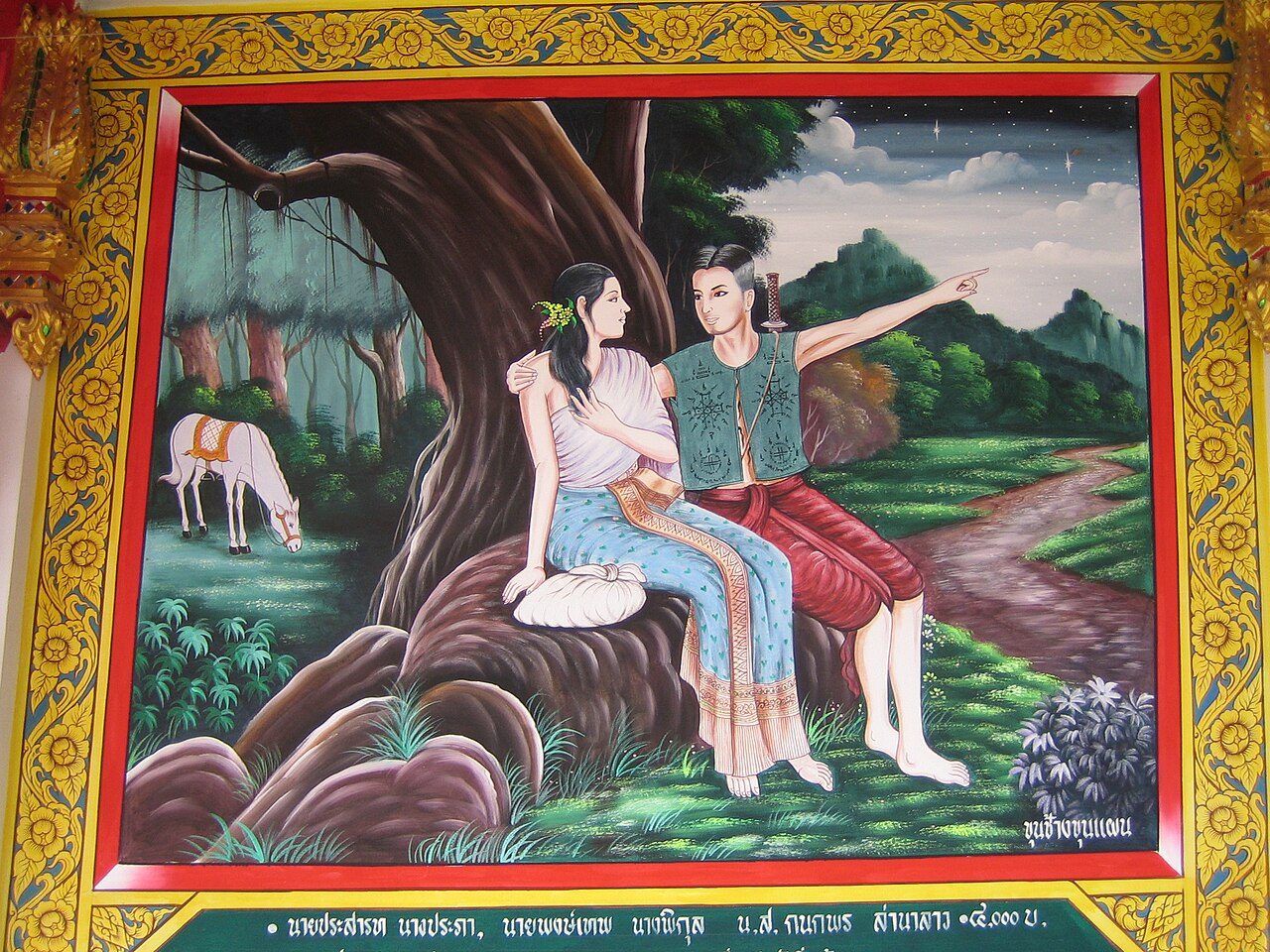
6 min read · 2 sourcesKhun Chang Khun Phaen (Thai: ขุนช้างขุนแผน, pronounced [kʰǔn tɕʰáːŋ kʰǔn pʰɛ̌ːn]) is a long Thai epic poem which originated from a legend of Thai folklore and is one of the most notable works in Thai literature. The work's entire length is over 20,000 couplets. Khun Chang and Khun Phaen are the leading male characters, where "Khun" was a junior feudal title given for male commoners. The story recounts the adventurous and amorous struggles of the three main protagonists. Much of their relationship can be described as a love triangle. Khun Phaen (dashing but poor) and Khun Chang (rich but ugly) compete for the lovely Wanthong from childhood for over fifty years. Their stories transpire amid the larger backdrop of national events, including two wars, several abductions, a suspected revolt, an idyllic sojourn in the forest, two court cases, trial by ordeal, jail, and treachery. Ultimately the King of Ayutthaya condemns Wanthong to death for failing to choose between the two men. The KCKP epic existed for a long time as an orally transmitted poem among Thai troubadours. The poem was first written down and published in printed form in 1872, and a standard edition first published in 1917–1918. Like many works with origins in popular entertainment, it is fast-moving and replete with heroism, romance, sex, violence, folk comedy, magic, horror, and passages of lyrical beauty. In Thailand, the story is universally known. 1
Origins and sepha
Khun Chang Khun Phaen is an old folk story in the Thai language. It originated as a folk entertainment some time around 17th century, developed by storytellers who recited episodes for local audiences, and passed on the story by word-of-mouth. By the 18th century, such performances had become the most popular form of entertainment in Siam. The storytellers recounted the story in stylized recitation, using two small sticks of wood (krap) to give rhythm and emphasis. The performances typically lasted a full night. The performance of Khun Chang Khun Phaen created a new genre known as sepha. For at least a century, only episodes from this work were known by this term. In the Fourth Reign (1851–1868), parts of the royal chronicles and a few other works were also rendered in this form on royal commission, but all but a few fragments have since disappeared. The origin of this word sepha is disputed. There is a musical form of the same name, but this seems unconnected. Kukrit Pramoj thought that sepha meant a jail and that the genre was developed by convicts in jail. Sujit Wongthet argued a connection to the Sanskrit word sewa, indicating some original association with ritual. 1
Development as literature
Beginning in the eighteenth century, prominent episodes from the story were written down. After the foundation of Bangkok in 1782, the new royal court made efforts to retrieve all kinds of texts which had survived the sack of Ayutthaya fifteen years earlier. Episodes of Khun Chang Khun Phaen were transcribed from earlier texts, or adapted from recitations by storytellers. No manuscripts of Khun Chang Khun Phaen have survived from the Ayutthaya era. It became conventional to render these written versions in the then-popular poetic meter, klon (Thai: กลอน), especially the variant with eight-syllable lines known as klon paet. Performance of these episodes were popular in the court and among the aristocracy. In the Second Reign (1809–1824), the performance was often enhanced by adding music. From the Fourth Reign (1851–1868), dancing was also added and more than one performer might share the task of recitation. Several chapters were written down by members of the literary salon of King Rama II (1809–1824). None of these works are signed, but certain chapters and part-chapters are conventionally attributed to King Rama II, the future King Rama III (r. 1824–1851), and the great poet Sunthorn Phu. Another member of the salon, Prince Mahasak Phonlasep, a son of King Rama I (1782–1809) and cousin of King Rama II, may also have contributed to the writing. Several other chapters were compiled later, probably during the reign of King Rama III, by Khru Jaeng, a performer of sepha and other forms of entertainment. Little is known of him except for an internal reference in the poem. For over half the 43 chapters in the standard version, the author is unknown. 1
Publication
A former missionary, Samuel J. Smith, printed the first book version in 1872, probably using a manuscript belonging to Somdet Chaophraya Borommaha Sisuriyawong. Another printed version was issued in 1889 by the Wat Ko Press. Five episodes composed by Khru Jaeng were printed around 1890. The standard modern edition appeared in three volumes in 1917–1918, published by the Wachirayan Library, and edited by its head, Prince Damrong Rachanubhab. Damrong compiled from four sets of samut thai manuscripts and a few other fragments. The earliest of the manuscripts dated from the Fourth Reign (1851–1868). He selected what he believed were the best versions of each episode, and added some link passages. He deleted some passages which he considered obscene, and some which depended on topical jokes and other material which he felt were no longer comprehensible. This standard edition is around 20,000 lines divided into 43 chapters. The main story ends in chapter 36, but a further seven chapters were included because the episodes were well-known and popular. Performers and authors had already developed many more episodes which extended the story down through three generations of Khun Phaen's lineage. Damrong decreed that these were not good enough as either narrative or poetry to deserve publication. Around fifty of these later chapters have since been published in various collections. 1
Synopsis
Khun Chang, Phlai Kaeo (who later is given the title Khun Phaen), and Nang Phim Philalai (who later changes her name to Wanthong) are childhood friends in Suphanburi. Khun Phaen is handsome and intelligent, but poor because the king has executed his father and seized their property. He enters the monkhood as a novice to get educated, excelling at military skills and love magic. Khun Chang is ugly and dim-witted, but rich and well-connected at the Ayutthaya court. By age 15, Phim is the belle of Suphanburi. She meets Phlai Kaeo when putting food in his almsbowl at Songkran (Thai New Year). Sparks fly. They have a passionate affair, with him shuttling between the wat (Buddhist monastery) and her bedroom. Khun Chang is also smitten by Phim. He competes for her using his wealth and status. He offers to give her mother Phim's weight in gold. After Phlai Kaeo and Phim are married, Khun Chang maneuvers the king to send Phlai Kaeo on military service, and then claims he is dead. When Phlai Kaeo returns victorious, Khun Chang plots to have him banished from Ayutthaya for negligence on government service. Phim (now Wanthong) resists Khun Chang's advance. But when Phlai Kaeo (now Khun Phaen) returns from war with another wife, they have a jealous quarrel. 1
Origins of the story
Prince Damrong believed that the Khun Chang Khun Ph… 1
The text above is adapted from the Wikipedia article “Khun Chang Khun Phaen”, available under the Creative Commons Attribution-ShareAlike 4.0 licence. 1
Khun Chang Khun Phaen is Thai epic poem, according to the structured record cited below. This entry was generated automatically from that record and has not yet been reviewed by a person familiar with the tradition. 2
The source record links this tradition to 3 external registers, which can be verified through the citation. 2