The tradition & historical record
7 min read · 2 sourcesThe Kilkenny cats are a fabled pair of cats from County Kilkenny (or Kilkenny city in particular) in Ireland, who fought each other so ferociously that only their tails remained at the end of the battle. Often the absurd implication is that they have eaten each other. In the nineteenth century the Kilkenny cats were a common simile for any conflict likely to ruin both combatants. Kilkenny cat is also used more generally for a fierce fighter or quarrelsome person. These senses are now rather dated. In the later twentieth century the motif was reclaimed by Kilkenny people as a positive symbol of tenacity and fighting spirit, and "the Cats" is the county nickname for the Kilkenny hurling team. The original story is attested from 1807 as a simple joke or Irish bull; some early versions are set elsewhere than Kilkenny. Nevertheless, theories have been offered seeking a historical basis for the story's setting. 1
Versions of the story
The earliest attested version of the story is from June 1807, in Anthologia, a collection of jokes and humorous pieces copied by "W.T." of Inner Temple from unnamed previous publications. Steven Connor characterises the story as an Irish bull. Under the heading "Kilkenny Cats" it runs: 1
In a company, consisting of naval officers, the discourse happened to turn on the ferocity of small animals; when an Irish gentleman present stated his opinion to be, that a Kilkenny cat, of all animals, was the most ferocious; and added, "I can prove my assertion, by a fact within my own knowledge:— I once," said he, "saw two of these animals fighting in a timber yard, and willing to see the result of a long battle, I drove them into a deep sawpit, and placing some boards over the mouth, left them to their amusement. Next morning I went to see the conclusion of the fight, and what d'ye think I saw?"– "One of the cats dead, probably," —replied one of the company.— "No by Ja—s! there was nothing left in the pit, but the two tails and a bit of flue!" The tale was repeated verbatim the next month in The European Magazine's review of Anthologia, as well as The Sporting Magazine, also in London, and Walker's Hibernian Magazine in Dublin. It reappeared in 1812 in Thomas Tegg's The Spirit of Irish Wit, and in the 1813 supplement to William Barker Daniel's Rural Sports. The following appears in Thomas Gilliland's The Trap, an 1808 satire on the theme of love: 1
When I was last at Kilkenny, said Teague, I saw two big ram-cats fight a duel for love, your honour; and they fought, and fought, till they ate each other up. 1
Elsewhere than Kilkenny
An 1817 memoir of the Irish wit John Philpot Curran situates the story in Sligo rather than Kilkenny, as a tall tale told by Curran: 1
Passing his first summer at Cheltenham ... he had resort to a story to draw himself into notice. ... The conversation of the table turning altogether on the stupid, savage, and disgusting amusement of cock-fighting, he was determined to put an end to it, by the incredible story of the Sligo cats. At [a cat-fight meeting in Sligo] three matches were fought on the first day ... and before the third of them was finished (on which bets ran very high), dinner was announced in the inn where the battle was fought. The company agreed ... to lock up the room, leaving the key in trust to Mr. 1
The battle of the cats of Ireland
S. Redmond in 1864 in Notes and Queries recounted a tale told to him "more than thirty years" earlier when he was "very young" by "a Kilkenny gentleman", about a battle "some forty years before" [i.e. about 1790] on "a plain near that ancient city": 1
One night, in the summer time, all the cats in the city and county of Kilkenny, were absent from their "local habitations;" and next morning, the plain alluded to (I regret I have not the name) was found covered with thousands of slain tabbies; and the report was, that almost all the cats in Ireland had joined in the contest; as many of the slain had collars on their necks, which showed that they had collected from all quarters of the island. The cause of the quarrel, however, was not stated; but it seemed to have been a sort of provincial faction fight between the cats of Ulster and Leinster—probably the quadrupeds took up the quarrels of their masters, as at that period there was very ill feeling between the people of both provinces. Although Redmond states "This has nothing to do with the story of the two famous Kilkenny cats", the two have occasionally been linked subsequently. A similar story was told in Charles Henry Ross' 1867 Book of Cats, to which Kilkenny antiquarian John G. A. Prim responded that he had heard such a story told of many places in Ireland, but not of Kilkenny. In 1863, Once A Week had a story of a similar battle in Yorkshire. Folklorist John O'Hanlon in 1898 published a version from John Kearns of Irishtown, Dublin which situated the battle on Scald Hill in Sandymount, the future site of Star of the Sea Catholic Church, witnessed by curate Father Corrigan. 1
Use as a simile
The story was sufficiently well known in the 19th century to be used frequently as a simile for "combatants who fight until they annihilate each other"; to "fight like [the] Kilkenny cats" means "to engage in a mutually destructive struggle". Early instances include: (from 1814) an account in Niles' Register of the loss of USS Wasp after sinking HMS Avon; (from 1816) the critique of Andrew O'Callaghan mentioned earlier; a letter from the 4th Duke of Buccleuch to Walter Scott comparing Lord Byron's poem "Darkness" to the story; and a riposte to disagreeing literary critics: 1
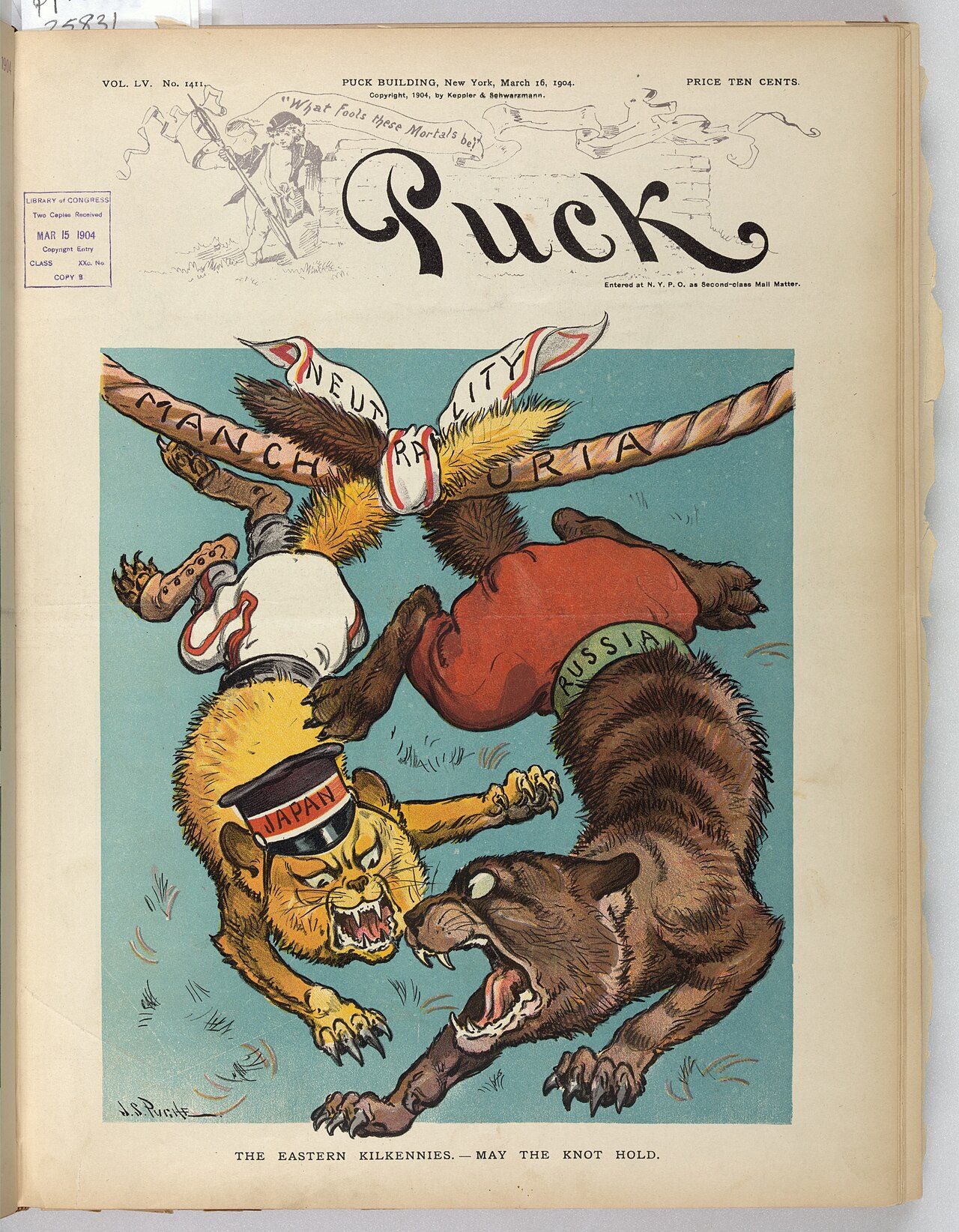
Indeed, so mortal is your reciprocal hostility, that your victims may, with Mercutio, form the reasonable expectation, that, being, 'two such, we shall have none shortly, for one will kill the other;' and like the celebrated Kilkenny cats, leave no other vestige to designate the tribe of ferae naturae to which you belong, than an odd tooth or a claw! One context for the simile was advocating isolationism, allowing one's enemies to defeat each other, or a divide-and-conquer policy. A report in Niles' Register of Spanish church opposition to the 1817 tax reform of Martín de Garay wished 'the fate of the "Kilkenny cats"' on "Ferdinand and his priests". Similarly Charles Napier in 1823 hoped "the French and Spaniards [would] war like Kilkenny cats"; likewise Figaro in London in 1832 urging British neutrality after the Ten Days' Campaign and Charles Darwin in 1833 in Buenos Aires during the Revolution of the Restorers. J. S. Pughe in a 1904 political cartoon in Puck depicted Japan and Russia as Kilkenny cats fighting the Russo-Japanese War in Manchuria. 1
Reclaimed
Irish counties have nicknames, some long established and in general use, others invented by sports journalists covering inter-county Gaelic games. 1
The text above is adapted from the Wikipedia article “Kilkenny cats”, available under the Creative Commons Attribution-ShareAlike 4.0 licence. 1
Kilkenny cats is two cats who fought leaving only their tails, according to the structured record cited below. This entry was generated automatically from that record and has not yet been reviewed by a person familiar with the tradition. 2
The source record links this tradition to 1 external register, which can be verified through the citation. 2