The tradition & historical record
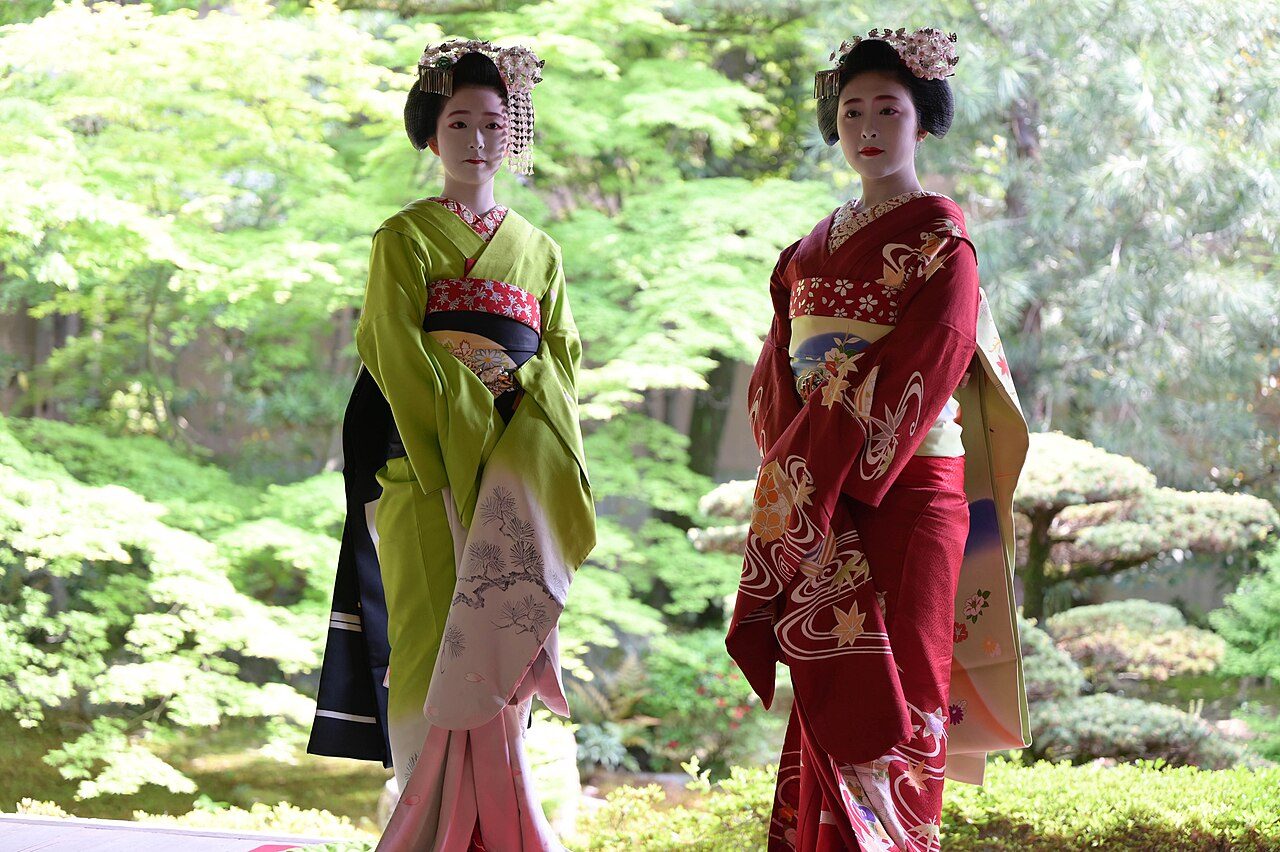
6 min read · 2 sourcesThe kimono (着物; Japanese pronunciation: [kʲi.mo.no], lit. 'thing to wear') is a traditional Japanese garment and the national dress of Japan. The kimono is a wrapped-front garment with square sleeves and a rectangular body, and is worn left side wrapped over right, unless the wearer is deceased. The kimono is traditionally worn with a broad sash, called an obi, and is commonly worn with accessories such as zōri sandals and tabi socks. Kimonos have a set method of construction and are typically made from a long, narrow bolt of cloth known as a tanmono, though Western-style fabric bolts are also sometimes used. There are different types of kimono for men, women, and children, varying based on the occasion, the season, the wearer's age, and – less commonly in the modern day – the wearer's marital status. Despite the kimono's reputation as a formal and difficult-to-wear garment, there are types of kimono suitable for both formal and informal occasions. The way a person wears their kimono is known as kitsuke (着付け, lit. 'dressing'). Until the Edo period (1603–1868), garments that resembled modern kimonos, characterized by narrow sleeve openings and hanging sleeves, were collectively referred to as kosode. In the late ninth century of the Heian period (794–1185), Japanese clothing began to diverge from Chinese styles, giving rise to uniquely Japanese garments such as the jūnihitoe. During this time, members of the court and the warrior class wore white kosode as underwear. 1
Yamato period to Nara period (300–794)
The first instances of kimono-like garments in Japan were traditional Chinese clothing introduced to Japan via Chinese envoys in the Kofun period (300–538 CE; the first part of the Yamato period), through immigration between the two countries and envoys to the Tang dynasty court leading to Chinese styles of dress, appearance, and culture becoming extremely popular in Japanese court society. The Imperial Japanese court quickly adopted Chinese styles of dress and clothing, with evidence of the oldest samples of shibori tie-dyed fabric stored at the Shōsōin Temple being of Chinese origin, due to the limitations of Japan's ability to produce the fabrics at the time. As early as the 4th century CE, images of priestess-queens and tribal chiefs in Japan depicted figures wearing clothing similar to that of Han dynasty China. In 718 CE, the Yōrō legal code was instituted; one of its stipulations that all robes had to be overlapped at the front with a left-over-right closure, following typical Chinese fashions. This convention of wear is still followed today, with a right-over-left closure worn only by the deceased. Clothing used by the upper classes was significantly simpler to don and wear than dress from the following Heian period. Sleeves, while narrow, were long enough to cover the fingers, since status was associated with covering more of the body. 1
Heian period to Azuchi–Momoyama period (794–1600)
During the Heian period (794–1193 CE), Japan stopped sending envoys to the Chinese dynastic courts. This prevented Chinese-imported goods—including clothing—from entering the Imperial Palace. This also prevented dissemination to the upper classes, who were the main arbiters of traditional Japanese culture at the time, and the only people allowed to wear such clothing. The ensuing cultural vacuum facilitated the development of a Japanese culture independent from Chinese fashions. Elements previously lifted from the Tang Dynastic courts developed independently into what is known literally as "national culture" or "kokufū culture" (国風文化, kokufū-bunka). The term is used to refer to Heian-period Japanese culture, particularly that of the upper classes. Women's clothing in the imperial palace became increasingly stylised in the formal jūnihitoe, with some elements being abandoned by both male and female courtiers, such as the round-necked and tube-sleeved chun ju jacket worn by both genders in the early 7th century. Others, such as the wrapped front robes also worn by men and women, were kept. Some elements, such as the mo skirt worn by women, continued to in a reduced capacity, worn only to formal occasions; the mо̄ (裳) grew too narrow to wrap all the way around and became a trapezoidal pleated train. Hakama (trousers) became longer than the legs and also trailed behind the wearer. During the later Heian period, various clothing edicts reduced the number of layers a woman could wear, leading to the kosode (lit. 'small sleeve') garment—previously considered underwear—becoming outerwear by the time of the Muromachi period (1336–1573 CE). Originally worn with hakama, the kosode began to be held closed with a small belt known as an obi instead. 1
Edo period (1603–1867)
During the Edo period (1603–1867 CE), both Japan's culture and economy developed significantly. A particular factor in the development of the Edo period was the early Genroku period (1688–1704 CE), wherein "Genroku culture" – luxurious displays of wealth and increased patronage of the arts – led to the further development of many art forms, including those of clothing. Genroku culture was led by the growing and increasingly-powerful merchant classes (chōnin), whose clothing was representative of their increasing economic power and rivalled the aristocracy and samurai classes, shown by their brightly coloured kimono that utilised expensive production techniques, such as hand-painted dyework. Rinzu, a damask fabric, also became the preferred material for kimono at this time, replacing the previously popular nerinuki plain-weave silk, which had been used to create tsujigahana. In response to the increasing material wealth of the merchant classes, the Tokugawa shogunate issued sumptuary laws on kimono for the lower classes, prohibiting the use of purple or red fabric, gold embroidery, and the use of intricately dyed shibori patterns. As a result, a school of aesthetic thought known as Iki developed. They valued and prioritised the display of wealth through an almost mundane appearance, and the concept of kimono design and wear continues to this day as a major influence. From this point onwards, the basic shape of both men's and women's kimonos remained largely unchanged. 1
Meiji period (1868–1912)
In 1869, the social class system was abolished after years of isolated and feudal rule. With the social class changes came class-specific sumptuary laws. 1
Taishō period (1912–1926)
Western clothing quickly became standard issue as army uniform for men and school uniform for boys, and between 1920 and 1930, the fuku sailor outfit replaced the kimono and undivided hakama as school uniform for girls. However, kimono still remained popular as an item of everyday fashion; following the Great Kantō Earthquake of 1923, cheap, informal and ready-to-wear meisen kimono, woven from raw and waste silk threads unsuitable for other uses, became highly popular, following the loss of many people's possessions. By 1930, ready-to-wear meisen kimono had become highly popular for their bright, seasonally changing designs, many of which took inspiration from the Art Deco movement. 1
The text above is adapted from the Wikipedia article “Kimono”, available under the Creative Commons Attribution-ShareAlike 4.0 licence. 1
kimono is traditional Japanese garment, according to the structured record cited below. This entry was generated automatically from that record and has not yet been reviewed by a person familiar with the tradition. 2
The source record links this tradition to 46 external registers, which can be verified through the citation. 2