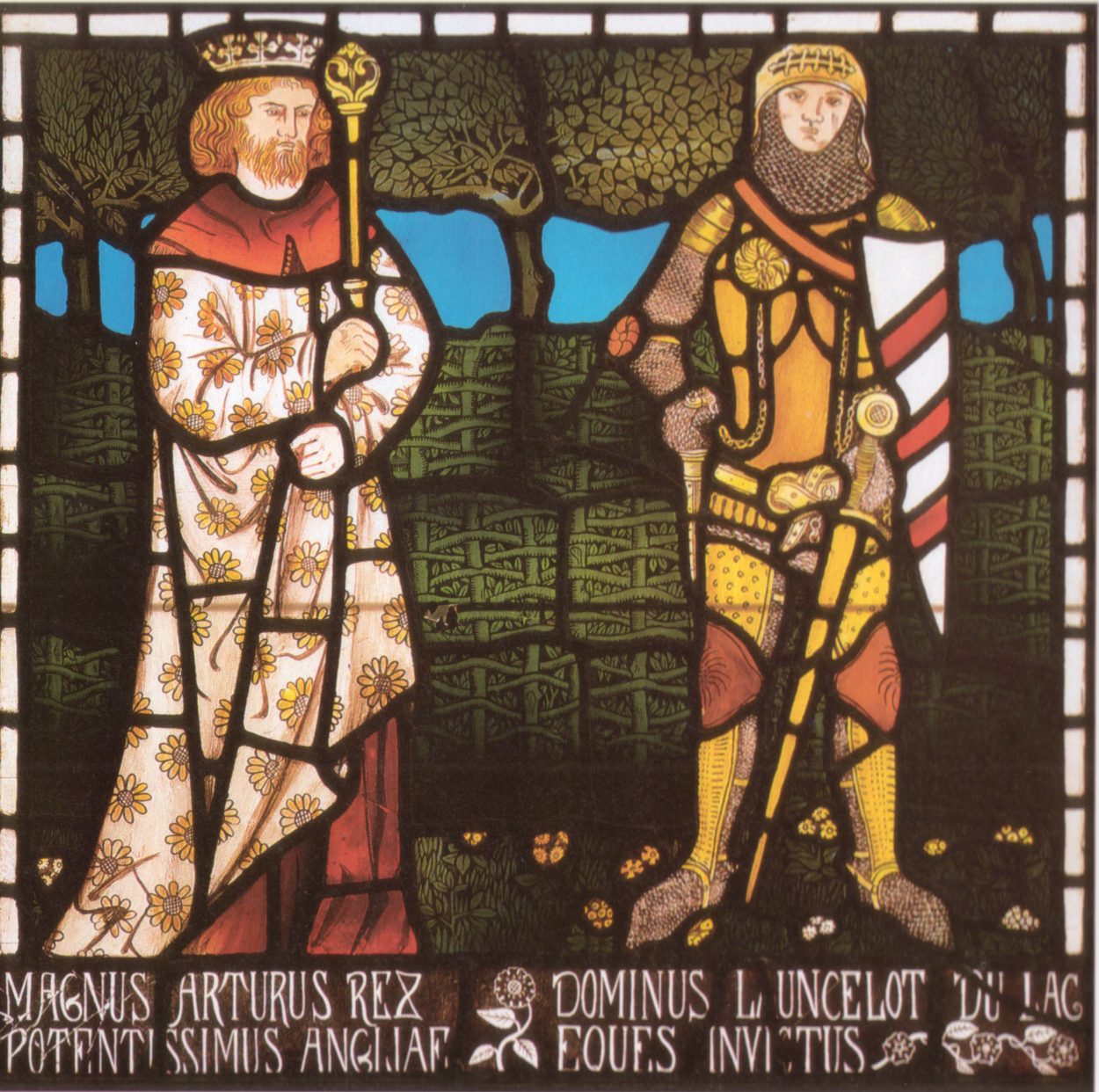
The tradition & historical record
6 min read · 2 sourcesKing Arthur (Welsh: Brenin Arthur; Cornish: Arthur Gernow; Breton: Roue Arzhur; French: Roi Arthur) was a legendary king of Britain. He is a folk hero and a central figure in the medieval literary tradition known as the Matter of Britain. In Welsh sources, Arthur is portrayed as a leader of the post-Roman Britons in battles against the Anglo-Saxons in the late 5th and early 6th centuries. He first appears in two early medieval historical sources, the Annales Cambriae and the Historia Brittonum, but these date to 300 years after he is supposed to have lived, and most historians who study the period do not consider him a historical figure. His name also occurs in early Welsh poetic sources, such as Y Gododdin, but it may be a late interpolation. Arthur's character developed through Welsh mythology, appearing either as a great warrior defending Britain from human and supernatural enemies or as a magical figure of folklore, and was sometimes associated with the Welsh otherworld Annwn. The legendary Arthur developed as a figure of international interest largely through the popularity of Geoffrey of Monmouth's fanciful and imaginative 12th-century Historia Regum Britanniae (History of the Kings of Britain). Geoffrey depicted Arthur as a king of Britain who defeated the Saxons and established a vast empire. 1
Historicity
King Arthur was traditionally accepted as a historic person. He was originally thought to have been an ancient British war commander and, at least from the early 12th century, a king. There was, however, much discussion regarding his various deeds, and contemporary scholars and clerics generally refuted the popular medieval belief in his extreme longevity and future return. From the eighteenth century onwards, there has been academic debate about the historicity of Arthur. Details of Arthur's story are mainly composed of Welsh mythology, English folklore and literary invention, and most modern historians writing about the period do not think that he was a historical figure. One school of thought, citing entries in the Historia Brittonum (History of the Britons) and Annales Cambriae (Welsh Annals), saw Arthur as a genuine historical Romano-British leader who fought against the invading Anglo-Saxons sometime in the late-5th to early-6th century. The Historia Brittonum, a 9th-century Latin historical compilation attributed in some late manuscripts to a Welsh cleric called Nennius, contains the first datable mention of King Arthur, listing twelve battles that Arthur fought. These culminate in the Battle of Badon, where he is said to have single-handedly killed 960 men. Recent studies question the reliability of the Historia Brittonum. Archaeological evidence in the Low Countries and what was to become England shows that early Anglo-Saxon migration to Great Britain reversed between 500 and 550, concurring with Frankish chronicles. 1
Name
The origin of the Welsh name "Arthur" remains a matter of debate. The most widely accepted etymology derives it from the Roman nomen gentile (family name) Artorius. Artorius itself is of obscure and contested etymology. Linguist Stephan Zimmer suggests Artorius possibly had a Celtic origin, being a Latinization of a hypothetical name *Artorījos, in turn derived from an older patronym *Arto-rīg-ios, meaning "son of the bear/warrior-king". This patronym is unattested, but the root, *arto-rīg, "bear/warrior-king", is the source of the Old Irish personal name Artrí. Some scholars have suggested it is relevant to this debate that the legendary King Arthur's name only appears as Arthur or Arturus in early Latin Arthurian texts, never as Artōrius (though Classical Latin Artōrius became Arturius in some Vulgar Latin dialects). Others believe the origin of the name Arthur, as Artōrius would regularly become Art(h)ur when borrowed into Welsh. Another commonly proposed derivation of Arthur from Welsh arth "bear" + (g)wr "man" (earlier *Arto-uiros in Brittonic) is not accepted by modern scholars for phonological and orthographic reasons. Notably, a Brittonic compound name *Arto-uiros should produce Old Welsh *Artgur (where u represents the short vowel /u/) and Middle/Modern Welsh *Arthwr, rather than Arthur (where u is a long vowel /ʉː/). In Welsh poetry the name is always spelled Arthur and is exclusively rhymed with words ending in -ur—never words ending in -wr—which confirms that the second element cannot be [g]wr "man". An alternative theory, which has gained only limited acceptance among professional scholars, derives the name Arthur from Arcturus, the brightest star in the constellation Boötes, near Ursa Major or the Great Bear. 1
Legends concerning the return of Arthur
That Arthur never died but is awaiting his return in some remote spot, often sleeping, is a central motif connected to the Arthurian legends. Before the twelfth century there are, as in the Englynion y Beddau, references to the absence of a grave for Arthur suggesting that he was considered immortal and not dead, but in this poem there is no indication that he was expected to return. From the early twelfth century onwards several sources report a popular belief in the return of King Arthur, although most often critically and mockingly presented. His future return is first mentioned by William of Malmesbury in 1125: "But Arthur's grave is nowhere seen, whence antiquity of fables still claims that he will return." The "Miracles of St. Mary of Laon" (De miraculis sanctae Mariae Laudunensis), written by a French cleric and chronicler named Hériman of Tournai about 1145, but referring to events occurring in 1113, mentions the Breton and Cornish belief that Arthur still lived. In 1191 the alleged tomb of Arthur was identified in an orchestrated discovery at Glastonbury Abbey. Whereas numerous scholars have argued that this could have been due to the Abbey wanting to stand out with an illustrious tomb, or to a desire of the Plantagenet regime to put an end to a legendary rival figure who inspired tenacious Celtic opposition to their rule, it may also have been motivated by how the Arthurian expectations were highly problematic to contemporary Christianity. The longing of the return of a mighty immortal figure returning before the end of time to re-establish his perfect rule, not only ran against basic Catholic tenets but could even threaten the quintessential focus on the longing for the return of Jesus. 1
Medieval literary traditions
The familiar literary persona of Arthur began with Geoffrey of Monmouth's pseudo-historical Historia Regum Britanniae (History of the Kings of Britain), written in the 1130s. The textual sources for Arthur are usually divided into those written before Geoffrey's Historia (known as pre-Galfridian texts, from the Latin form of Geoffrey, Galfridus) and those written afterwards, which could not avoid his influence (Galfridian, or post-Galfridian, texts). 1
Pre-Galfridian traditions
The earliest literary references to Arthur come from Welsh and Breton sources. 1
The text above is adapted from the Wikipedia article “King Arthur”, available under the Creative Commons Attribution-ShareAlike 4.0 licence. 1
King Arthur is legendary British leader of the late 5th and early 6th centuries, according to the structured record cited below. This entry was generated automatically from that record and has not yet been reviewed by a person familiar with the tradition. 2
The source record links this tradition to 74 external registers, which can be verified through the citation. 2