The tradition & historical record
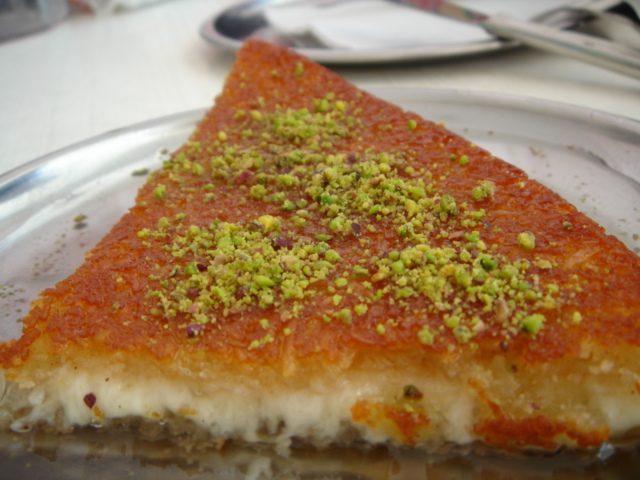
5 min read · 2 sourcesKnafeh (Arabic: كنافة) is a traditional Arab dessert made with kadayif (spun pastry dough) layered with cheese and soaked in a sweet, sugar-based syrup called attar. Knafeh is popular throughout the Arab world, especially Egypt and the Levant. Knafeh is often served on special occasions, holidays and Ramadan. The most common variant in Jordan and Palestine, Knafeh Nabulseyeh, originated in the Palestinian city of Nablus. 1
Etymology
English borrowed the word knafeh from Levantine and Egyptian Arabic, and transliterates it as kanafeh, kenafeh, knafeh, kunafah, kunafeh, konafa, knéfé, kunafa, and similar variations. The ultimate origin of the word is debated. It may come from the Coptic Egyptian kenephiten, a bread or cake. Or it may come from a Semitic root meaning "side" or "wing", and from the Arabic kanafa, "to flank or enclose". Early uses appear in One Thousand and One Nights, a collection of Middle Eastern folktales. 1
History
A common story is that the knafeh was created to satisfy the hunger of caliphs during Ramadan. The story, which dates in writing as early as the 10th century, is variously said to have occurred in Fatimid Egypt or in the Umayyad Caliphate in Damascus, Syria, where Levantine dessert makers preparing it for Mu'awiya I. 1
Ibn Sayyar al-Warraq's tenth century Arabic cookbook, Kitab al-Tabikh (Book of Dishes), which documented many recipes from Abbasid courts, does not mention or describe knafeh. However, it does feature a chapter on qatayif, an Arabic pancake dumpling dessert that originated in the Fatamid Empire. The 13th century cookbook, Kitab al tabikh fi-l-Maghrib wa-l-Andalus (Book of Dishes from Maghreb and Al-Andalus), of unknown authorship, provides a number of recipes for knafeh, which it describes as a pancake dumpling thinner than qatayif prepared on a flat pan. Some call for layering the thin pancake with fresh cheese, baking it, and topping it with honey and rose syrup. Ibn al-Jazari gives an account of a 13th-century Mamluk period market inspector who rode through Damascus at night ensuring the quality of knafeh, qatayif, and other foods associated with Ramadan. Over time, new preparation methods were developed, including a technique of dripping thin batter onto a metal sheet from a perforated container, creating hair-like strings. A mid-15th century Ottoman Turkish translation of Muhammad bin Hasan al-Baghdadi's Kitab al-Tabikh added several new contemporary knafeh recipes, but does not specify where they originated. 1
Modern era
According to historian Mary Isin, cheese-filled knafeh does not appear in any historical records prior to the 19th century. Turkish and Arabic Damascene recipes from the 18th century always used different nuts as filling. An 1844 dictionary for Syrian and Egyptian Arabic by Swedish orientalist Jacob Berggren mentions a knafeh made of string dough and qaymaq, a sort of cooked cream. Food historian Daniel Newman cites an 1885 cookbook published in Beirut as the earliest documented example of a cheese-filled variant. The 1885 Beirut cookbook Ustadh al-Tabbakhin by author Khalil Khattar Sarkis provided four recipes for knafeh: cheese-filled, burma (rolled), mafroukeh (where knafeh pastry is rubbed by hand to soften it), and knafeh basma, which is made with two layers of pastry. Gustaf Dalman described in 1935 knafeh basma made with sweetened cheese between two layers of pastry being made in Sidon and Jerusalem. The book "Comparative Encyclopedia of Aleppo" by Syrian author Khayr al-Din al-Asadi, completed in 1971 and published posthumously in 1981, described 10 different kinds of knafeh, including Nabulsi knafeh. 1
Knafeh Nabulseyeh (Nablus, Palestine)
Knafeh has been described as a "Palestinian Institution." Knafeh Nabulseyeh is a popular version which originated in the Palestinian city of Nablus, hence the name Nabulseyeh (also spelled as Nabilsiyeh). Nablus is still renowned in for its knafeh, which "is filled with the city’s trademark firm, white, salty nabulsi cheese" and covered with a sweet syrup called qatir, it has one layer of either rough (kadayif) or soft (semolina) knafeh pastry atop the cheese, typically prepared upside down then flipped, with soft dough being more popular than kadayif for Nabulsi knafeh. It is prepared by pressing the dough (traditionally includes orange food coloring) into a large baking pan coated with clarified butter. Desalted white cheese is layered evenly over the dough, and the pan is heated on a stovetop until the bottom crust cooks. The pastry is then inverted onto a serving platter and briefly placed back on the stove so the cheese fully melt. Finally, the dish is finished by pouring syrup over it and garnishing it with nuts before serving hot. Associations between Nablus and knafeh date back to at least 1923 when Khalil Totah described knafeh as "a part of a Nabulsi's life". ʻAbd al-Wahhāb ʻAzzām's 1950 book Riḥlāt noted that "Nablus is famous for its knafeh". Today, knafeh Nabulseyeh is the most common variant in Jordan and Palestine. As a result, academics have described Nablus as the modern-day knafeh capital. 1
Knafeh Ghazawiya (Gaza Strip, Palestine)
Knafeh Ghazawiya is a Palestinian variant unique to the Gaza Strip. It is made with a variety of Gazan nuts and spices, with "nutmeg and cinnamon replacing the cheese." The pastry is made from semolina and bulgur. 1
The text above is adapted from the Wikipedia article “Knafeh”, available under the Creative Commons Attribution-ShareAlike 4.0 licence. 1
knafeh is Eastern dessert, according to the structured record cited below. This entry was generated automatically from that record and has not yet been reviewed by a person familiar with the tradition. 2
The source record links this tradition to 2 external registers, which can be verified through the citation. 2