The tradition & historical record
7 min read · 2 sourcesA knife (pl.: knives; from Old Norse knifr 'knife, dirk') is a tool or weapon with a cutting edge or blade, usually attached to a handle or hilt. One of the earliest tools used by humanity, knives appeared at least 2.5 million years ago, as evidenced by the Oldowan tools. Originally made of wood, bone, and stone (such as flint and obsidian), over the centuries, in step with improvements in both metallurgy and manufacturing, knife blades have been made from copper, bronze, iron, steel, ceramic, and titanium. Most modern knives have fixed or folding blades, with styles varying by maker and country. Knives can serve various purposes. Hunters use the hunting knife, soldiers use the combat knife, scouts, campers, and hikers carry the pocketknife; there are kitchen knives for preparing foods (the chef's knife, the paring knife, bread knife, cleaver), table knife (butter knives and steak knives), weapons (daggers or switchblades), knives for throwing or juggling, and knives for religious ceremony or display (the kirpan). 1
Parts
A modern knife consists of: 1
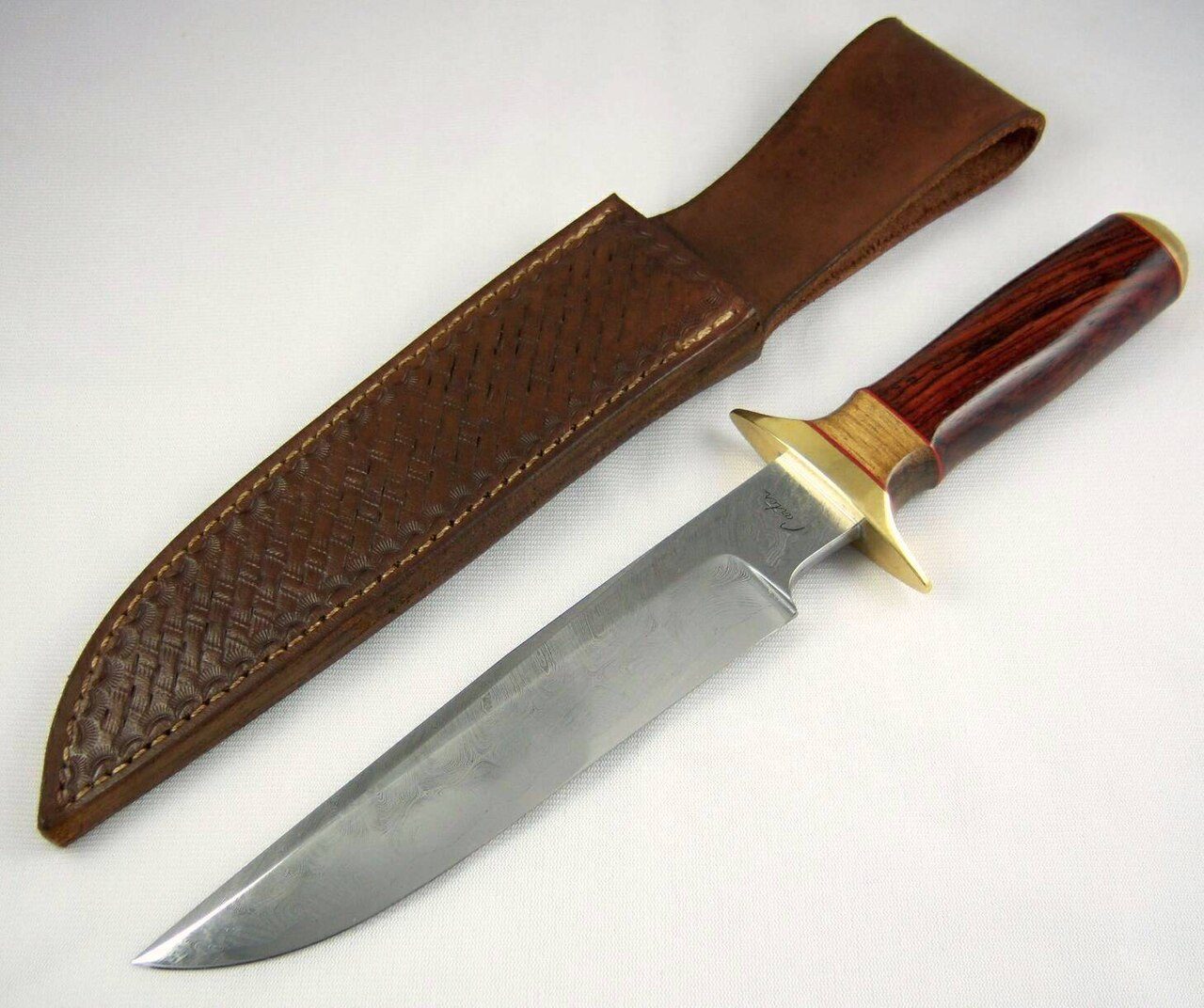
the blade the handle the point – the end of the knife used for piercing the edge – the cutting surface of the knife extending from the point to the heel the grind – the cross section shape of the blade the spine – the thickest section of the blade; on a single-edged knife, the side opposite the edge; on a two-edged knife, more toward the middle the fuller – a groove added to make the blade lighter (optional) the ricasso – the flat section of the blade located at the junction of the blade and the knife's bolster or guard (optional) the guard – the barrier between the blade and the handle which prevents the hand from slipping forward onto the blade and protects the hand from the external forces that are usually applied to the blade during use (optional) the hilt or butt – the end of the handle used for blunt force the lanyard – a strap used to secure the knife to the wrist (optional) The blade edge can be plain or serrated, or a combination of both. Single-edged knives may have a reverse edge or false edge occupying a section of the spine. These edges are usually serrated and are used to further enhance function. The handle, used to grip and manipulate the blade safely, may include a tang, a portion of the blade that extends into the handle. Knives are made with partial tangs (extending part way into the handle, known as "stick tangs") or full tangs (extending the full length of the handle, often visible on top and bottom). There is also the enterçado construction method present in antique knives from Brazil, such as the Sorocaban Knife, which consists in riveting a repurposed blade to the ricasso of a bladeless handle. The handle may include a bolster, a piece of heavy material (usually metal) situated at the front or rear of the handle. 1
Blade
Knife blades can be manufactured from a variety of materials, each of which has advantages and disadvantages. Carbon steel, an alloy of iron and carbon, can be very sharp. It holds its edge well, and remains easy to sharpen, but is vulnerable to rust and stains. Stainless steel is an alloy of iron, chromium, possibly nickel, and molybdenum, with only a small amount of carbon. It is not able to take quite as sharp an edge as carbon steel, but is highly resistant to corrosion. High carbon stainless steel is stainless steel with a higher amount of carbon, intended to incorporate the better attributes of carbon steel and stainless steel. High carbon stainless steel blades do not discolor or stain, and maintain a sharp edge. Laminated blades use multiple metals to create a layered structure, combining the attributes of both. For example, a harder, more brittle steel may be pressed between an outer layer of softer, tougher stainless steel to reduce vulnerability to corrosion. In this case, however, the part most affected by corrosion, the edge, is still vulnerable. Damascus steel is a form of pattern welding with similarities to laminate construction. Layers of different steel types are welded together, but then the stock is manipulated to create patterns in the steel. Titanium is a metal that has a higher strength-to-weight ratio and more flexible than steel. Although less hard and unable to take as sharp an edge, carbides in the titanium alloy allow them to be heat-treated to a sufficient hardness. Ceramic blades are hard, brittle, lightweight, and do not corrode: they may maintain a sharp edge for years with no maintenance at all, but are fragile and will break if dropped on a hard surface or twisted in use. 1
Fixed-blade features
A fixed blade knife, sometimes called a sheath knife, does not fold or slide, and is typically stronger due to the tang, the extension of the blade into the handle, and lack of moving parts. 1
Folding blade features
A folding knife connects the blade to the handle through a pivot, allowing the blade to fold into the handle. To prevent injury to the knife user through the blade accidentally closing on the user's hand, folding knives typically have a locking mechanism. Different locking mechanisms are favored by various individuals for reasons such as perceived strength (lock safety), legality, and ease of use. Popular locking mechanisms include: 1
Slip joint – Found most commonly on traditional pocket knives, the opened blade does not lock, but is held in place by a spring device that allows the blade to fold if a certain amount of pressure is applied. Lockback – Also known as the spine lock, the lockback includes a pivoted latch affixed to a spring, and can be disengaged only by pressing the latch down to release the blade. Linerlock – Invented by Michael Walker, a Linerlock is a folding knife with a side-spring lock that can be opened and closed with one hand without repositioning the knife in the hand. The lock is self-adjusting for wear. Compression Lock – A variant of the Liner Lock, it uses a small piece of metal at the tip of the lock to lock into a small corresponding impression in the blade. This creates a lock that does not disengage when the blade is torqued, instead of becoming more tightly locked. It is released by pressing the tab of metal to the side, to allow the blade to be placed into its groove set into the handle. Frame Lock – Also known as the integral lock or monolock, this locking mechanism was invented by a custom knifemaker Chris Reeve for the Sebenza as an update to the liner lock. 1
Common locking mechanisms
In the lock back, as in many folding knives, a stop pin acting on the top (or behind) the blade prevents it from rotating clockwise. A hook on the tang of the blade engages with a hook on the rocker bar which prevents the blade from rotating counter-clockwise. The rocker bar is held in position by a torsion bar. 1
The text above is adapted from the Wikipedia article “Knife”, available under the Creative Commons Attribution-ShareAlike 4.0 licence. 1
knife is tool with a cutting edge or blade, according to the structured record cited below. This entry was generated automatically from that record and has not yet been reviewed by a person familiar with the tradition. 2
The source record links this tradition to 60 external registers, which can be verified through the citation. 2