The tradition & historical record
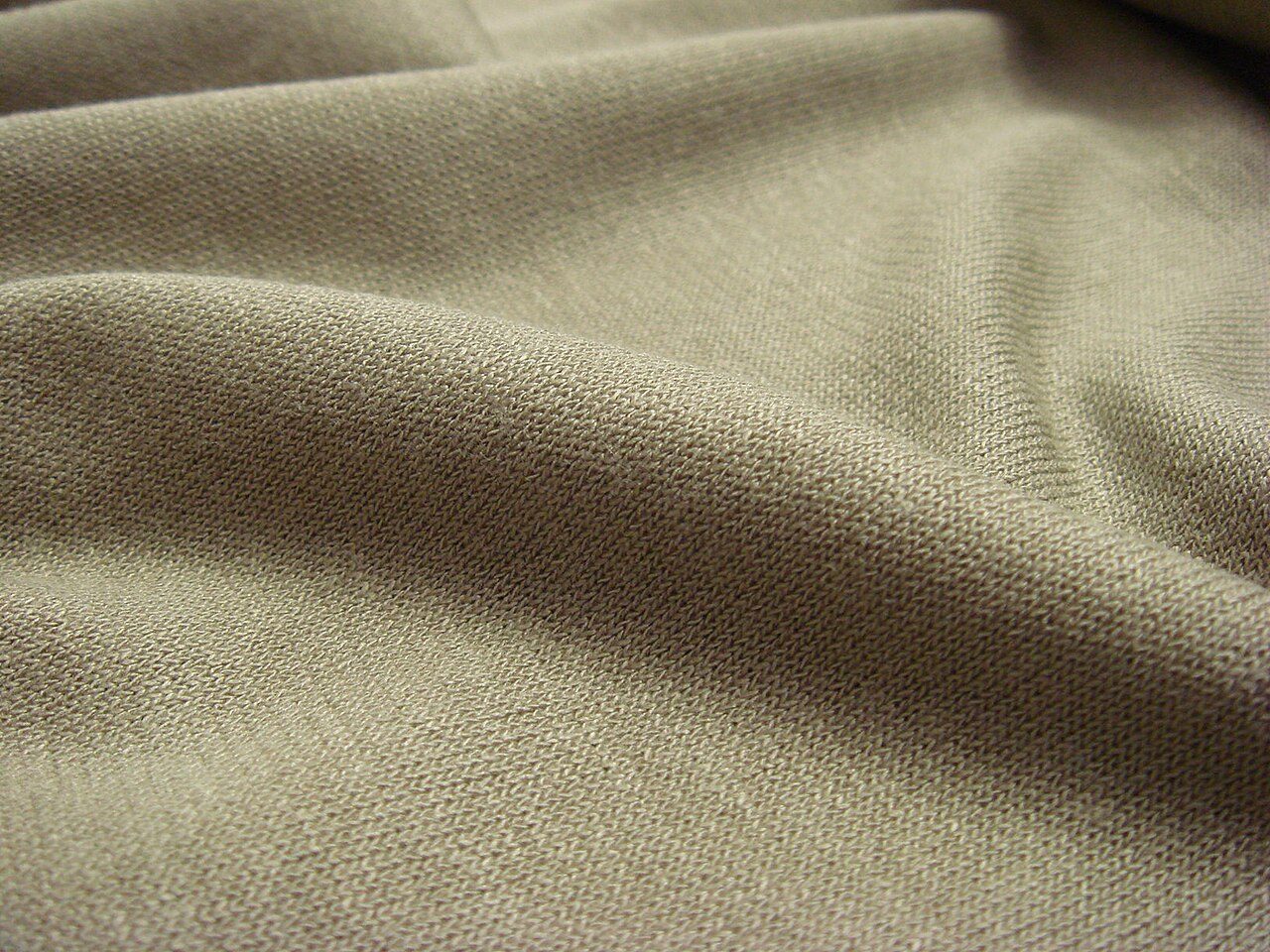
5 min read · 2 sourcesKnitted fabric is a textile that results from knitting, the process of inter-looping of yarns or inter-meshing of loops. Its properties are distinct from woven fabric in that it is more flexible and can be more readily constructed into smaller pieces, making it ideal for socks and hats. 1
Weft-knit and warp-knit fabric
There are two basic varieties of knit fabric: weft-knit and warp-knit fabric. Warp-knitted fabrics such as tricot and milanese are resistant to runs, and are commonly used in lingerie. Weft-knit fabrics are easier to make and more common. When cut, they will unravel (run) unless repaired. Warp-knit fabrics are resistant to runs and relatively easy to sew. Raschel lace—the most common type of machine made lace—is a warp knit fabric but using many more guide-bars (12+) than the usual machines which mostly have three or four bars. (14+) 1
Courses and wales
In weaving, threads are always straight, running parallel either lengthwise (warp threads) or crosswise (weft threads). By contrast, the yarn in knitted fabrics follows a meandering path (a course), forming symmetric loops (also called bights) symmetrically above and below the mean path of the yarn. These meandering loops can be easily stretched in different directions giving knit fabrics much more elasticity than woven fabrics. Depending on the yarn and knitting pattern, knitted garments can stretch as much as 500%. For this reason, knitting is believed to have been developed for garments that must be elastic or stretch in response to the wearer's motions, such as socks and hosiery. For comparison, woven garments stretch mainly along one or other of a related pair of directions that lie roughly diagonally between the warp and the weft, while contracting in the other direction of the pair (stretching and contracting with the bias), and are not very elastic, unless they are woven from stretchable material such as spandex. Knitted garments are often more form-fitting than woven garments, since their elasticity allows them to contour to the body's outline more closely; by contrast, curvature is introduced into most woven garments only with sewn darts, flares, gussets and gores, the seams of which lower the elasticity of the woven fabric still further. Extra curvature can be introduced into knitted garments without seams, as in the heel of a sock; the effect of darts, flares, etc. can be obtained with short rows or by increasing or decreasing the number of stitches. 1
Knitting stitches and stitch patterns
Different stitches and stitch combinations affect the properties of knitted fabric. Individual stitches look differently; knit stitches look like "V"'s stacked vertically, whereas purl stitches look like a wavy horizontal line across the fabric. Patterns and pictures can be created using colors in knitted fabrics by using stitches as "pixels"; however, such pixels are usually rectangular, rather than square. Individual stitches, or rows of stitches, may be made taller by drawing more yarn into the new loop (an elongated stitch), which is the basis for uneven knitting: a row of tall stitches may alternate with one or more rows of short stitches for an interesting visual effect. Short and tall stitches may also alternate within a row, forming a fish-like oval pattern. Stitches also affect the physical properties of a fabric. Stockinette stitch forms a smooth nap. Aran knitting patterns are used to create a bulkier fabric to retain heat. 1
In the simplest knitted fabric pattern, all the stitches are knit or purl; this is known as a garter stitch. Alternating rows of knit stitches and purl stitches produce what is known as a stockinette pattern/stocking stitch. Vertical stripes (ribbing) are possible by having alternating wales of knit and purl stitches. For example, a common choice is 2x2 ribbing, in which two wales of knit stitches are followed by two wales of purl stitches, etc. Horizontal striping (welting) is also possible, by alternating rows of knit and purl stitches. 1
Right- and left-plaited stitches
Both types of plaited stitches give a subtle but interesting visual texture, and tend to draw the fabric inwards, making it stiffer. Plaited stitches are a common method for knitting jewelry from fine metal wire. 1
Edges and joins between fabrics
The initial and final edges of a knitted fabric are known as the cast-on and bound/cast-off edges. The side edges are known as the selvages; the word derives from "self-edges", meaning that the stitches do not need to be secured by anything else. Many types of selvages have been developed, with different elastic and ornamental properties. Edges are introduced within a knitted fabric for button holes, pockets, or decoration, by binding/casting off and re-casting on again (horizontal) or by knitting the fabrics on either side of an edge separately. Two knitted fabrics can be joined by embroidery-based grafting methods, most commonly the Kitchener stitch. New wales can be begun from any of the edges of a knitted fabric; this is known as picking up stitches and is the basis for entrelac, in which the wales run perpendicular to one another in a checkerboard pattern. 1
The text above is adapted from the Wikipedia article “Knitted fabric”, available under the Creative Commons Attribution-ShareAlike 4.0 licence. 1
knitted fabric is textile material made using knitting techniques, often by machine knitting, according to the structured record cited below. This entry was generated automatically from that record and has not yet been reviewed by a person familiar with the tradition. 2
The source record links this tradition to 12 external registers, which can be verified through the citation. 2