The tradition & historical record
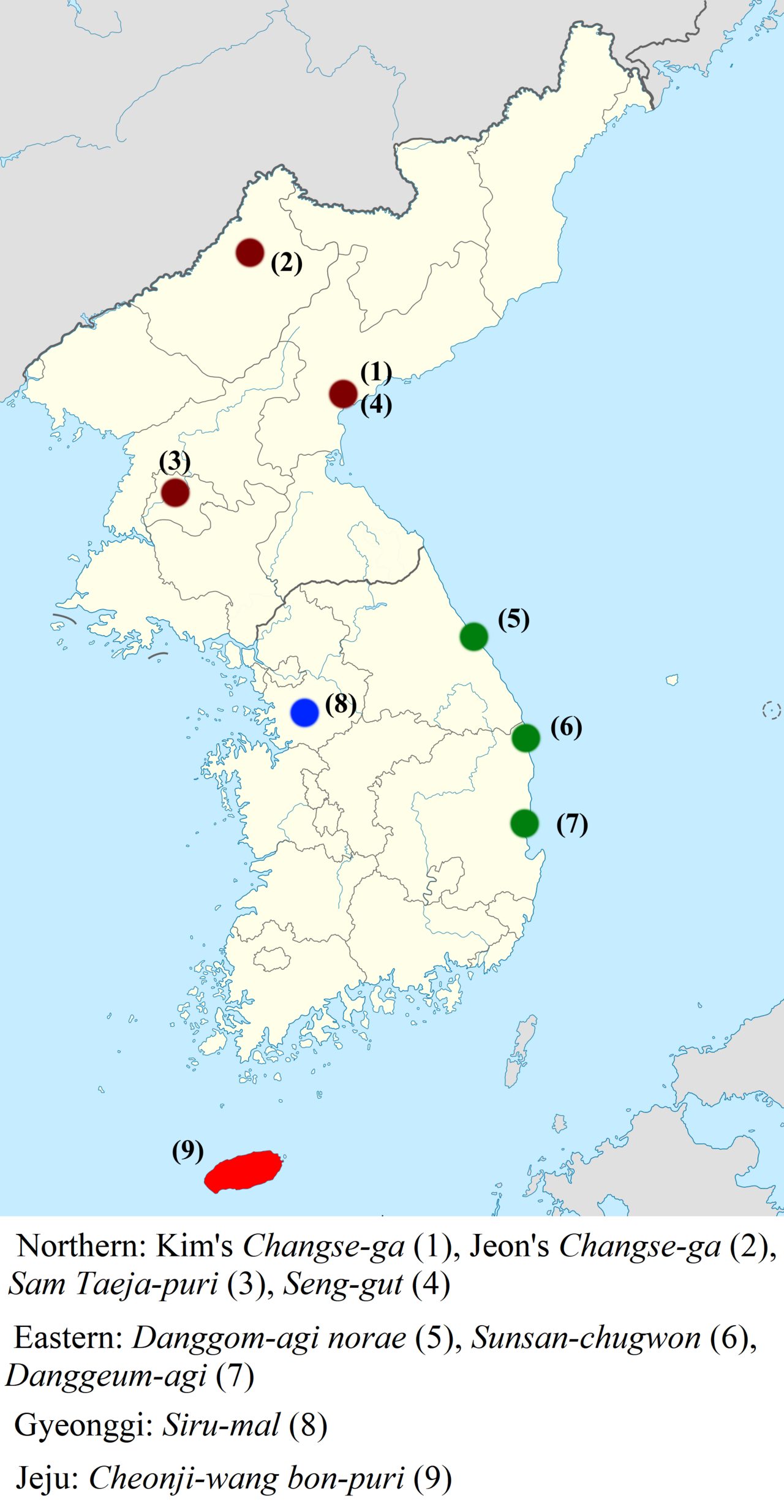
6 min read · 2 sourcesKorean creation narratives are Korean shamanic narratives which recount the mythological beginnings of the universe. They are grouped into two categories: the eight narratives of mainland Korea, which were transcribed by scholars between the 1920s and 1980s, and the Cheonji-wang bon-puri narrative of southern Jeju Island, which exists in multiple versions and continues to be sung in its ritual context today. The mainland narratives are subdivided into four northern and three eastern varieties, plus one from west-central Korea. Many elements are shared by most Korean creation narratives. In one such episode, two gods grow flowers in a contest to decide who will rule the human world. The deserving, benevolent god grows the (better) blossom, but the other god steals it while the good god sleeps. The undeserving cheater thereby becomes the ruler of humanity and spreads evil into the world. In another pan-Korean episode, there are originally two suns and two moons, making the world unbearably hot during the day and intolerably cold at night, until a deity destroys one of each. Nonetheless, there are major structural differences between most mainland narratives and the Jeju Cheonji-wang bon-puri. In the former, the world is created by the god Mireuk, who ushers in an ancient age of plenty. Mireuk is then challenged by the god Seokga, and the two gods often engage in contentions of supernatural power, culminating in Seokga's victory through trickery in the flower contest. 1
Sources and ritual context
Korean creation narratives belong to the genre of shamanic narratives, hymns which convey a myth and which are sung by shamans during rituals called gut. In the Korean language, works of the genre often bear the title puri "narration" or bon-puri "origin narration". These myths are traditionally taught line-by-line by accomplished shamans to novices, who are trained over the course of many gut rituals. Korean creation narratives are geographically divided between the eight mainland narratives, transcribed between the 1920s and the 1980s, and twenty known variants of the Cheonji-wang bon-puri, which is still performed in its ritual context on Jeju Island and whose associated rituals are the most archaic. The mainland narratives are subdivided into three groups: four northern, three eastern, and the Siru-mal from west-central Gyeonggi Province. The seven northern and eastern narratives are similar in content, although the eastern ones are more truncated. On the other hand, the story of the Siru-mal is closer to the Cheonji-wang bon-puri. The basic framework for understanding Korean creation myths—such as the identification of major shared elements between the narratives—was established by Seo Dae-seok of Seoul National University in the first major study of the myths, published in 1980. Kim Heonsun of Kyonggi University made a major contribution in a 1994 monograph that included transcripts of all then-known narratives, including the previously largely unknown Changse-ga hymn of Jeon Myeong-su. 1
Mainland narratives
Eight creation narratives have been preserved from mainland Korea. Some are independent narratives. Others survive as elements of the Jeseok bon-puri, a pan-Korean shamanic narrative that celebrates fertility deities. 1
The Hamhŭng Changse-ga was transcribed in 1923 by ethnographer Son Jin-tae, based on the recitation of Kim Ssang-dori, a "great shamaness" of Unjŏn-myŏn (modern Hŭngnam) born in 1856. The ritual context is poorly understood. Kim herself recalled that it was a hymn only heard during certain large-scale gut, and that it was not learned by common shamans and that she had been specially trained to perform it. It is the oldest recorded creation narrative. The Kanggye Changse-ga was also transcribed by Son Jin-tae in approximately 1931, with the male shaman Jeon Myeong-su as source. Kim Heonsun calls the two Changse-ga hymns "representative of the northern creation narratives". The Seng-gut is known from a 1965 recitation by the female shaman Gang Chun-ok, who had fled from Hamhŭng to South Korea during the division of Korea. A very long song with Buddhist influences that strings six stories together, beginning with a creation narrative and ending with a Jeseok bon-puri narrative, it was part of an important ceremony that beseeched the gods to grant long life and sons. Both Kim's Changse-ga and the Seng-gut were recited by Hamhŭng shamans, which may explain a number of shared elements not found in the other northern narratives. The Sam Taeja-puri was performed in 1966 by two shamans, Jeong Un-hak and Im hak-suk, who had fled Pyongyang during the division. 1
Jeju Island
In the shamanism of Jeju Island, the creation narrative is recited in the Great Gut, a large-scale sequence of rituals in which all eighteen thousand gods are venerated, as well as in certain smaller ceremonies dedicated to specific deities. Unlike in mainland Korea, Jeju's creation narrative continues to be performed as sacred ritual. The Chogam-je is the first procedure of the Great Gut by which the shaman invites all eighteen thousand deities to partake in the rituals, from the supreme deity Cheonji-wang to minor spirits such as the shaman's own ancestors. The very first ceremonies of the Chogam-je involve explaining the circumstances of the gut so that the gods may know when, where, and why to come. But before giving the specific details for any particular gut, the shaman begins by retelling the history of the universe in order to give the rituals their full historical and mythological context, a ceremony called the Bepo-doeop-chim. 1
Before singing the Bepo-doeop-chim narrative, the shaman dances with the sacred knives and bell to the accompaniment of buk drums and suspended and bowl gongs, thus physically reenacting the narrative that is about to follow and also paying respect to the deities of the directions. The creation narrative then opens with the division of a mingled universe into the discrete spheres of heaven and earth and the subsequent creation of mountains, rivers, and other natural entities. Next, the shaman recounts the birth and deeds of the twin deities Daebyeol-wang and Sobyeol-wang. 1
Shared elements
Despite significant variation between and within regions, many elements are shared across Korean creation narratives, such as the following: 1
Heaven and earth were originally fused, often being divided by a giant Humans and non-humans were indistinct in the early universe Two deities engaged in a flower-growing contest to decide who would rule the human world, and the deity who could not grow a good flower won by stealing the other's blossom while he slept The current order of the universe formed under this cheating deity, explaining why there is evil on earth There were originally two suns and two moons, and one each was destroyed The flower contest and the destruction of the doubled sun and moon, both of which are found throughout mainland and Jeju corpuses, have received especial scholarly attention. 1
Splitting of heaven and earth
Out of the mainland narratives, the initial act of creation is de… 1
The text above is adapted from the Wikipedia article “Korean creation narratives”, available under the Creative Commons Attribution-ShareAlike 4.0 licence. 1
Korean creation narratives is Aspect of Korean mythology, according to the structured record cited below. This entry was generated automatically from that record and has not yet been reviewed by a person familiar with the tradition. 2