The tradition & historical record
5 min read · 2 sourcesKorean ceramic history (도자기; dojagi) begins with the oldest earthenware from around 8000 BC. Throughout the history, the Korean peninsula has been home to lively, innovative, and sophisticated art making. Long periods of stability have allowed for the establishment of spiritual traditions, and artisan technologies specific to the region. Korean ceramics in Neolithic period have a unique geometric patterns of sunshine, or it is decorated with twists. In Southern part of Korea, Mumun pottery were popular. Mumun togi used specific minerals to make colors of red and black. Korean pottery developed a distinct style of its own, with its own shapes, such as the moon jar or Buncheong sagi which is a new form between earthenware and porcelain, white clay inlay celadon of Goryeo, and later styles like minimalism that represents Korean Joseon philosophers' idea. Many talented Korean potters were captured and brought to Japan during the invasions of Korea, where they heavily contributed to advancing Japanese pottery. Arita ware, founded by Yi Sam-pyeong opened a new era of porcelain in Japan. Another Japanese representative porcelain, Satsuma ware was also founded by Dang-gil Shim and Pyeong-ui Park. 14th generation of Su-kwan Shim have been using the same name to his grandfather and father to honor they are originally Korean, 14th Su-kwan Shim is honorable citizen of Namwon, Korea. 1
Jeulmun pottery period (Neolithic)
The earliest known Korean pottery dates back to around 8000 BC, and evidence of Mesolithic Pit–Comb Ware culture (or Yunggimun pottery) is found throughout the peninsula, such as in Jeju Island. Jeulmun pottery, or "comb-pattern pottery", is found after 7000 BC, and is concentrated at sites in west-central regions of the Korean Peninsula, where a number of prehistoric settlements, such as Amsa-dong, existed. Jeulmun pottery bears basic design and form similarities to that of Eurasian lands. The earliest pottery of this design is found in Korea. 1
Mumun pottery period (Bronze Age)
The Mumun age starts around 3000 BC and lasts to 400 BC. Mumun pottery are often found in dolmens with Korean harp, bipa shaped bronze dagger and bronze tools around. Potteries of this period have flat bottoms and smooth surface, it has got the name Minmuneui, Mumun pottery. Ancient Joseon and Buyeo used them for ritualistic purposes as well as practical usage. As rice cultivation widely spread, practical jars with handles on both sides were developed, which is called Misongri Togi. 1
Samhan period
Different gray colors and shapes of potteries baked at around 900 degree Celsius appears during Samhan period. These potteries were initially called Gimhae pottery named after the discovered site, Gimhae. Many of them were inside shell midden near river. 1
Later Silla
Pottery of the Later Silla period (668–935) or Silla period had a unique goopdari stand stool designs like Gaya kingdom. In comparison to Gaya, they had more objects put on potteries, three dimensional. There are antlers, horns, horse motifs in stonewares, and they have left interesting objects like Roman soldier, Arabian, anteater and elephants. Because those animals do not live in Korea, it can be assumed they travelled very far. Celadon subsequently became the main production. Temples increased the demand for celadon-glazed wares (cheongja), causing cheongja celadon to evolve very quickly, with more organic shapes and decorations, such as animal and bird motifs. But the celadon do not have any relationships with Buddhism itself, there are jade gokok in the old Stone Age, Korea and jade necklaces in the Neolithic age. The jade was valued as a treasure like we can witness many jade gokoks are hanging in Shilla's golden crown. Those jade gokok were symbol of creativity of the universe. When making cheongja wares, a small amount of iron powder was added to the refined clay, which was then coated with a glaze and an additional small amount of iron powder, and then finally fired. This allowed the glaze to be more durable, with a shinier and glossier finish than white wares. 1
Goryeo
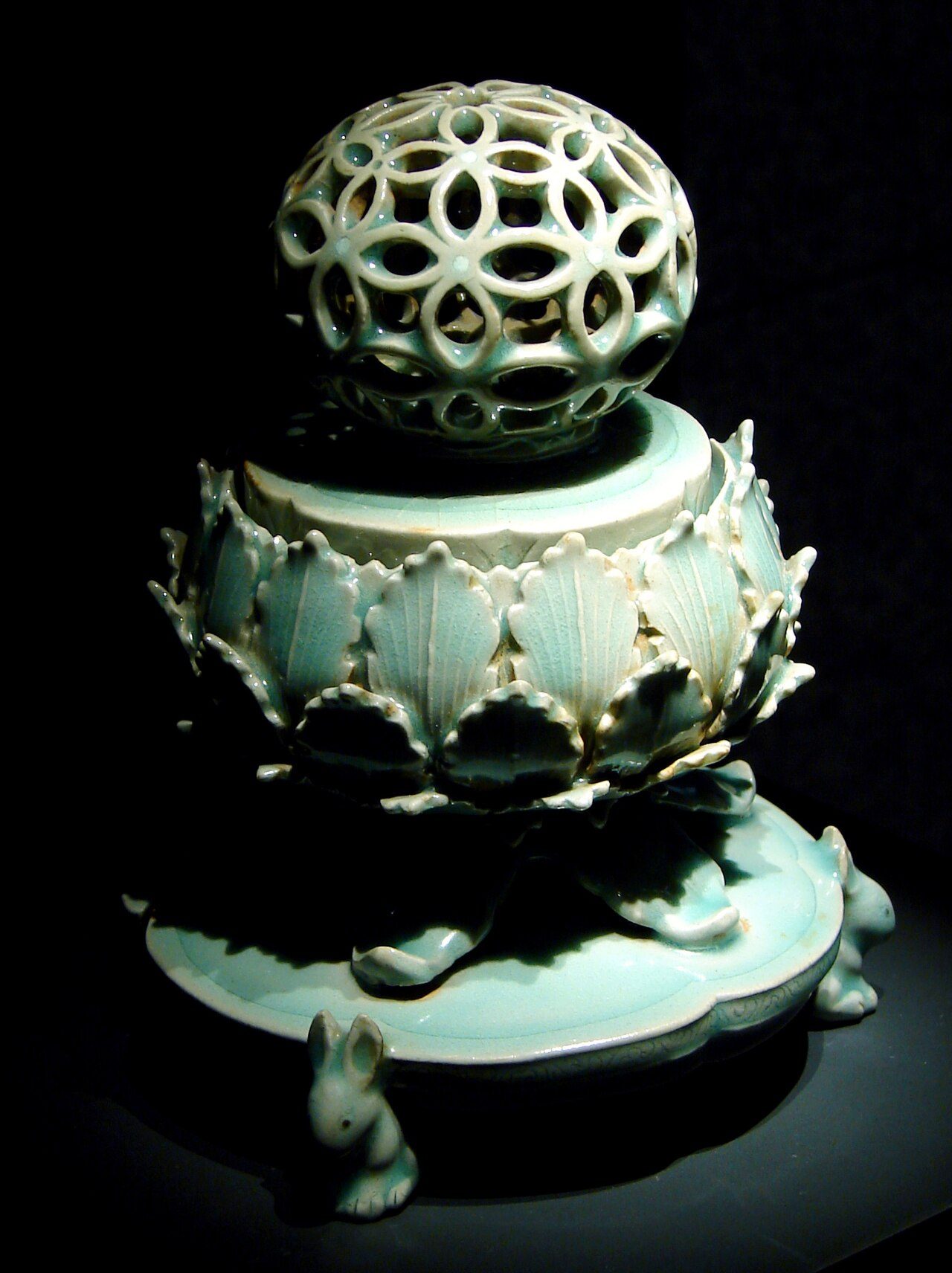
The Goryeo dynasty (918–1392) achieved the unification of the Later Three Kingdoms under Wang Geon. The works of this period are generally considered to be the finest works of ceramics in Korean history. Korean celadon reached its pinnacle with the invention of the sanggam inlay technique in the early 12th century. Key-fret, foliate designs, geometric or scrolling flowerhead bands, elliptical panels, stylized fish, insects, birds and the use of incised designs began at this time. Glazes were usually various shades of celadon, with browned glazes to almost black glazes being used for stoneware and storage. Celadon glazes could be rendered almost transparent to show black and white inlays. Jinsa "underglaze red", a technique using copper oxide pigment to create copper-red designs, was developed in Korea during the 12th century, and later inspired the "underglaze red" ceramics of the Yuan dynasty. While the forms generally seen are broad-shouldered jars, larger low jars or shallow smaller jars, highly decorated celadon cosmetic boxes, and small slip-inlaid cups, the Buddhist potteries also produced melon-shaped vases, chrysanthemum cups often of spectacularly architectural design on stands with lotus motifs and lotus flower heads. In-curving rimmed alms bowls have also been discovered similar to Korean metalware. Wine cups often had a tall foot which rested on dish-shaped stands. Baekja wares came from highly refined white clay, glazed with feldspar, and fired in regulated and clean large kilns. 1
The text above is adapted from the Wikipedia article “Korean pottery and porcelain”, available under the Creative Commons Attribution-ShareAlike 4.0 licence. 1
Korean pottery and porcelain is overview of Korean pottery and porcelain, according to the structured record cited below. This entry was generated automatically from that record and has not yet been reviewed by a person familiar with the tradition. 2
The source record links this tradition to 8 external registers, which can be verified through the citation. 2