The tradition & historical record
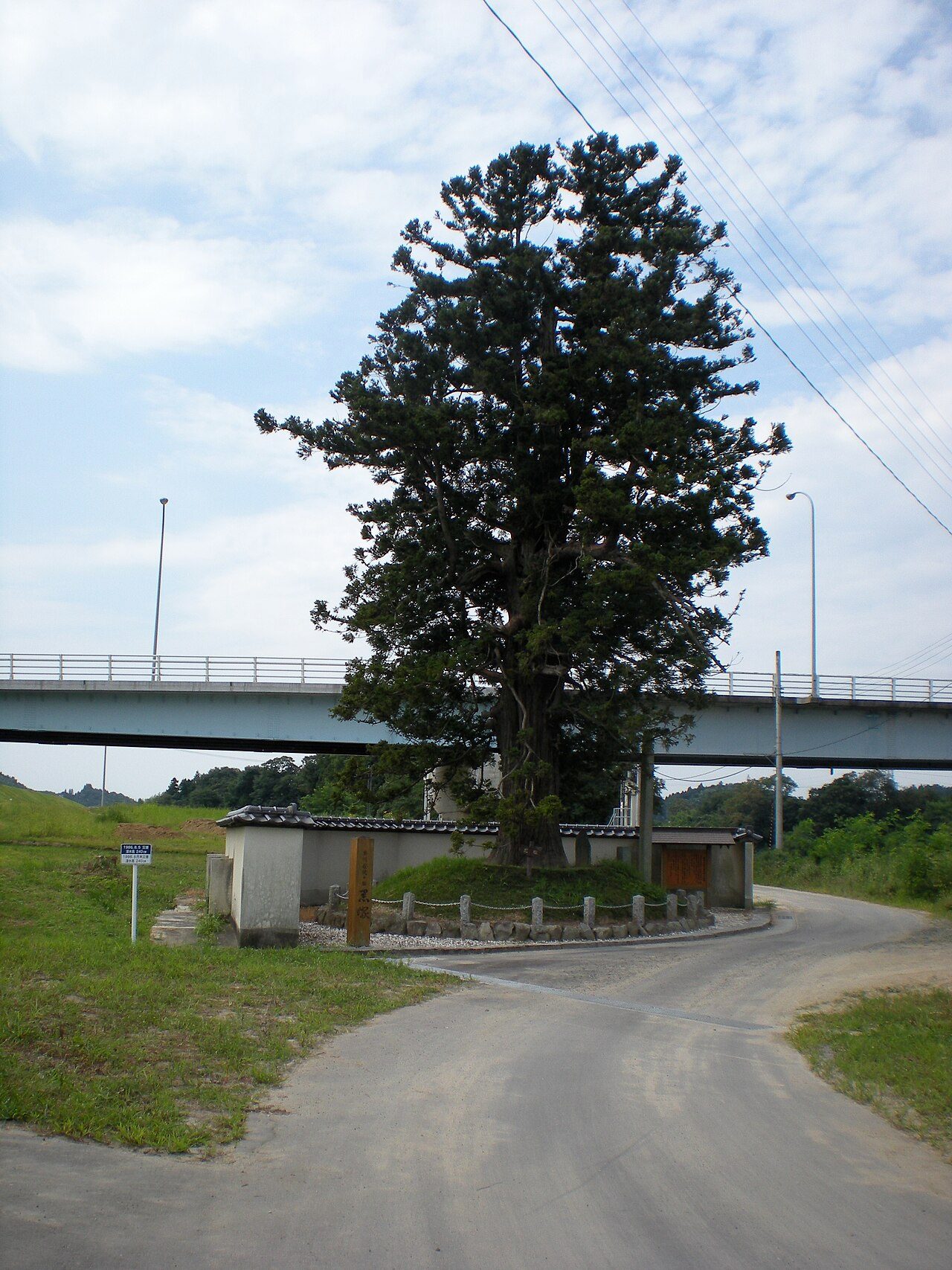
7 min read · 2 sourcesKurozuka (黒塚, "black mound") is the grave of an onibaba in Nihonmatsu, Fukushima Prefecture (previously Oodaira), Adachi District, or the legend of that onibaba. It lives in Adachigahara (the name of the eastern shore of Abukuma River as well as the eastern base of Mount Adatara) and it is told in legends as the "Onibaba of Adachigahara." The Kurozuka is actually the name of the mound in which this onibaba is buried, but nowadays it can also be used to refer to the onibaba as well. Also based on this legend are the noh titled Kurozuka, the nagauta and kabuki performance Adachigahara, and the kabuki jōruri Ōshū Adachigahara (奥州安達原). 1
Legend
According to the Ōshū Adachigahara Kurozuka Engi (奥州安達ヶ原黒塚縁起) published by the temple Mayumisan Kanze-ji near Adachigahara, the legend of the onibaba is told as follows. 1
It was a year of fire tiger in Jinki (the year 726). A monk from the Kii Province, Tōkōbō Yūkei was journeying in Adachigahara when the sun was about to set, and requested to be allowed to stay in a cave for lodging. An old lady lived in that cave. The old lady who seemed to have kindly let in Yūkei then left the cave telling Yūkei that there was not enough firewood and she needed go outside to get some more but that during this time Yūkei must not look further in the room. However, Yūkei opened the shutter out of curiosity, and when he peeked inside, there was a mountain of human bones piled up inside. Dumbfounded by this sight, Yūkei recalled a rumor of an onibaba at Adachigahara who would kill travelers and devour their blood and meat, and he got the feeling that this old lady was the rumored onibaba, so he fled the cave. After a while, the old lady returned to the cave and noticed Yūkei's departure, whereupon her appearance transformed into that of a fearsome onibaba and then started to give chase at a furious speed. The onibaba caught up and was right behind Yūkei. In this time of desperation, Yūkei took out his statue of Nyoirin Kan'non Bosatsu (a form of Guanyin) from his pack and started to desperately chant a sutra. As he did so, the Bosatsu statue started to dance up into the sky, forming a shining demon-slaying pure white bow and a vajra (indestructible substance) arrow that shot and slew the onibaba. Though the onibaba lost her life, she was able to go to peace from the guidance of Buddha. 1
Variations
There are certain variations on how the onibaba story played out. 1
From the power of the Guanyin statue, there was a thunderous roar and a lightning strike that killed the onibaba. The onibaba was not actually killed but was reformed by the high priest and returned to the ways of Buddha. Yūkei desperately ran from the onibaba, and when dawn came, he was able to lose the onibaba from pursuit. There is also a legend where Yūkei did not happen upon the onibaba by chance but came to Adachigahara with the intent to slay the onibaba, as follows: 1
Yūkei received an order to exorcise the onibaba that has been assaulting travelers on Adachigahara and headed immediately towards Adachigahara. However, he was one step too late and the onibaba had fled to the north. Giving chase, Yūkei eventually caught the onibaba at Oyama (now Kakuda, Miyagi Prefecture) and slashed at the onibaba. However, the onibaba was only slightly wounded and thus fled, so Yūkei constructed a building there. About 3 years later, a certain traveler caught sight of the onibaba, and hearing of this report, Yūkei immediately went to go slay the onibaba, and after he chased and caught the fleeing onibaba, he was able to achieve slaying the onibaba. The head of the onibaba was stored in the building that Yūkei constructed, and the body was buried at a certain hill in Oyama, and as a memorial service for the onibaba, a cherry tree was planted there. 1
The temple Tōkō-ji where the onibaba's head was stored later became abandoned, and the skull has been passed down along Yūkei's descendants, the Adachi family. The name of the family, Adachi, also comes from Adachigahara, and there has been none of the name Adachi that has been confirmed to be near Oyama. 1
Origin of the onibaba
Near the aforementioned Kanze-ji, there is a jizō statue named Koigoromo Jizō and it is stated to deify a woman who was killed by the onibaba, Koigoromo. As the origin of this jizō statue, there is the following legend concerning how the onibaba was a human transformed into an onibaba. 1
In the past, there was a woman called Iwate who served as a nurse at a kuge (aristocratic) estate in the Kyō no Miyako (capital of capital). However, the princess that she cherished had an incurable illness since birth and was unable to speak even at the age of 5. Iwate, who doted on the princess, wanted to save the princess somehow, and believing the words of a fortune-teller who said that liver from the fetus with the womb of a pregnant woman would be effective against the disease, she left her daughter who was just born to go on a journey. Arriving at Adachigahara in Ōshū, Iwate found lodging in a cave, and awaited for a pregnant woman to target. After long years and months, one day, a young couple requested lodging inside the cave. The woman was pregnant. Just at that moment, the woman started going into labor, and the husband went out to buy some medicine. It was the perfect opportunity. Iwate took out a knife and assaulted the woman, slicing open her belly and took out the liver from the fetus. However, at that moment, Iwate caught sight of the protective charm that the woman had on her, giving Iwate a great surprise. It was the very same one that she left for her daughter when she left the capital. 1
Landmarks and other
It is said that near Kurozuka, Yūkei built a temple to deify Guanyin, and in present-day this is considered to be the Mayumisan Kanze-ji (4-126 Adachigahara, Nihonmatsu, Fukushima Prefecture) in the city of Nihonmatsu. In the grounds of this temple, other than a statue of the onibaba, there is also a grave for the onibaba, the cave where the onibaba lived, and the pond where the onibaba is said to have washed the blood-soaked knife, and there are many visitors to this temple. It is said that even after such a long time after the time of the legend, it continues to inspire fear and sorrow in people's hearts, and the haiku poet Masaoka Shiki also visited this temple, writing "Suzushisaya/kikeba mukashi wa/oni no tsuka" (this coolness.../if you ask, it was in the past/the mound of an oni). Also, in the womb of the Nyoirin Kan'non Bosatsu at Kanze-ji, the Nyoirin Kan'non Bosatsu statue that Yūkei used in the slaying of the onibaba is buried within, and it has been open to the public for about 60 years. In the tourist attraction building "Adachigahara Furusato-Mura" in the city of Nihonmatsu, and other than the "Kurozuka Theatre" re-enacting the legend of the onibaba, there is also the mascot character "Bappy-chan," a deformation of the onibaba into a figure with two heads for wiping away the creepiness of the legend, among other creations. 1
Taira no Kanemori's tanka
One of the Thirty-Six Immortals of Poetry from the Heian Period, Taira … 1
The text above is adapted from the Wikipedia article “Kurozuka”, available under the Creative Commons Attribution-ShareAlike 4.0 licence. 1
Kurozuka is Grave of Japanese legendary being, according to the structured record cited below. This entry was generated automatically from that record and has not yet been reviewed by a person familiar with the tradition. 2
The source record links this tradition to 2 external registers, which can be verified through the citation. 2