The tradition & historical record
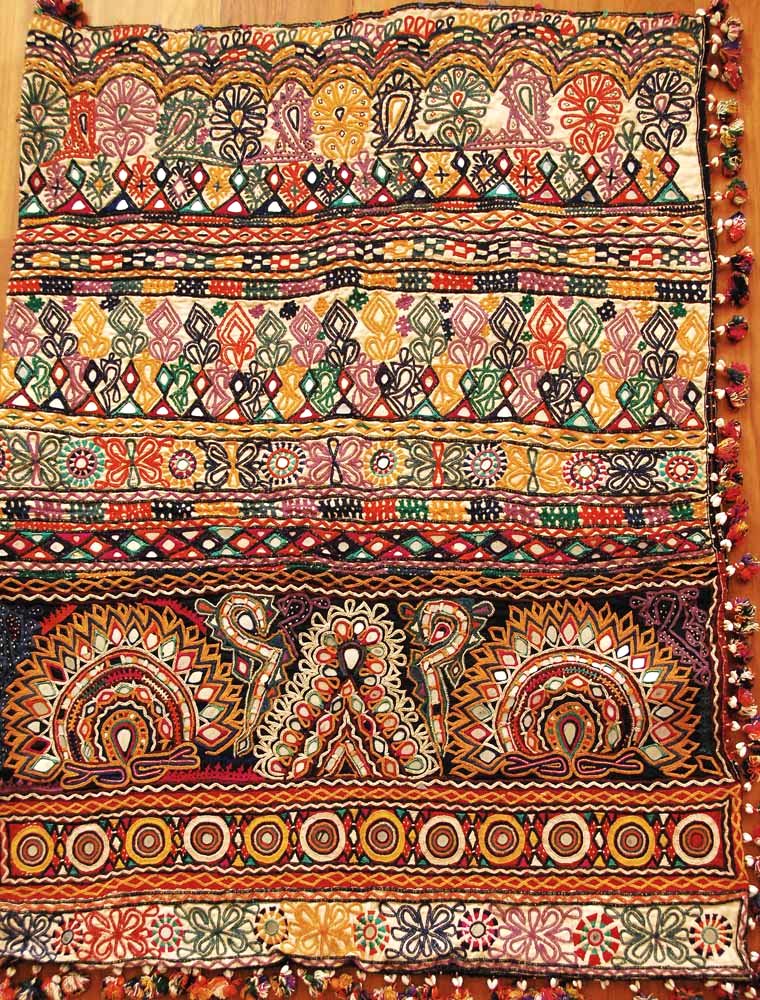
4 min read · 2 sourcesKutch embroidery is a handicraft and textile signature art tradition of the tribal community of Kutch district in Gujarat, India. The tradition and its designs has made a notable contribution to Indian embroidery traditions. The embroidery, most frequently made by women, is generally done on fabrics of cotton, in the form of a net using cotton or silk threads. In certain patterns, it is also crafted over silk and satin. The types of stitches adopted are "square chain, double buttonhole, pattern darning, running stitch, satin and straight stitches". The signature effect of the colorful embroidery sparkles when small mirrors called abhla are sewn over the geometrically shaped designs. Depending on the tribal sub groups of Rabari, Garasia Jat, and Mutava involved with this craft work many hand embroidered ethnic styles have evolved. These six styles: Suf, khaarek, Paako, Rabari, Garasia Jat, and Mutava. This embroidery product of Kutch has been registered for protection under the List of Geographical indication of the Trade Related Intellectual Property Rights (TRIPS) agreement. In March 2013, it was listed as "Kutch Embroidery" under the GI Act 1999 of the Government of India with registration confirmed by the Controller General of Patents Designs and Trademarks under Class 24 Textile and Textile Goods, and its logo registered in November 2015 vide application number 509 for the dated 8 January 2012. 1
Location
Kutch embroidery is made in several villages in the Kutch district, which lie within the geographical coordinates of 24°44′8″N 68°07′23″E and 24°41′30″N 71°46′45″E. These villages are Abdasa, Anjar, Bhachau, Bhuj, Lakhpat, Mandvi, Mundra, Nakhatrana, and Rapar. 1
History
Kutch embroidery traces to the 16th and 17th centuries, when the region saw increased immigration from countries such as Afghanistan, Greece, Germany, Iran and Iraq to Gujarat. It is also said that cobblers known as Mochis were trained in this art form by the Muslim sufi saints of Sindh. The art form became a vocation for women of Kutch not only to meet their own clothing requirements but also to make a living. It became a generational art with the skills taught from mother to daughter. They embroidered clothes for festive occasions and to decorate deities and to create a source of income. 1
Production procedure
Embroidered products are of 16 types known by specific names as: 1
Ahir, done by peasants of Ahir community with designs of animals and birds done with chain stitch with hooked needles, herringbone stitch and fixed with small mirrors known as 'abhla', practiced by women during the lean season Aari, done by cobblers with intricate chain stitch patterned on designs of the Mughals. Gotauvn or Gotany, which includes Chekan, Chopad, Katri and Mukko types, is done by Muslim pastoral people of 11 villages, using several intricate patterns of stitches, expensive silk fabrics, metallic threads and mirrors. Jat-Garasia and Jat-Fakirani are done by the two Jat communities, is a cross stitch product with intensive use of mirrors of small size adopting "satin stitch with radiating circles of a couched stitch". Kambira and Khudi-Tebha, generally adopted in quilts, is embroidered by the Harijan people of the Banni grasslands on the border with the Great Rann. Kharek, practiced by the Sodha, Rajput and Megwar people, is usually in the shape of a set of bars created by adopting "black double running stitch and satin stitch". Neran, meaning "eye brows", is a style which adopts buttonhole stitch in the shape of a curve. Pakko, done by the Sodha, Rajput and Megwar people, is akin to the Ahir style with dominance of geometric designs with an embossed appearance and is embroidered with close knitting with buttonhole stitches. Rabari, made by Rabaris of the Giri region, has prominent patterns adopted from mythology embroidered with "square chain interlaced with buttonhole" stitches fixed with mirrors, it is unlike another any other embroidery of Kutch. Khadi material in maroon colour is used as the fabric to make door hangings, canopies, wall decorations, etc. 1
The text above is adapted from the Wikipedia article “Kutch embroidery”, available under the Creative Commons Attribution-ShareAlike 4.0 licence. 1
Kutch embroidery is handicraft and textile art tradition of Kutch, Gujarat, India, according to the structured record cited below. This entry was generated automatically from that record and has not yet been reviewed by a person familiar with the tradition. 2
The source record links this tradition to 1 external register, which can be verified through the citation. 2