The tradition & historical record
6 min read · 2 sourcesJean de La Fontaine collected fables from a wide variety of sources, both Western and Eastern, and adapted them into French free verse. They were issued under the general title of Fables in several volumes from 1668 to 1694 and are considered classics of French literature. Humorous, nuanced and ironical, they were originally aimed at adults but then entered the educational system and were required learning for school children. 1
Composition history
Divided into 12 books, there are 239 of the Fables, varying in length from a few lines to some hundred, those written later being as a rule longer than those written earlier. The first collection of Fables Choisies had appeared March 31, 1668, dividing 124 fables into six books over its two volumes. They were dedicated to "Monseigneur" Louis, le Grand Dauphin, the six-year-old son of Louis XIV of France and his queen consort Maria Theresa of Spain. By this time, La Fontaine was 47 and known to readers chiefly as the author of Contes, lively stories in verse, grazing and sometimes transgressing the bounds of contemporary moral standards. The Fables, in contrast, were completely in compliance with these standards. Eight new fables published in 1671 would eventually take their place in books 7–9 of the second collection. Books 7 and 8 appeared in 1678, while 9-11 appeared in 1679, the whole 87 fables being dedicated to the king's mistress, Madame de Montespan. Between 1682 and 1685 a few fables were published dealing with people in antiquity, such as "The Matron of Ephesus" and "Philemon and Baucis". Then book 12 appeared as a separate volume in 1694, containing 29 fables dedicated to the king's 12-year-old grandson, Louis, Duke of Burgundy. 1
Plot sources
The first six books, collected in 1668, were in the main adapted from the classical fabulists Aesop, Babrius and Phaedrus. In these, La Fontaine adhered to the path of his predecessors with some closeness; but in the later collections he allowed himself far more liberty and in the later books there is a wider range of sources. In the later books, the so-called Indian Bidpai is drawn upon for oriental fables that had come to the French through translations from Persian. The most likely source for La Fontaine was the pseudonymous version by Gilbert Gaulmin (1585–1665) under the title The book of Enlightenment or the Conduct of Kings (French: Le Livre des lumières ou la Conduite des Roys, composée par le sage Pilpay Indien, traduite en français par David Sahid, d’Ispahan, ville capitale de Perse; 1644). Another translation by Father Pierre Poussines appeared in 1666 with the Latin title Specimen sapientiae Indorum veterum (A sample of ancient Indian wisdom). With a genealogy going back to the Indian Panchatantra, they were then attributed to Bidpai (Pilpay), who is given more than his fair due by La Fontaine in the preface to his second collection of Fables: "I must acknowledge that I owe the greatest part to Pilpay, the Indian sage." (French: Je dirai par reconnaissance que j’en dois la plus grande partie à Pilpay sage indien.) His sources are in fact much more diverse and by no means mainly oriental; of 89 fables, no more than twenty are found in Bidpai's collection. Avienus and Horace are also drawn upon in the later books along with the earlier French writers Rabelais, Clément Marot, Mathurin Régnier and Bonaventure des Périers. Boccaccio, Ariosto, Tasso and Machiavelli's comedies were also sources. 1
Content
The subject of each of the Fables is often common property of many ages and ethnicities. What gives La Fontaine's Fables their rare distinction is the freshness in narration, the deftness of touch, the unconstrained suppleness of metrical structure, the unfailing humor of the pointed moral, the consummate art of their apparent artlessness. Keen insight into the foibles of human nature is found throughout, but in the later books ingenuity is employed to make the fable cover, yet convey, social doctrines and sympathies more democratic than the age would have tolerated in unmasked expression. Almost from the start, the Fables entered French literary consciousness to a greater degree than any other classic of its literature. For generations many of these little apologues have been read, committed to memory, recited, paraphrased, by every French school child. Countless phrases from them are current idioms, and familiarity with them is assumed. "La Fontaine's Fables", wrote Madame de Sévigné, "are like a basket of strawberries. You begin by selecting the largest and best, but, little by little, you eat first one, then another, till at last the basket is empty". Silvestre de Sacy has commented that they supply delights to three different ages: the child rejoices in the freshness and vividness of the story, the eager student of literature in the consummate art with which it is told, the experienced man of the world in the subtle reflections on character and life which it conveys. Reception to the moral aspect has generally been positive, with exceptions such as Rousseau and Lamartine. 1
Reaching children
When he first wrote his Fables, La Fontaine had a sophisticated audience in mind. Nevertheless, the Fables were regarded as providing an excellent education in morals for children, and the first edition was dedicated to the six-year-old Dauphin. Following La Fontaine's example, his translator Charles Denis dedicated his Select Fables (1754) to the sixteen-year-old heir to the English throne. The 18th century was particularly distinguished for the number of fabulists in all languages and for the special cultivation of young people as a target audience. In the 1730s eight volumes of Nouvelles Poésies Spirituelles et Morales sur les plus beaux airs were published, the first six of which incorporated a section of fables aimed at children. These contained fables of La Fontaine rewritten to fit popular airs of the day and arranged for simple performance. The preface to this work announces that its aim is specifically to "give them an attraction to useful lessons which are suited to their age [and] an aversion to the profane songs which are often put into their mouths and which only serve to corrupt their innocence". 1
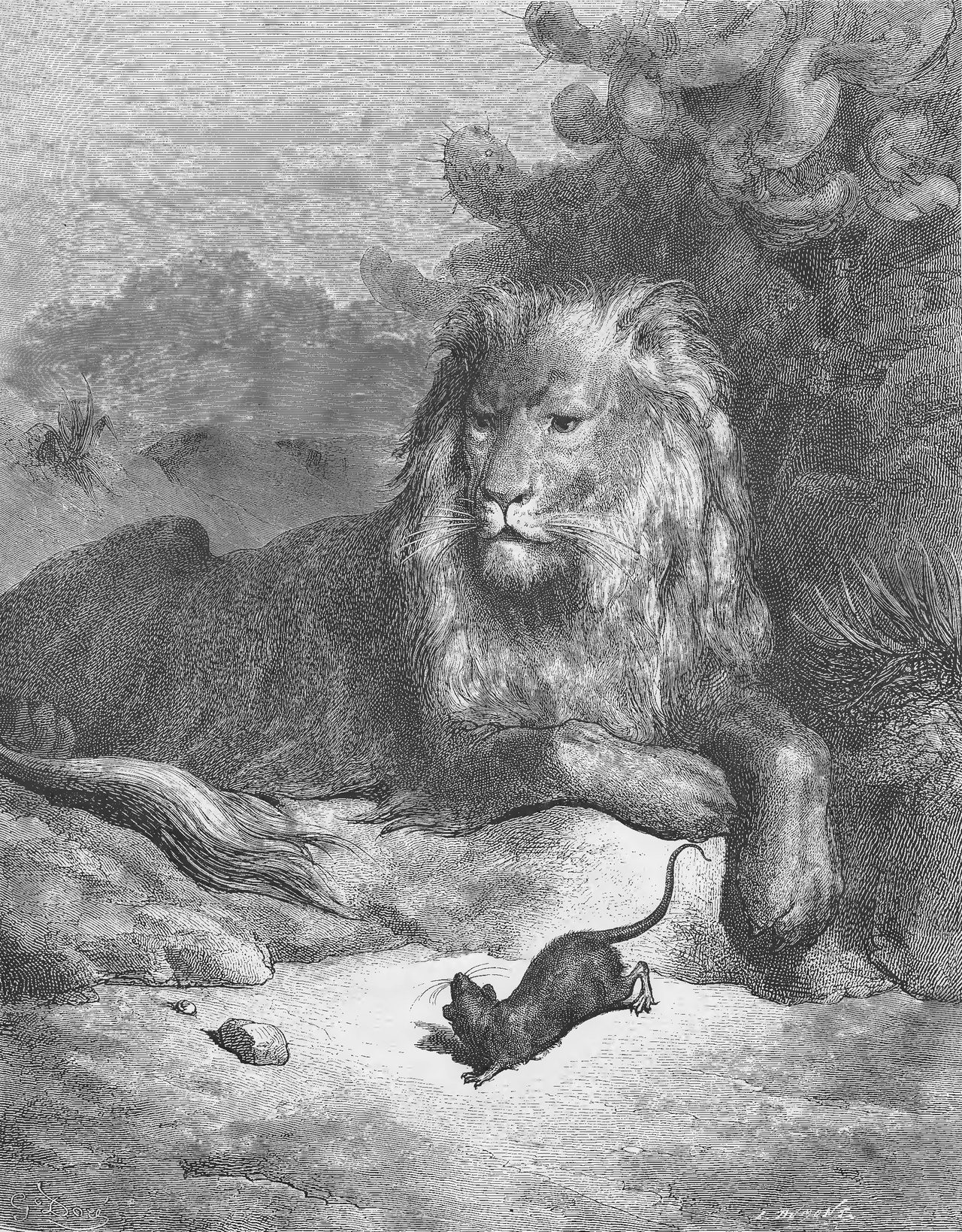
This was in the context of getting the young people of the family to perform at social gatherings. Eventually the fables were learned by heart for such entertainments and afterwards they were adopted by the education system, not least as linguistic models as well. Reinforcing the work were illustrated editions, trade cards issued with chocolate and meat extract products, postcards with the picture on one side and the poem on the other, and illustrated chinaware. There have also been television series based on the fables. 1
Individual fables
The following fables have individual articles devoted to them: 1
The text above is adapted from the Wikipedia article “La Fontaine's Fables”, available under the Creative Commons Attribution-ShareAlike 4.0 licence. 1
La Fontaine's Fables is collection of fables assembled by Jean de La Fontaine, according to the structured record cited below. This entry was generated automatically from that record and has not yet been reviewed by a person familiar with the tradition. 2
The source record links this tradition to 23 external registers, which can be verified through the citation. 2