The tradition & historical record
5 min read · 2 sourcesThe Milkmaid and Her Pail is a folktale of Aarne-Thompson-Uther type 1430 about interrupted daydreams of wealth and fame. Ancient tales of this type exist in the East but Western variants are not found before the Middle Ages. It was only in the 18th century that the story about the daydreaming milkmaid began to be attributed to Aesop, although it was included in none of the main collections and does not appear in the Perry Index. In more recent times, the fable has been variously treated by artists and set by musicians. 1
In the East
There is a theme common to the many different stories of this type that involves poor persons daydreaming of future wealth arising from a temporary possession. When they get carried away by their fantasy and start acting it out, they break the container on which their dream is founded and find themselves worse off. One of the earliest is included in the Indian Panchatantra as "The brahman who built air-castles". There a man speculates about the wealth that will flow from selling a pot of grain that he has been given, progressing through a series of sales of animals until he has enough to support a wife and family. The child misbehaves, his wife takes no heed, so he kicks her and in doing so upsets the pot that was to make his fortune. Other variants include Bidpai's "The Poorman and the Flask of Oil", "The Barber's Tale of his Fifth Brother" from The 1001 Nights and the Jewish story of "The Dervish and the Honey Jar". 1
The Western fable
At its first appearance in the 14th century Dialogus creaturarum, the story was told as a cautionary fable of a milkmaid who engages in detailed financial calculations of her profits. In a Castilian form it is told under the title "Of what happened to a woman called Truhana" in Don Juan Manuel's Tales of Count Lucanor (1335), illustrating the lesson that you should 'Confine your thoughts to what is real'. In this case it is the jar of honey from which she hopes to enrich herself that Truhana unbalances from her head. The story gained lasting popularity after it was included in La Fontaine's Fables (VII.10). The charm of La Fontaine's poetic form apart, however, it differs little from the version recorded in his source, Bonaventure des Périers' Nouvelles récréations et joyeux devis (1558). There the fable is made an example of the practice of alchemists, who are like 'a good woman that was carrying a pot of milk to market and reckoning up her account as follows: she would sell it for half a sou and with that would buy a dozen eggs which she would set to hatch and have from them a dozen chicks; when they were grown she would have them castrated and then they would fetch five sous each, so that'd be at least a crown with which she would buy two piglets, a male and a female, and farrow a dozen more from them once they were grown, and they'd sell for twenty sous a piece after raising, making twelve francs with which she'd buy a mare that would have a fine foal. It would be really nice as it grew up, prancing about and neighing. And so happy was the good woman imagining this that she began to frisk in imitation of her foal, and that made the pot fall and all the milk spill. 1
Artistic uses of the fable
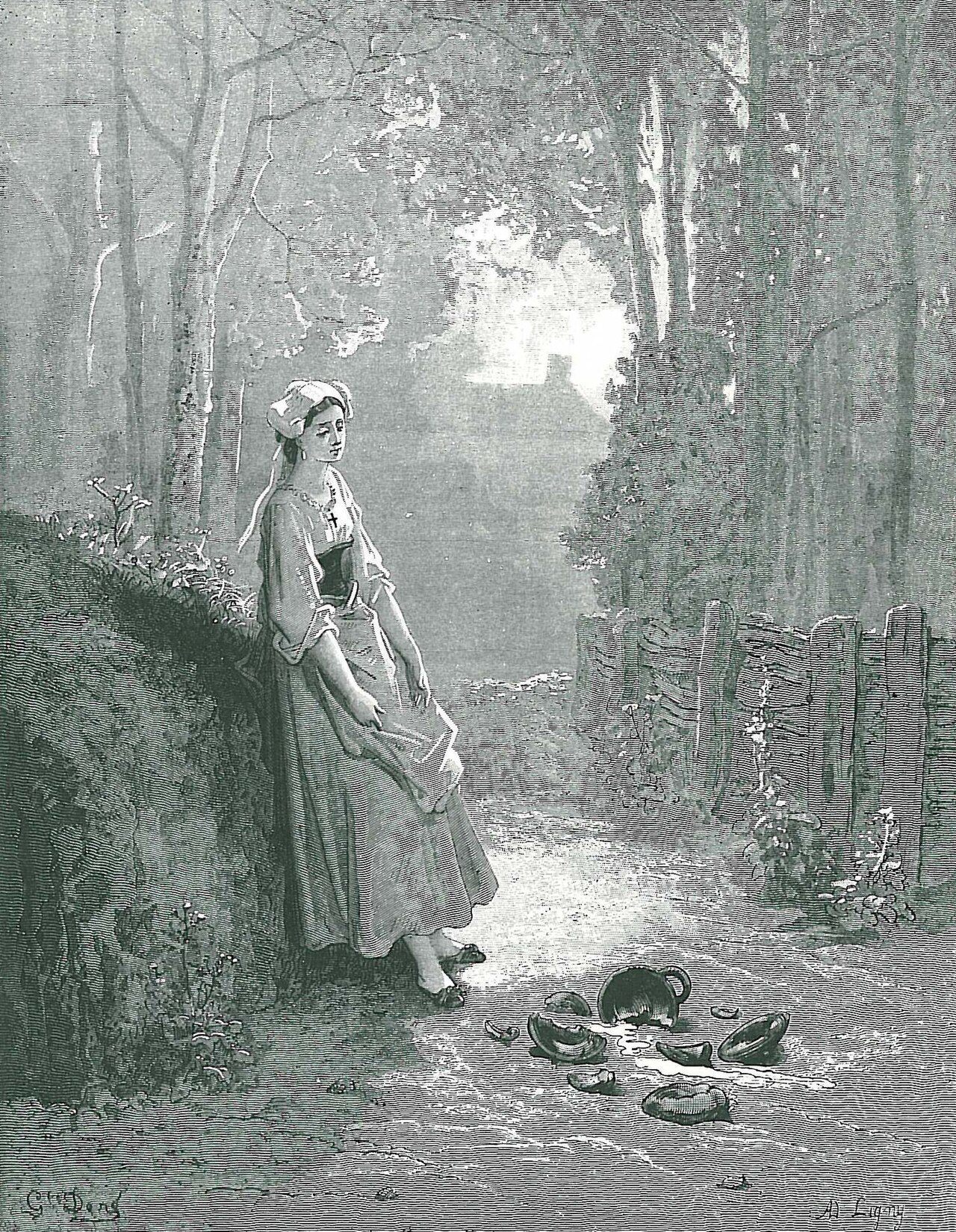
Illustrations of La Fontaine's fables in books, limited as they are to the dismayed milkmaid looking down at her broken crock, are almost uniformly monotonous. An early exception is Jean-Baptiste Oudry's print in which the girl has fallen on her back (1755), an episode unsanctioned by the text. The explanation for the inelegant posture seems to be that the idiom la cruche casée (the broken pitcher) then meant the loss of virginity and so suggests a less innocent explanation of how the milk came to be spilt. Jean-Honoré Fragonard also depicts a fall in his picture of the fable (1770), although in this case the girl has tumbled forward and the smoke of her dreams spills from the pitcher at the same time as the milk. Other paintings that allude to the fable at the time include Jean-Baptiste Huet's "The milkmaid" (La Laitière, 1769) and François Boucher's "The little milkmaid" (1760). A Gobelins tapestry based on this was later to be presented to the king. In the 19th century the story was taken up elsewhere. The American Symbolist, Albert Pinkham Ryder, painted his "Perrette" some time before 1890, taking its title from the name that La Fontaine gave his milkmaid. She walks abstractedly through a visionary landscape with the bucket balanced on her head. The Spanish Joaquín Sorolla y Bastida painted his "The Milkmaid" in 1890 and portrays a pensive girl seated on a flowering bank with her bucket overturned beside her. In Kate Greenaway's painting of 1893 she is seated instead on the steps of a cottage with the pail on the ground in a treatment that has been described as Pre-Raphaelite. 1
The text above is adapted from the Wikipedia article “The milkmaid and her pail”, available under the Creative Commons Attribution-ShareAlike 4.0 licence. 1
La Laitiere et le Pot au Lait is folk tale, according to the structured record cited below. This entry was generated automatically from that record and has not yet been reviewed by a person familiar with the tradition. 2
The source record links this tradition to 3 external registers, which can be verified through the citation. 2