The tradition & historical record
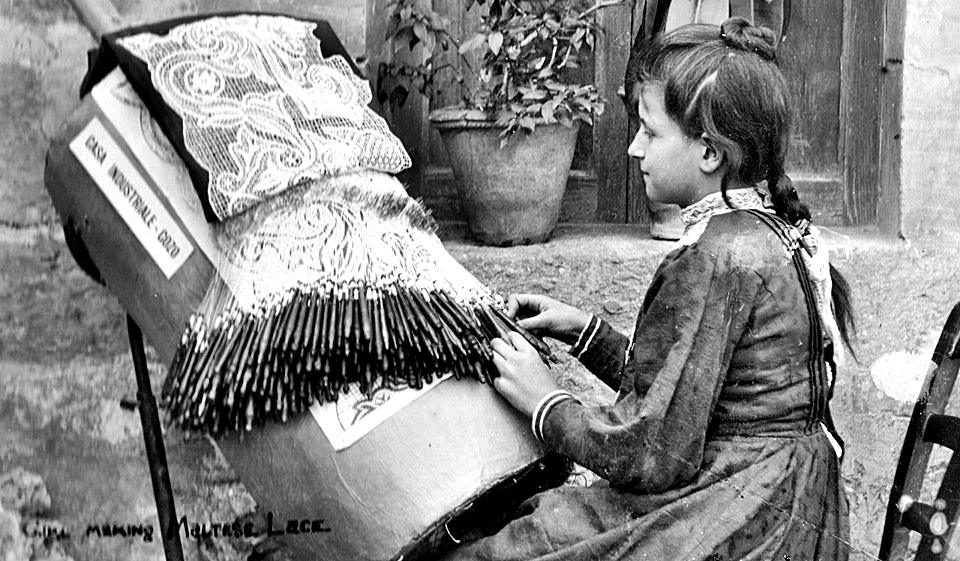
6 min read · 2 sourcesLace tells were catchy rhymes chanted to the rhythm of bobbin lace manufacture in lace schools and workshops in Flanders, the English East Midlands, and the Saxon Ore Mountains (German: Erzgebirge). Tells helped lacemakers to count stitches, maintain a steady rhythm, and stay awake and focused. Lace tells were also used in lacemaking schools in order to increase the speed of work and to teach discipline and lace skills to children—including basic numeracy. Lace tells often borrowed content from existing songs and legends, adapting familiar narratives and formulations to metaphors relying on jargon and details of lace manufacture. Aside from lace manufacture, lace tells often concerned death and violence, as well as expressions of resentment and vengefulness against parents, school mistresses, and lace merchants. The repertoire of surviving lace tells has been studied as a corpus of work songs by women and girls. Parallels between Flemish and English tells may point to a Flemish provenance of the East Midlands lace industry. Common elements found in lace tales from all three regions indicate that lace telling likely began with the establishment of the lace industry in the sixteenth century and was disseminated throughout Europe by migrant lacemakers. 1
Content
As counting rhymes, lace tells sometimes featured number sequences, either counting down—often from 20 in English tells—or counting up. Some were adapted from existing songs by simply appending a number to the beginning of each line. Some lace tells did not enunciate any numbers, and it is not clear how these were used. Lace tells were often intertextual, with familiar material from various types of religious and secular song being appropriated and adapted to the form. David Hopkin writes that references to lacemaking in the lyrics of lace tells were made "in an elliptical manner, with references hidden in a maze of apparent nonsense." 1
English tells
English lace tells were catchy and allusive, often appropriating familiar material from ballads, children's rhymes, games, legends, and riddles. Gerald Porter writes that the presence of well-known children's rhymes in lace tells could help promote discipline and focus among workers, many of whom were children. Lace tells which borrowed from games frequently incorporated sinister elements in order to evoke the consequences of breaking rhythm or looking up before the tell was complete. Content from narrative ballads—also sung by lacemakers at work—was adapted into lace tells by truncating the ballad's story such that the lace tell version would only be meaningful to someone familiar with the full version. Metaphors in lace tells often relied on jargon and references to lacemaking practice that would be opaque to outsiders, and details of the work process were integrated in lyrical narratives of lace tells. For example, a common ballad opening that described 24 boys playing ball was reworked in a lace tell to refer instead to 19 "golden girls"—a metaphor for the gold-headed pins used to attach the lace, with 19 being the number at which lacemakers often began counting down their pins. G. F. R. Spenceley explains that 19 was "the greatest number of stitches a worker could complete in a single burst before she 'looked off' for a moment's relief." English lace tells were typically in doggerel verse. David Hopkin writes that the lyrics of lace tells expressed a sense of occupational identity among lacemakers and that their references to work practices created intimacy and a sense of shared experience in the work environment. Porter identifies a retaliatory theme in lace tells, condemning the insolent lace merchants who sold the lacemakers' work. 1
Flemish tells
Some surviving Flemish tells (tellingen) are several hundred lines long, though most ranged from dozens to a hundred. Hopkin compares Flemish lace tells to sea shanties, in that both forms of song are performed in direct relation to the labor process. He describes Flemish tellingen as "bizarre composites of songs, hymns, [and] prayers." Though the content of tellingen were more religious (due to Flemish lace schools being often overseen by nuns or beguines), the general themes were similar to their English counterparts: "the workers are hungry, exhausted, given mouldy bread, thrown in a hole… Mothers complain about their daughters' lack of work; fathers are even more threatening figures." While some Flemish tells refer explicitly to the experiences of lace schools, most do not. Direct mentions of lace manufacture in Flemish tells were most often positive. Narratives of death, incest, infanticide, "drawn-out executions", and violence (particularly between fathers and daughters) were common in Flemish tells. Some Flemish lace tells were open expressions of resentment at the girls' parents—particularly their fathers—for sending them to work long hours at lace schools, which were associated with ill health and premature death. For example: 1
Some tells expressed vengeful desires toward the parents. For example: 1
Another common theme in Flemish tells is the dream of escaping lace school. Hopkin interprets these songs as cathartic rather than resistant, considering that no material resistance by lacemakers is documented, and that some Flemish tells about punishment may have served to condition girls to accept the mistress's authority. 1
Performance
Porter notes that lace tells are unconventional as work songs, which are typically "dominated by images of male physical labor" and feature shouted refrains. In contrast, lace tells precisely described the work of lacemaking and served to "excite [the lacemakers] to regularity and cheerfulness." Lace tells were chanted to the rhythm of work, helping lacemakers to count their pins—knowing how many pins corresponded to each tell—and maintain a regular, quick pace. Lace tells were also used in lacemaking schools to increase the speed of work and to teach discipline and lacemaking skills in the children, including basic numeracy. Marguerite Coppens writes that lace tells allowed lacemakers, who often worked 10-hour days, to stay awake and alert as they stitched. Students who lost rhythm or failed to keep pace with the tells were punished with a "glum" or "time of gloom"—a period during which they could neither speak nor participate in lace telling. Workshop-wide glums could also be initiated for non-punitive reasons. For instance, a verse ending with the line "for thirty-one speak or look off for sixty-two" triggered a mandatory silence in the workshop until each girl had placed 31 pins—or 62 if the silence was broken. Both English and Flemish lace tells were chanted rather than sung. 1
Flemish lace tells were primarily a feature of lace schools, and it is not clear if adult lacemakers continued to use tells to time their work, even as they recalled and occasionally performed them. 1
Collection and scholarship
According to David Hopkin, "[lace] tells are the one genre in English lacemakers' song repertoire that has been documented." Gerald Porter wrote in 1994 that the reperto… 1
The text above is adapted from the Wikipedia article “Lace tells”, available under the Creative Commons Attribution-ShareAlike 4.0 licence. 1
Lace tells is rhyming chants used to aid lacemaking, according to the structured record cited below. This entry was generated automatically from that record and has not yet been reviewed by a person familiar with the tradition. 2