The tradition & historical record
5 min read · 2 sourcesLāčplēsis ("The Bear-Slayer") is an epic poem by Andrejs Pumpurs, a Latvian poet, who wrote it between 1872 and 1887 based on local legends. It is set during the Livonian Crusades telling the story of the mythical hero Lāčplēsis "the Bear Slayer". Lāčplēsis is regarded as the Latvian national epic. 1
Synopsis
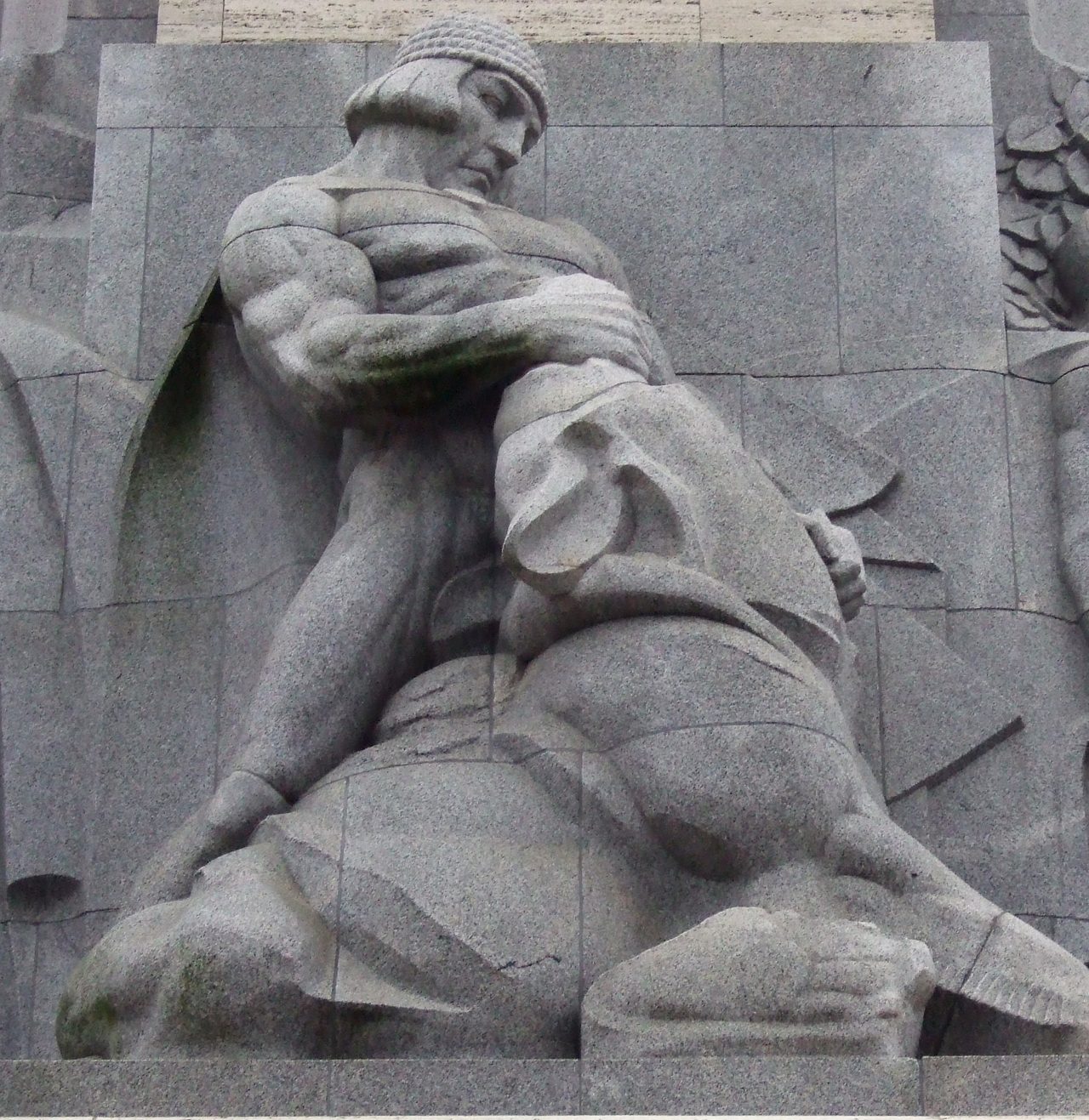
The poem opens at the council of the Baltic gods at the palace of Pērkons in the sky where the Father of Destiny declares that Latvians are under threat because Christian crusaders are going to come and conquer the Baltic lands and enslave the Latvian nation. The Gods promise to protect the Latvians. When the meeting comes to an end suddenly Staburadze arrives and ask for advice in her matter: she has found a young man drowning in the river Daugava where he has to turn into stone. Pērkons says that he has chosen this man for an important matter and that he will save the man. The council ends with the question, will the Baltic gods ever come back together? There follows a flashback of a few days to an occasion upon which the Lord of Lielvārde is taking a walk with his 18-year-old son. Suddenly a bear jumps out to attack them. Undaunted, the son seizes the bear by the jaws and rips it apart as if it had been no more of a threat than a small goat, thus earning himself the name Lāčplēsis - the bear slayer. After this he is sent off to the castle of Burtnieks to continue his studies. On the way, at the castle of Lord Aizkrauklis, he spies on the activities of the witch Spīdala, who is under the control of the Devil, and the holy man Kangars, who is in reality a traitor plotting with crusaders to replace the old gods with Christianity. Spīdala tries to drown Lāčplēsis by throwing him into the whirlpool of Staburags in the Daugava, but he is rescued by the goddess Staburadze and taken to her underwater crystal castle. There Lāčplēsis meets and falls in love with the maiden Laimdota. 1
Contemporary background
The work was written during the Latvian national awakening. At this time a popular belief around Europe was that a Nation can be defined by the fact that it has a National epic while the Nations East of the Baltic sea were left without one. Finns wrote their epic Kalevala in 1835, Estonians published their Kalevipoeg 1857-1861. There were several attempts create a Latvian National Epic which were finally realized by the poet and military man Andrejs Pumpurs and released during the 3rd Latvian Song Festival on 1888. Unlike in the Finnish and Estonian text no original folk song are used in the Latvian story, but it's heavily based on Latvian folklore. By this time it was already considered to be an anachronism, but still amongst the people it became the National epic. From the time of the Northern Crusades in the early 13th century, most of the land in the Baltic governorates was owned by nobles descended from the German invaders. In 1863, the Russian authorities issued laws to enable Latvians, who formed the bulk of the population, to acquire the farms which they held, and special banks were founded to help them. By this means, some occupants bought their farms, but the great mass of the population remained landless, and lived as hired laborers, occupying a low position in the social scale. This was the situation prevailing at the time of writing – thus, the strongly negative presentation of these German invaders had clear contemporary implications for the writer's own time. Scholarship suggests that the legendary hero Lāčplēsis mirrors similar tales of strong men born of animals and who go on adventures. These tales are classified in the Aarne-Thompson-Uther Index as tale types ATU 650A, "Strong John" and AT 301B, "Jean de l'Ours" or "John The Bear". 1
Cultural impact
It is known to be one of the most influential works of Latvian culture. Interpretations of the story keep appearing frequently. Based on the story at the context of the 1905 Russian Revolution, Rainis issued a symbolic play Uguns un Nakts (Fire and Night). There, he focuses on the relationships of Lāčplēsis and Spīdola, where Lāčplēsis is the symbol of strength and Spīdola the symbol of wisdom, beauty and change. While Spīdola is in love with Lāčplēsis, he decides to stay with Laimdota. Still, after Lāčplēsis falls into the Daugava during the battle, Spīdola promises to follow him and help him in the battle, giving hope for Latvian freedom. During the Latvian War of Independence, the battles between Latvian and German troops under the command of Bermondt-Avalov were compared with the battle between Lāčplēsis and the Black Knight. The decisive victory of Latvians happened on November 11 next to the Daugava where it was promised in the epic, and ever since, it is called the day of the Bear Slayer. In 1930, a movie named Lāčplēsis was made. The play Uguns and Nakts was frequently played during the Soviet occupation. Unlike the Soviet propaganda had intended it to show the battle between Latvians and Germans, the Latvian society started to identify the Crusaders with the Soviets. In 1988, the rock opera Lāčplēsis was performed more than 40 times, becoming one of the turning point of the 3rd Latvian National Awakening. Using the mythological narrative it depicted the occupation of Latvia, work of KGB, russification, the destruction of Christianity in Latvia etc. A memorable moment in the rock opera happened on the bewitched island where Lāčplēsis turned people who had turned into rock back into human flesh. 1
The text above is adapted from the Wikipedia article “Lāčplēsis”, available under the Creative Commons Attribution-ShareAlike 4.0 licence. 1
Lāčplēsis is Latvian epic poem, according to the structured record cited below. This entry was generated automatically from that record and has not yet been reviewed by a person familiar with the tradition. 2
The source record links this tradition to 9 external registers, which can be verified through the citation. 2