The tradition & historical record
6 min read · 2 sourcesThe gusle (Serbian Cyrillic: гусле) or lahuta (Albanian: lahutë; related to English lute) is a bowed single-stringed musical instrument (and musical style) traditionally used in the Dinarides region of Southeastern Europe (in the Balkans). The instrument is always accompanied by singing; musical folklore, specifically epic poetry. The gusle player (Serbian Cyrillic: гуслар, romanized: guslar; Albanian: lahutar) holds the instrument vertically between the knees, with the left hand fingers on the string. The string is never pressed to the neck, giving a harmonic and unique sound. On November 29, 2018, the Serbian Gusle was inscribed as a part of Serbia's intangible cultural heritage on the UNESCO Intangible Cultural Heritage of Humanity. On December 9, 2025, the Albanian Lahuta was inscribed on the UNESCO List of Intangible Cultural Heritage in Need of Urgent Safeguarding. 1
Etymology
The Old Slavic root morpheme gǫdsli (cf. Russian gúsli, Slovak: husle, Czech: housle, Slovene: gósli) is associated with guditi/gósti, or gudalo/godalo, related to onomatopoeia for a low resonating sound; cf. gu(n)delj/гу(н)дељ = cockchafer, which makes such sound when flying. The exact origin of the nominations of the related concepts gusle, gadulka, gudok and gudalo, the latter as the name for the bow of the gusle could also illuminate a more accurate assignment in the history of the gusle after Walther Wünsch. In the parlance of the South Slavs, in addition to the feminine plurale tantum gusle that has prevailed as a lexeme, even the older "gusli", which is found in the area of the middle Drina River region to Arilje and throughout Montenegro. The use of the phonemes /e/ and /i/ is in the same language as the same speaker, or it can be used in lyrics or everyday speech. The singular form gusla is found only in Eastern Serbia, west of the Timok, around Niš, Ivanjica, as well as in the area of Zlatibor. On Korčula only gusla is in use. The term gusle by Alberto Fortis has been introduced into European literature. Gusle is in Serbian linguistic usage, however, a feminine plurale tantum (Serbo-Croatian: gusla or gusle, Albanian: lahuta or lahutë). 1
Origin
There is no consensus about the origin of the instrument. 7th-century Byzantine Greek historian Theophylact Simocatta (fl. c. 630) wrote about "small lyres" brought by the Slavs who settled in the Balkans; some researchers believe that this might have been the gusle. Others, such as F. Sachs, believe that the gusle has an Oriental origin, brought to Europe in the 10th century via the Islamic cultural wave. Arab travellers report evidence that the Slavs used the gusle in the 10th century. Teodosije the Hilandarian (1246–1328) wrote that Stefan Nemanjić (r. 1196–1228) often entertained the Serbian nobility with musicians with drums and "gusle". Reliable written records about the gusle appear only in the 15th century. 16th-century travel memoirs mention the instrument in Bosnia and Serbia. In the 19th and 20th centuries the instrument was mentioned in Montenegro, Serbia, Bosnia and Herzegovina, Croatia and Albania (where it is called lahuta, "lute"). 1
Construction and use
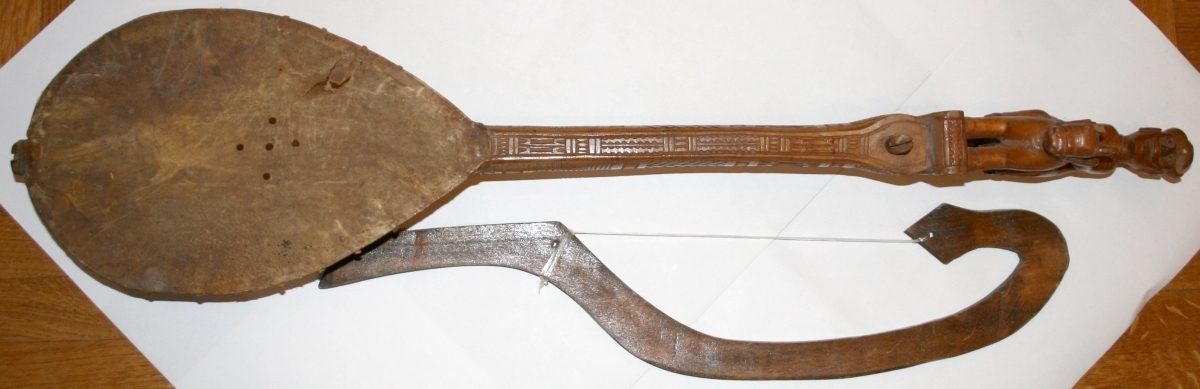
The gusle consists of a wooden sound box, the maple being considered as the best material (therefore often the instrument is referred to as "gusle javorove" - maple gusle), covered with an animal skin and a neck with an intricately carved head. A bow is pulled over the string/s (made of horsetail), creating a dramatic and sharp sound, expressive and difficult to master. The string is made of thirty horsehairs. The instrument is held vertically between the player's knees, with the left hand fingers on the neck. The strings are never pressed to the neck, giving a harmonic and unique sound. The most common and traditional version is single-stringed, while a much less-common version is the two-stringed found in Bosanska Krajina and in Lika. The varieties of gusle music are based on cultural basis; the content of the stories of each ethnic group is different, as different epic poems are used to accompany the instrument. There is minor differing characteristics of vocality in the regions of Southeast Europe. The design of the instrument is identical; only the design of the neck and head varies with ethnic or national motif. The gusle instrumentally accompanies heroic songs (epic poetry) in the Balkans. 1
Serbs
The Serbian gusle is a one-stringed instrument that is usually made of maple wood. A guslar (Serbian Cyrillic: гуслар) is an individual capable of reproducing and composing poems about heroes and historical events to the accompaniment of this instrument, usually in the decasyllable meter. There are records of an instrument named gousli (гоусли) being played at the court of the 13th-century Serbian King Stefan Nemanjić, but it is not certain whether the term was used in its present-day meaning or it denoted some other kind of string instrument. Polish poets of the 17th century mentioned the gusle in their works. In a poem published in 1612, Kasper Miaskowski wrote that "the Serbian gusle and gaidas will overwhelm Shrove Tuesday" (Serbskie skrzypki i dudy ostatek zagluszą). In the idyll named Śpiewacy, published in 1663, Józef Bartłomiej Zimorowic used the phrase "to sing to the Serbian gusle" (przy Serbskich gęślach śpiewać). In some older Serbian books on literature it was stated that a Serbian guslar performed at the court of Władysław II Jagiełło in 1415. The earliest known Serbian guslar is referred to in 1551 by Hungarian historian Sebastian Tinody, saying, "There are many gusle players here in Hungary, but none is better at the Serbian style than Dimitrije Karaman". In addition Sebastian describes the performance, explaining that the guslar would hold the gusle between the knees and goes into a highly emotional artistic performance with a sad and dedicated expression on their face. The gusle has played a significant role in the history of Serbian epic poetry because of its association with the centuries-old patriotic oral legacy. Most of the epics are about the era of the Ottoman occupation and the struggle for the liberation from it. 1
Bosniaks
There are few active Bosniak guslari today, but there were many examples in history. Guslari were always guests at the Bosniak beg's courtyards, and it was with gusle they performed Bosniak heroic songs about prominent figures or events. In these songs were Đerzelez Alija, Mujo Hrnjica, Mustay-Bey of Lika The Battle of Banja Luka or the Battle at Očakov. Avdo Međedović was the most versatile and skillful guslari encountered by Milman Parry and Albert Lord during their research in the oral epic tradition of Bosnia, Herzegovina and Montenegro in the 1930s. At Parry's request, Avdo sang songs he already knew and some songs he heard in front of Parry, convincing him that someone Homer-like could produce a poem so long. 1
The text above is adapted from the Wikipedia article “Gusle”, available under the Creative Commons Attribution-ShareAlike 4.0 licence. 1
lahuta is single-stringed musical instrument, according to the structured record cited below. This entry was generated automatically from that record and has not yet been reviewed by a person familiar with the tradition. 2
The source record links this tradition to 17 external registers, which can be verified through the citation. 2