The tradition & historical record
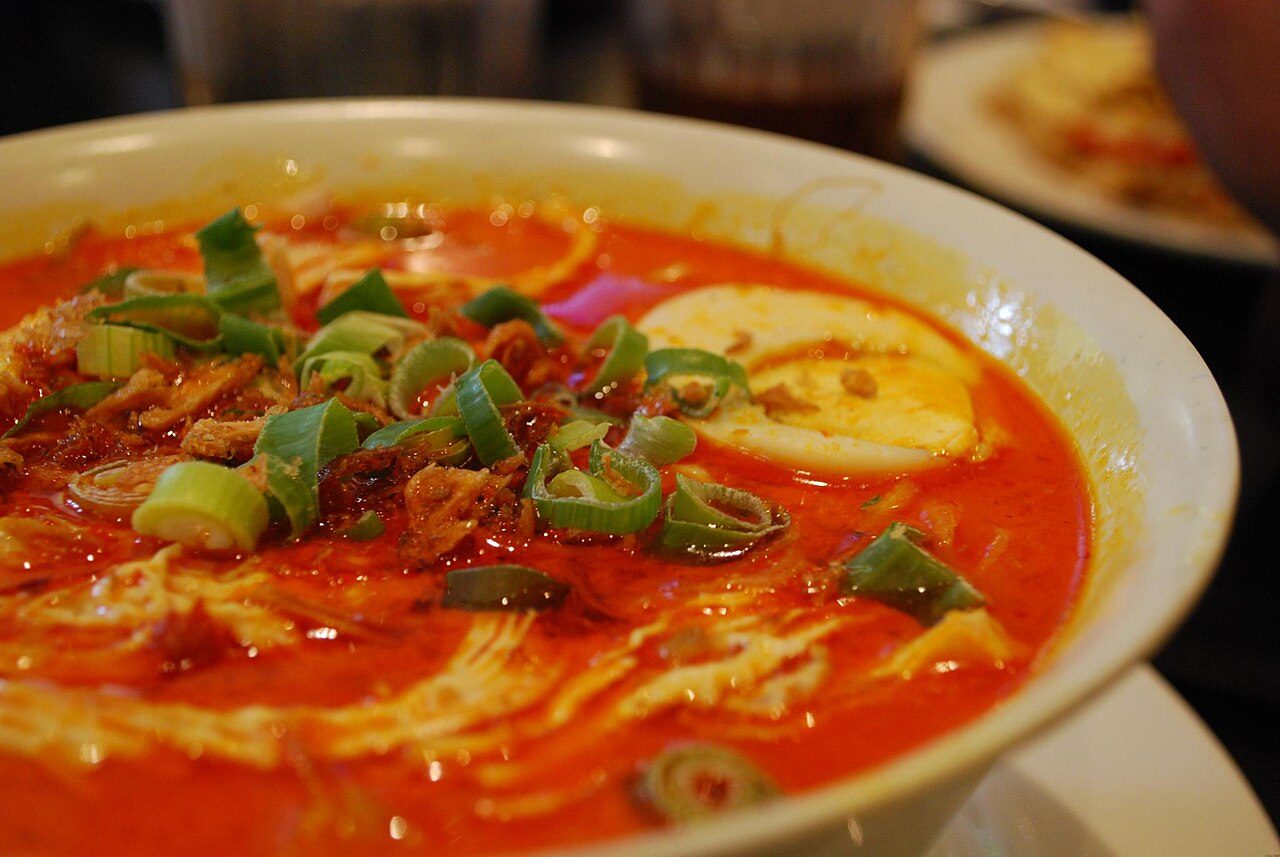
5 min read · 2 sourcesLaksa (Jawi: لقسا; Chinese: 叻沙) is a spicy noodle dish popular in Southeast Asia. Laksa consists of various types of noodles, most commonly thick rice noodles, with toppings such as chicken, prawns or fish. Most variations of laksa are prepared with a rich and spicy coconut curry soup or a broth seasoned with a souring ingredient like tamarind or asam gelugur. Originating from Peranakan Chinese cuisine, laksa recipes are commonly served in Singapore, Indonesia, and Malaysia. 1
Etymology
The word laksa is borrowed from Malay and derives from the Persian word lāḵisha, literally meaning "slippery", which was used to refer to noodles. An early mention of laksa in the English language can be found in a Royal Geographical Society journal from 1846. According to Denys Lombard in the book Le carrefour Javanais. Essai d'histoire globale II (The Javanese Crossroads: Towards a Global History, 2005), one of the earliest record of the word laksa to describe noodles was found in the Javanese Biluluk inscription dated from 1391 of Majapahit era that mentions the word hanglaksa. In Kawi, hanglaksa means "vermicelli maker". 1
Origin
Laksa is a dish of Peranakan Chinese origin, with a variety of ingredients and preparation processes that vary greatly by region. Because laksa has different varieties across the region, it is difficult to pinpoint the exact origin of the dish. Nevertheless, a number of laksa recipes have been developed along the trade channels of Southeast Asia—where the ports of Singapore, Penang, Medan, Malacca, Palembang, and Batavia (now Jakarta) are the major stops along the historic spice route. The intensive trade links among these port cities enable exchanges of ideas to take place, including sharing recipes. There are various theories about the origins of laksa. One goes back to the 15th-century Ming Chinese naval expeditions led by Zheng He, whose armada navigated Maritime Southeast Asia. Overseas Chinese migrants had settled in various parts of Maritime Southeast Asia, long before Zheng He's expedition. However, it was after this that the number of Chinese migrants and traders significantly increased. These Chinese men intermarried into the local populations, and together they formed mixed-race communities called the Peranakan Chinese or Straits Chinese. In Malaysia, the earliest variant of laksa is believed to have been introduced by the Peranakan Chinese in Malacca. In Singapore, the dish is believed to have been created after interaction between the Peranakan Chinese with local Singaporean Malays. In traditional Sundanese community of Baduy in Banten province, there is a harvest ceremony involving the making of laksa, called ngalaksa ceremony. Ngalaksa is a Sundanese traditional harvest thanksgiving ceremony, in which a traditional noodle-like laksa dish made of rice flour is prepared and consumed communally. 1
Ingredients
A wide variety of laksa exists in Southeast Asia, with regional and vendor-specific differences. Laksa can be broadly categorized by its two main ingredients: noodles and soup. Most preparations of laksa are garnished with herbs. Two of the most widely used herbs are mint and Vietnamese coriander, known in Malay as daun kesum or by its colloquial name daun laksa "laksa leaf". Another popular garnish used for many laksa recipes is the unopened flower bud of the torch ginger, usually sliced or shredded. 1
Noodles
Thick rice noodles, also known as "laksa noodles" are most commonly used, although thin rice vermicelli (米粉 "bee hoon") are also common. Some laksa variants might use fresh rice noodles handmade from scratch, other types of noodles; Johor laksa for example uses wheat-based spaghetti, while Kelantanese laksam is served with wide strips of rice noodle rolls similar in texture to shahe fen. 1
Soup
The type of Laksa is generally based upon the soup base employed in its recipe; either rich and savoury coconut milk, fresh and sour asam (tamarind, tamarind slice), or a combination of those two. 1
Laksa with a rich and strongly spiced coconut gravy is typically described in Malaysia and Singapore as Laksa Lemak or Nyonya Laksa (Laksa Nyonya). Lemak is a Malay culinary description that specifically refers to the presence of coconut milk which adds a distinctive richness to a dish, whereas Nyonya alludes to the dish's Peranakan origins and the role of women in Peranakan cuisine. "Laksa" is also an alternate name used for curry mee, a similar coconut soup noodle dish widely popular within the region which is sometimes known as curry laksa. The most common toppings for the various versions of coconut soup laksa include eggs, deep-fried tofu, beansprouts, and herbs, with a spoonful of sambal chilli paste on the side as a relish. The Malay word asam refers to any ingredient that makes a dish taste sour (e.g. tamarind (Malay: Asam Jawa) or tamarind slice (Malay: Asam Gelugor), which comes from a different tree despite its name). The main ingredients for tamarind-based laksa typically include shredded fish, normally mackerel (ikan kembung), and finely sliced vegetables including cucumber, onions, red chillies, pineapple, mint leaves, laksa leaves, and shredded torch ginger flower. Preparations for tamarind-based laksa usually produce tangy, spicy, sour flavours. This type of Laksa is normally served with either thick rice noodles ("laksa") or thin rice noodles ("mee hoon") and topped off with otak udang or hae ko (Penang Hokkien: 蝦膏; hêe-ko), a thick sweet shrimp paste. In Indonesia, most laksa variants are coconut milk-based soups. 1
The text above is adapted from the Wikipedia article “Laksa”, available under the Creative Commons Attribution-ShareAlike 4.0 licence. 1
laksa is Southeast Asian noodle soup origin from Malacca, originally introduced by Persian trader, according to the structured record cited below. This entry was generated automatically from that record and has not yet been reviewed by a person familiar with the tradition. 2
The source record links this tradition to 3 external registers, which can be verified through the citation. 2