The tradition & historical record
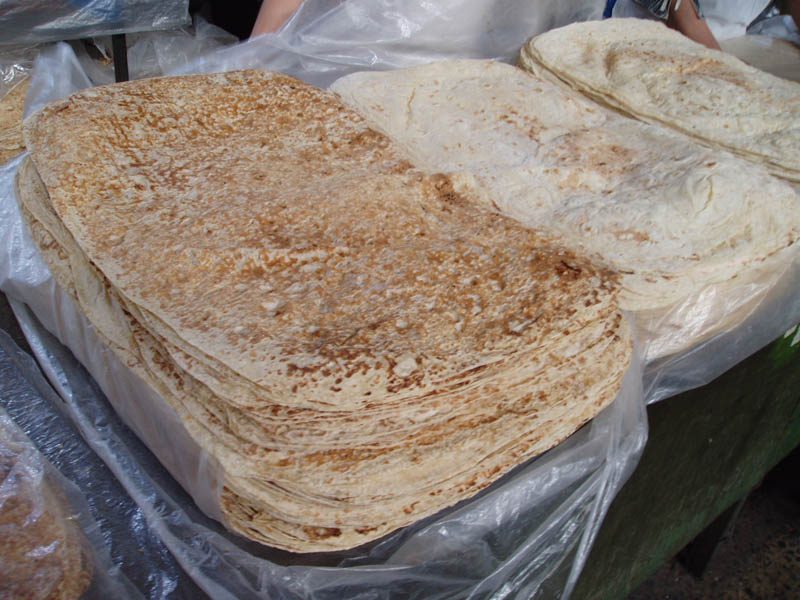
7 min read · 2 sourcesLavash is a thin flatbread made of leavened or unleavened wheat dough, baked in a tandoor (a type of clay oven) or on a saj griddle. Some forms are sourdough fermented with dough from previous batches. Lavash cooks very quickly in a tandoor, being placed on the sides using a cushion. It is large and thin, though there are many variations in size and shape. It is soft when fresh but is often dried. Lavash is common to the cuisines of South Caucasus and West Asia. It is a staple food in Armenia, eastern Georgia, and parts of Iran. Soft lavash can be used for wraps, which use ingredients such as kebabs, barbecued meat, or cheese. It may also be served with dip or with stew to be eaten by hand. Lavash is often prepared in large batches. It lasts months once dried and can be hydrated to restore softness. Dried lavash is sometimes broken up and eaten in dishes such as the Armenian stew khash. Lavash originated in ancient times, with several countries claiming its origin. In the modern day, lavash is widespread in many parts of Asia between Turkey and Kashmir, and also exists in other regions where it was introduced by Armenian immigrants. It is served at many restaurants, as well as at weddings. In Armenian culture, the preparation of lavash by women is a community event. The UNESCO Intangible Cultural Heritage List inscribed lavash "as an expression of culture in Armenia" in 2014. 1
Etymology
The word lavash entered English partly from Armenian (լավաշ, lavaš), Persian (لواش, lavaš), and Turkish (lavaş). Similar names are used in many Asian languages, including Georgian (lavaš-i), Azerbaijani (lavaş), Tatar (lawaš), Turkmen (lavaš), and Pashto (lawausha). Lavash is the most common name for the bread in American English; the spellings lavosh, lahvosh, lawaash, and lawasha are also used. Other English terms include cracker bread, Armenian cracker bread, mountain bread, and paraki. The Arabic equivalent is called khobiz sajj, or markouk in Lebanon. The etymology of lavash is unknown. A widely held theory states that the word spread to other languages from Persian. Sevan Nişanyan connects the Persian word for lavash to the Aramaic לושׁ lwš root meaning 'to knead' and recorded al-Faraj ba'd ash-Shiddah from 1451 as the oldest text to use the term in Turkish. Hrach Martirosyan tentatively connects the Armenian word with words derived from Proto-Armenian *law 'flat'. 1
Preparation
Lavash is made with wheat flour—usually white flour—kneaded with water and salt, forming a stiff dough. High-extraction flour is typically used, at about 80–82% extraction. Leavened and unleavened forms of lavash exist. It may be leavened with yeast or with a sourdough starter known in Armenian as ttkhmor, which consists of dough from the previous batch. Some producers in Iran instead use baking soda, although this is prohibited by the Ministry of Health. A mixture of yeast and baking soda may also be used. The dough of lavash and the similar sangak contain about 83% flour by weight, higher than other breads in Iran. For every 100 g flour, lavash dough may have about 45–55 g water, 2 g salt, 1 g least, and 0.25 g baking soda. The leavened dough may be fermented for 30–60 minutes, at about 30 °C, before being shaped into 100–300 gram balls, then risen again for 5–20 minutes. The dough is rolled with a rolling pin, commonly a thin rod known as an okhlavoo. Then, it may be rolled with a spiked rolling pin that forms indentations. 1
The dough is slapped against the hot walls of a tandoor (also known as tonir or tanoor), a type of clay oven. To place the dough in the oven, it is stretched over a round cushion with a handle, functioning as a peel. This tool is known in Iran as saruj and in Armenia as batat or rabata. Lavash cooks very quickly—about 15 to 40 seconds—due to thermal radiation and convection from the flame and conduction from the wall. The bread is removed using a metal hook and stacked. Aside from a tandoor, lavash may be baked on top of a saj, a metal griddle. This may be placed in or on a wood-powered oven, or over an open fire. 1
Serving
Lavash is often prepared and stored in large batches. The dryness of lavash makes it very shelf-stable; dried lavash lasts three to six months. It is sprinkled or soaked with water to make it softer again, enabling consumption after 15–20 minutes. In Armenia, it may be eaten as a breakfast with jam and curd, or a snack with cheese. Lavash is similarly eaten for breakfast in Iran. Lavash is commonly used for wraps, with toppings such as cheese, greens, or meats including kebabs or kofta. In Armenia, lavash is used to wrap the barbecue dish khorovats, which is eaten for lunch or dinner, while tarragon-spiced eggs are wrapped in lavash for breakfast. Lamb or beef is wrapped in lavash to prepare tantuni, a specialty of Mersin, Turkey. In Kashmiri cuisine, a lavash wrap with barbecued meat and chickpeas is known as masala lavasa. Lavash can be used to wrap around and pick up accompanying dishes, such as stew. This is typical in parts of the Iranian plateau, where it is considered the central part of the meal. It may also be served with dips, such as hummus or muhammara. In Armenia, the dried bread is broken up for stews such as khash, a hoof meat stew, which is also eaten with soft lavash instead of a spoon. Another preparation in Iran uses hard lavash, mashed with butter to form bite-sized balls. In Turkish cuisine, lavash can be used also for sweet dishes, served alongside Turkish desserts like kaysefe, hasude, pestil kavurması ('braised fruit leather'), ağuz and helva. 1
Nutrition and properties
Based on various bakery samples from Iran, lavash contains about 61–62% carbohydrates, 21%–25% water, 8.7%–8.9% protein, 1–4% ash, and 0.4%–0.8% fat. A 100 g serving contains 291 dietary calories. The glycemic index is about 72, lower than that of breads with higher baking times as there is less time for starch gelatinization. The sodium content of lavash in Iran is about 1.1%, higher than recommendations, while lavash has a lower sodium content than other breads in Turkey. Lavash is high in iron, with about 3.8 mg per 100 g serving, and low in zinc, with about 0.6 mg per 100 g serving. Yeast in lavash increases breakdown of phytic acid, thus increasing the ability to absorb nutrients. Using baking soda results in worse nutritional value. According to a study by H. A. Faridi et al, the ideal flour for Iranian breads such as lavash is made from soft wheat containing 9.8% protein. Commercial flour blends designed for lavash in Iran contain, on average, 13% moisture, with the remaining mass consisting of 66% starch, 12.3% protein, 11.0% dry gluten, 6.7% fiber, 1.5% fat, and 0.8% ash. The addition of hydrocolloids may improve shelf life and other physical qualities of lavash; for example, a study by Hamid Tavakolipour and Ahmad Kalbasi-Ashtari found that carboxymethyl cellulose may increase shelf life by 45%. Studies have also found that the addition of whey protein may increase softness, thinness, yellow color, and acceptibility of taste. 1
Origin and historical record
Lava… 1
The text above is adapted from the Wikipedia article “Lavash”, available under the Creative Commons Attribution-ShareAlike 4.0 licence. 1
lavash is thin flatbread usually leavened, traditionally baked in a tonir, according to the structured record cited below. This entry was generated automatically from that record and has not yet been reviewed by a person familiar with the tradition. 2
The source record links this tradition to 5 external registers, which can be verified through the citation. 2