The tradition & historical record
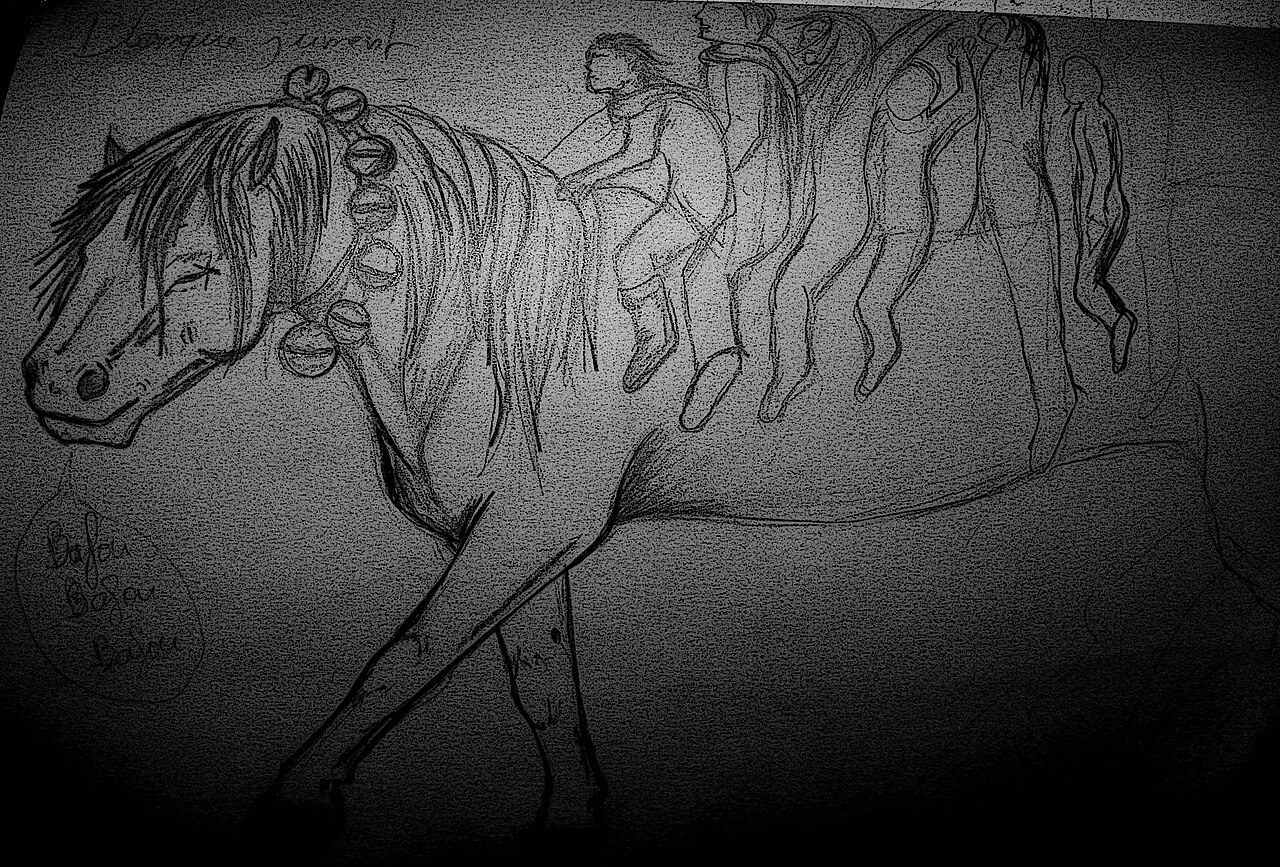
5 min read · 2 sourcesThe legendary horses of Pas-de-Calais are fabulous, diabolical white animals, mentioned in the folklore of Artois, Ternoise and Boulonnais under various names. The blanque mare is said to appear at dusk or in the middle of the night to deceive children and men. She would tempt the latter to ride her, and her back could stretch to accommodate, usually, up to seven riders. Once they had settled on her back, she would lure them into traps or throw them into the water. This animal is also mentioned under the same name in Samer. Ech goblin and the qu'vau blanc from Saint-Pol-sur-Ternoise, which wore a collar with bells to attract its victims, play the same role, as does ch'blanc qu'vo from Maisnil, or the animal from Vaudricourt, a white horse or gray donkey that carried off twenty children and eventually drowned them. All these legends from the region are part of French folklore, with its abundance of pale, evil horses associated with night, water and their dangers. 1
Legends
The Nord-Pas-de-Calais region abounds in legends, whether attached to trees, stones, mountains, ghosts, the devil, giants, saints or fantastic animals. According to Bernard Coussée, "there isn't a city, a village or a market town that doesn't have a bit of an enigma to tell". Among fantastic animals, the horse is mentioned several times in the Pas-de-Calais department. These legends share many common features in the vision of these pale horses, with their negative symbolism, their lengthening backs and all ending up rid of their riders, usually by throwing them into the water. 1
Blanque mare from Boulonnais and Samer
According to Bernard Coussée and the Société de Mythologie Française, the blanque mare appears on full-moon nights in the Boulonnais region. Its back can stretch to allow seven riders to sit on it, but the fabulous animal always ends up getting rid of it in the water. This legend is also common in Artois, particularly in the Ternoise region. The Boulonnais horse is a breed of draft horse unique to the region, with a light gray coat that is often perceived as white. 1
The blanque mare was mentioned in detail in a letter from a doctor, M. Vaidy, to M. Eloi Johanneau on 4 June 1805 in Samer. It is recorded by the Celtic Academy:"Finally, my dear friend, I went to visit the Tombelles, guided by a peasant woman who told me, without my asking, that this place was the cemetery of a foreign army that had occupied the area around Questreque a long time ago. This ancient burial ground is now a small piece of communal land, situated half a league south of Samer, and three-quarters of a league south-west of Questreque, on an arid plain at the foot of Mont de Blanque-Jument (...). The Mont de Blanque-Jument, according to the tradition of the inhabitants of Samer, is so named because a white mare of perfect beauty, belonging to no master, was once seen on its summit, approaching passers-by and offering her rump to be ridden. All wise people were wary of yielding to such a seduction. But one day, an unbeliever had the temerity to ride the white mare, and was immediately struck down and crushed. 1
Ech Goblin, qu'vau blanc or ch'gvo blanc from Saint-Pol-sur-Ternoise
Ech goblin, also known as qu'vau blanc or ch'gvo blanc, is a creature similar to the blanque mare, which was recorded in the nineteenth century as a type of lutin, specifically a goblin capable of assuming the form of a mammal with long white fur and a collar of bells around its neck. The melodious sound of these bells encourages people, especially children, to ride the animal as soon as they hear it. The ech goblin's back lengthens as more and more people mount it. When it has enough on its back, it races to the nearest river to drown its riders. At night, this creature would hide in quarries or excavations along roads leading to the forest. Up until the 1830s, ech goblin was evoked to frighten disobedient children, who were told to "Gare a ti, v'lo ch'goblin", mainly in the Saint-Pol-sur-Ternoise region, near Béthune. Ech goblin was also the name given to the local sludge-collector's cart, to which a horse or donkey with bells was hitched. 1
Ch'blanc qu'vo de Maisnil
Ch'blanc qu'vo is mentioned by elficologist Pierre Dubois in his Encyclopédie des fées as a fabulous horse specific to Maisnil, whose mane is trimmed with bells. Mlle Leroy reports in Henri Dontenville's La France mythologique that, according to a folklorist from Artesia, ch 'blanc qu'vose is confused with ech goblin "which was used to threaten unbearable children". 1
Vaudricourt gray donkey or white horse
Two similar creatures are mentioned in Vaudricourt, one as a gray donkey and the other as a white horse. In his Evangiles du Diable, Claude Seignolle tells of a gray donkey that appeared in the square at Vaudricourt during midnight mass and obediently allowed itself to be ridden by the children fleeing the church, stretching out its back so that twenty of them could sit on it. When the mass was over, it bolted at full speed and plunged into a trough where all its victims were drowned. Since then, the horse has reappeared every Christmas Eve carrying the damned children, circling the village, returning to its starting point at midnight and returning to the trough from which it emerged. Pierre Dubois mentions the same story in his Encyclopédie des fées, but this time it concerns a "magnificent white horse" that drowns its young riders in a bottomless pond, and disappears into a chasm after each of its reappearances on Christmas Day. 1
The text above is adapted from the Wikipedia article “Legendary horses of Pas-de-Calais”, available under the Creative Commons Attribution-ShareAlike 4.0 licence. 1
Legendary horses of Pas-de-Calais is French mythological horses, according to the structured record cited below. This entry was generated automatically from that record and has not yet been reviewed by a person familiar with the tradition. 2
The source record links this tradition to 1 external register, which can be verified through the citation. 2