The tradition & historical record
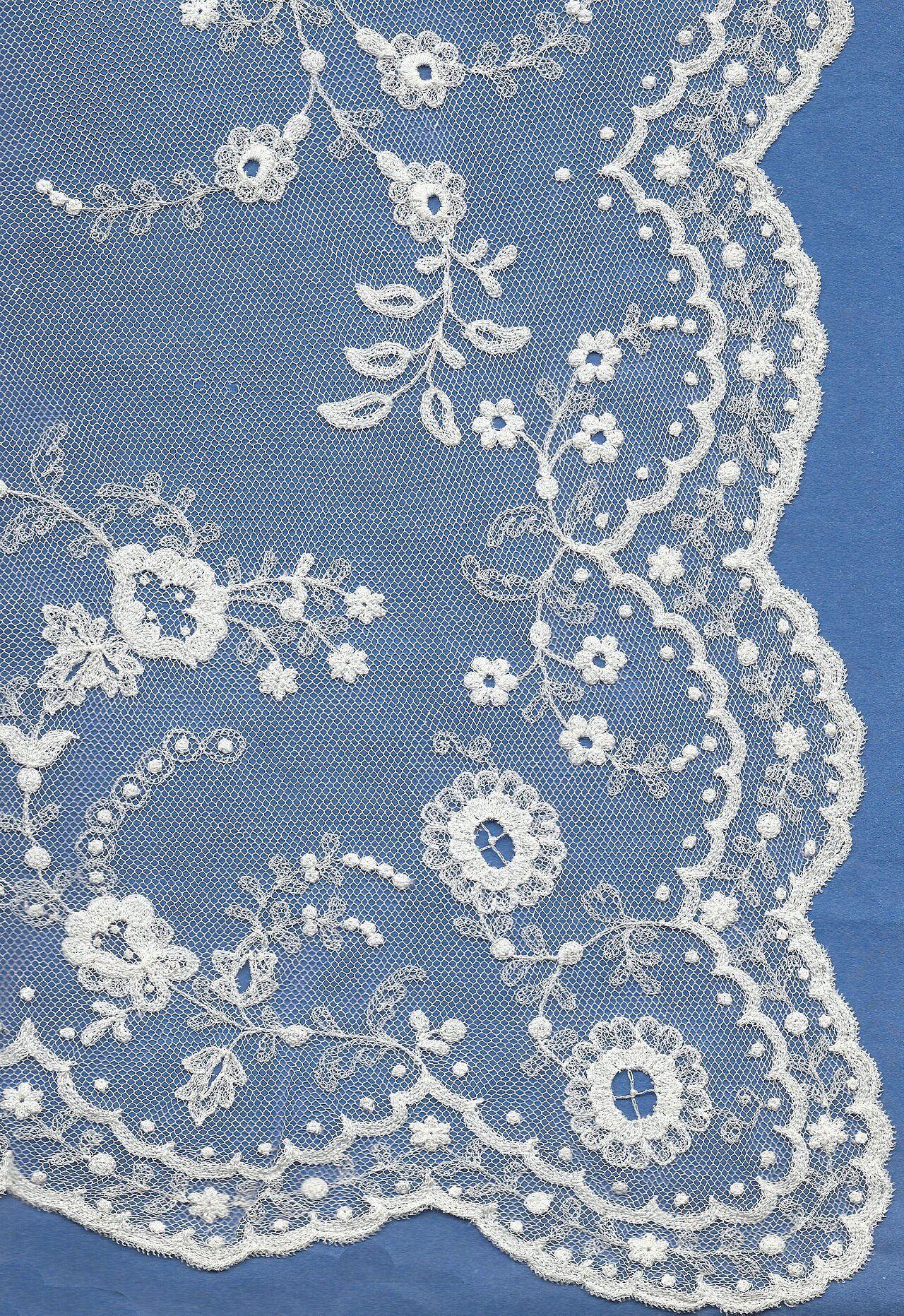
5 min read · 2 sourcesLimerick lace is a specific class of lace originating in Limerick, Ireland, which was later produced throughout the country. It evolved from the invention of a machine which made net in 1808. Until John Heathcoat invented a net-making machine in Devon in 1815, handmade net was a very expensive fabric. This meant cheap net became available to Irish lacemakers, particularly after 1823 when Heathcoat's patent expired. Limerick lace is a hybrid lace of embroidered needle lace or crocheted lace on a machine made net base. It is a 'mixed lace' rather than a ‘true lace’, which would be entirely hand made. Limerick lace comes in two forms: tambour lace, which is made by stretching a net over a frame like a tambourine and drawing threads through it with a hook, and needlerun lace, which is made by using a needle to embroider on a net background. The lace was noted for its variety of delicate fillings, as many as 47 different ones being found in one collar. 1
History
The Limerick lace industry was founded in 1829 by Charles Walker, a native of Oxfordshire. The history of Limerick lace can be divided into two broad periods: the age of factory production 1829-c.1870 and the age of home and workshop production c.1870-1914. In 1829, Walker brought over 24 girls to teach lace-making in Limerick, drawn to the area by the availability of cheap, skilled female labour, and his business thrived. Charles Walker chose Limerick after touring various sites for the business. Limerick previously had a thriving Limerick glove industry, but at this time had a large population of unemployed women with a tradition of factory work. Limerick lace was produced mainly in factories for the first forty years of its existence. Between the 1830s and 1860s, several lace factories operated in Limerick. The city’s second lace factory was established in 1835 by William Lloyd, initially at Clare Street and later in Abbey Court off Nicholas Street. In 1841, there were 400 women and girls working for him. In 1836, Leycester Greaves (1809-47), a Cork man opened a factory in Limerick. These lace factories employed almost 2,000 women and girls. In the 1840s, Limerick lace making was introduced to a number of convents and convent-run institutions, both in Limerick and elsewhere. In 1850, lace making was introduced to the Good Shepherd Convent on Clare Street Limerick, but it was also made in other religious houses based in the city, including the Presentation Convent in Sexton Street and the Mercy Convent at Mount Saint Vincent, on O’Connell Avenue. Limerick lace was disseminated widely throughout Ireland by Catholic religious sisters, anxious to provide employment at the time of the Famine. 1
Features
Limerick lace is formed on a mesh using one or both of two techniques: 1
Tambour – where chain stitch is created using a hook. Needlerun – where stitches are darned onto the ground using a needle. Sometimes applique was used, including net appliqued onto net, which made a gossamer fabric. The types of lace made in the first factory at this time were fichus, blond lace trimming and grey lace (spotted), traced by tambour workers and filled by runners. Later in the 1840s the types of lace in production were floss work, satin stitch, Valencienne, two-stitch and moss work, however the introduction of machine-made lace was impacting the quality of the running work. 1
Modern revival
Limerick lace is still produced on a very small commercial basis by individual lace makers such as Eileen Browne. A number of classes are held both within Limerick and throughout the country in an attempt to revive the practice. In 2014, Limerick City Council published a comprehensive history on Limerick lace called Amazing Lace, written by Dr Matthew Potter, Curator of Limerick Museum. In 2019, Limerick lace was added to the Irish National Inventory of Intangible Cultural Heritage. In 2019, Veronica Rowe, the granddaughter of Florence Vere O'Brien, handed over her lace collection on longterm loan to the Limerick Museum. In 2023, Grania McElligott donated the Maude Kearney lace collection to the Limerick Museum, adding to the existing Limerick lace collection. Since 2017, a series of exhibitions and conferences, both virtual and actual dedicated to Limerick lace have been held by Limerick Museum. In the same year, a group of lacemakers and lace enthusiasts came together under the name "Friends of Lace Limerick" to work with Limerick Museum on the preservation and cataloguing of lace artefacts in the museum collection and on the revival of Limerick lace traditions. Friends of Lace Limerick organised the Amazing Lace Symposium in collaboration with Limerick Museum in 2018, 2019 and again in 2024. For August 2025, Limerick Museum is planning a lace exhibition that will include the highlights of all its collections. 1
The text above is adapted from the Wikipedia article “Limerick lace”, available under the Creative Commons Attribution-ShareAlike 4.0 licence. 1
Limerick lace is type of embroidered net lace, according to the structured record cited below. This entry was generated automatically from that record and has not yet been reviewed by a person familiar with the tradition. 2
The source record links this tradition to 4 external registers, which can be verified through the citation. 2