The tradition & historical record
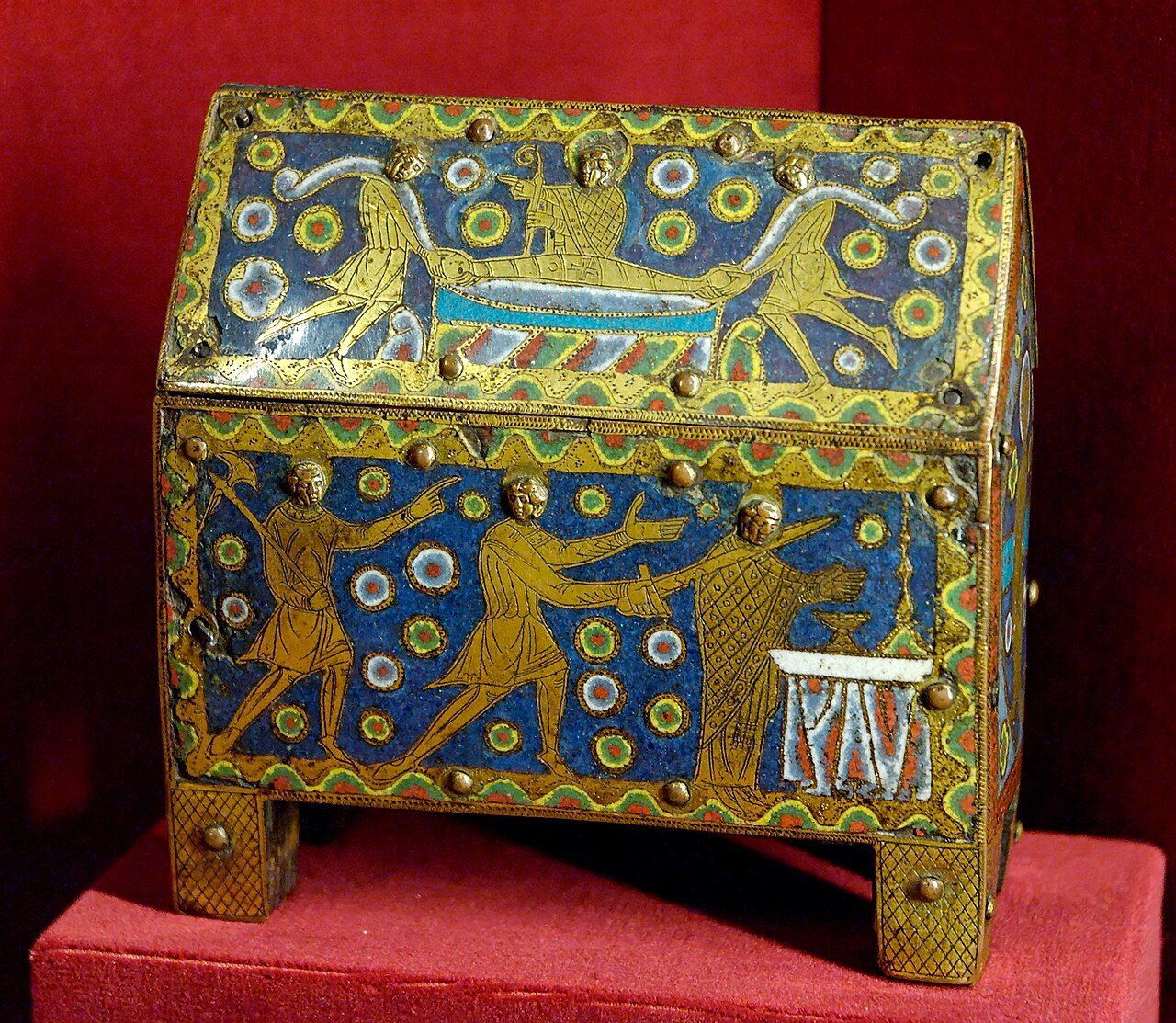
6 min read · 2 sourcesLimoges enamel has been produced at Limoges, in south-western France, over several centuries up to the present. There are two periods when it was of European importance. From the 12th century to 1370 there was a large industry producing metal objects decorated in enamel using the champlevé technique, of which most of the survivals (estimated at around 7,500 pieces), and probably most of the original production, are religious objects such as reliquaries. After a gap of a century, the industry revived in the late 15th century, now specializing in the technique of painted enamel, and within a few decades making rather more secular than religious pieces. In the French Renaissance it was the leading centre, with several dynastic workshops, who often signed or punchmarked their work. Luxury pieces such as plates, plaques and ewers were painted with sophisticated Mannerist decoration of pictorial figure scenes, which on vessels were surrounded by elaborate borders. In both periods the largest pieces include narrative scenes. These exemplify the styles of their respective periods. In the medieval champlevé the action is simply and directly shown by a few figures, with patterned backgrounds. 1
Medieval champlevé enamel
Limoges was already the largest and most famous, but not the most high quality, European centre of champlevé vitreous enamel production by the 12th century; its works were known as Opus de Limogia or Labor Limogiae. The town's main competitors in the price-conscious market were northern Spanish workshops, and Limoges work shows signs of Spanish and Islamic influence from very early on; it has been speculated that there was movement of workers between the two regions. The later vermiculated style and pseudo-Kufic borders are two examples of such influence. Some of the early Limoges enamel pieces display a band in pseudo-Kufic script, which "was a recurrent ornamental feature in Limoges and had long been adopted in Aquitaine". Champlevé plaques and "chasse caskets" or reliquaries on copper were eventually almost mass-produced and affordable by parish churches and the gentry. However, the highest quality champlevé work came from the Mosan Valley, in pieces such as the Stavelot Triptych, and later the basse-taille enamellers of Paris, Siena and elsewhere led the top end of the enamel market, often with bases in precious metal; almost all these pieces have been melted down at some point. But Limoges still received orders for important pieces for cathedrals or royal patrons, especially in the 12th and 13th centuries, and there were a range of qualities of work available. The industry was already in decline by 1370, when the brutal sack of the city after the Siege of Limoges by the English, led by Edward the Black Prince, effectively ended it. By then, goldsmiths in larger centres had mostly turned to other techniques such as basse-taille. 1
Techniques
Limoges enamel was usually applied on a copper base, but also sometimes on silver or gold. Preservation is often excellent due to the toughness of the material employed, and the cheaper Limoges works on copper have survived at a far greater rate than courtly work on precious metals, which were nearly all recycled for their materials at some point. The parts not covered in enamel were generally gilded; there were two basic styles. In the first, the more common but only introduced around 1200, the figures were gilded and often at least partly in relief, while the backgrounds were mainly in coloured enamels. In the other, this was reversed, and the figures were enamels, against a gilded background. The gilded areas were also marked with incised lines, depicting the faces and clothes of figures or patterns in the backgrounds (this last known as the vermiculated style). Pieces were often decorated with jewels, usually imitations in enamel or glass in surviving pieces, and the multicoloured roundels in many of the backgrounds can be understood as imitation gems. From about 1200, blue, with the gold of the gilded areas, was the predominant colour in the Limoges palette. In medieval art blue was notoriously expensive in other media such as painting, but relatively easy to achieve in both enamel and stained glass, whose makers took full advantage of this. The smaller relief elements were mainly made by stamping into dies carrying the design of details like the heads of figures that are otherwise flat; where whole figures are in relief they are usually made from a separate piece of copper which is first pushed out from behind to make the rough shape, then finished by working on the front. 1
Growth
The growth of the Limoges industry and its reputation in the 12th century appears to have owed much to the Grandmontines, a monastic order whose mother house of Grandmont was outside the city. The order grew rapidly after the death of its founder, Saint Stephen of Muret in 1124, and was patronized by King Henry II of England. It is no longer thought that there was an enamel workshop in the abbey of Grandmont itself; instead the secular workshops of Limoges were patronized. The order had little land and was poor, as well as its austere rule on the face of it discouraging spending on art; it did not use monumental sculpture. Nonetheless, enamels were sent to the new houses springing up, mainly in France. Pope Innocent III (1198–1216), who visited Grandmont twice, commissioned Limoges work for Rome: a reliquary for his titular church and work for the shrine of Saint Peter in Saint Peter's Basilica, effectively the most prestigious setting in the Western Church. The 4th Lateran Council, convened by Innocent, specified that Limoges enamel was suitable for one of the two pyxes every church was required to have (although it was not considered an appropriate material for chalices, which Catholic regulations still generally require to be at least plated in precious metal). Other factors in spreading the reputation of Limoges work were that Limoges was on a main pilgrimage route to Santiago de Compostela, and was also patronized by the Knights Templar. Pieces were given as gifts as far afield as the Crusader Kingdoms of the Holy Land and Scandinavia, and have been preserved at Novgorod in Russia. 1
Uses
Apart from the caskets which are such a large part of production throughout the period, there were many other types of objects made in Limoges enamel. Those made for church use have had a better chance of surviving, and in the early part of the period probably predominated. Some types of objects, such as candlesticks, which are usually small with a pricket, and ornamental medallions for chests, usually have secular or neutral decoration and were probably made the same for both markets. In the later period other objects can have distinctly secular decoration, such as chivalric scenes of knights in combat, or rarer scenes of courtly love. 1
Renaissance painted enamel
The painted enamel technique appeared during the mid-15th century, perhaps first in the Netherlands, soon followed by Limoges during the reign of Louis XI (146… 1
The text above is adapted from the Wikipedia article “Limoges enamel”, available under the Creative Commons Attribution-ShareAlike 4.0 licence. 1
Limoges enamel is artistic material made in Limoges, France, according to the structured record cited below. This entry was generated automatically from that record and has not yet been reviewed by a person familiar with the tradition. 2
The source record links this tradition to 6 external registers, which can be verified through the citation. 2