The tradition & historical record
7 min read · 2 sourcesLittle Red Riding Hood (French: Le Petit Chaperon rouge, German: Rotkäppchen, Italian: Cappuccetto Rosso) is a fairy tale about a young girl and a Big Bad Wolf. Some later versions include a woodsman. Its origins can be traced back to several pre-17th-century European folk tales (including in present-day France, Italy, and German-speaking regions), with parallels in ancient oral narratives and motifs; it was first recorded in literary form in French by Charles Perrault, and later retold in the 19th-century by the Brothers Grimm. The story has varied considerably in different versions over the centuries, translations, and as the subject of numerous modern adaptations. Other names for the story are "Little Red Cap" or simply "Red Riding Hood". It is number 333 in the Aarne–Thompson classification system for folktales. 1
Plot
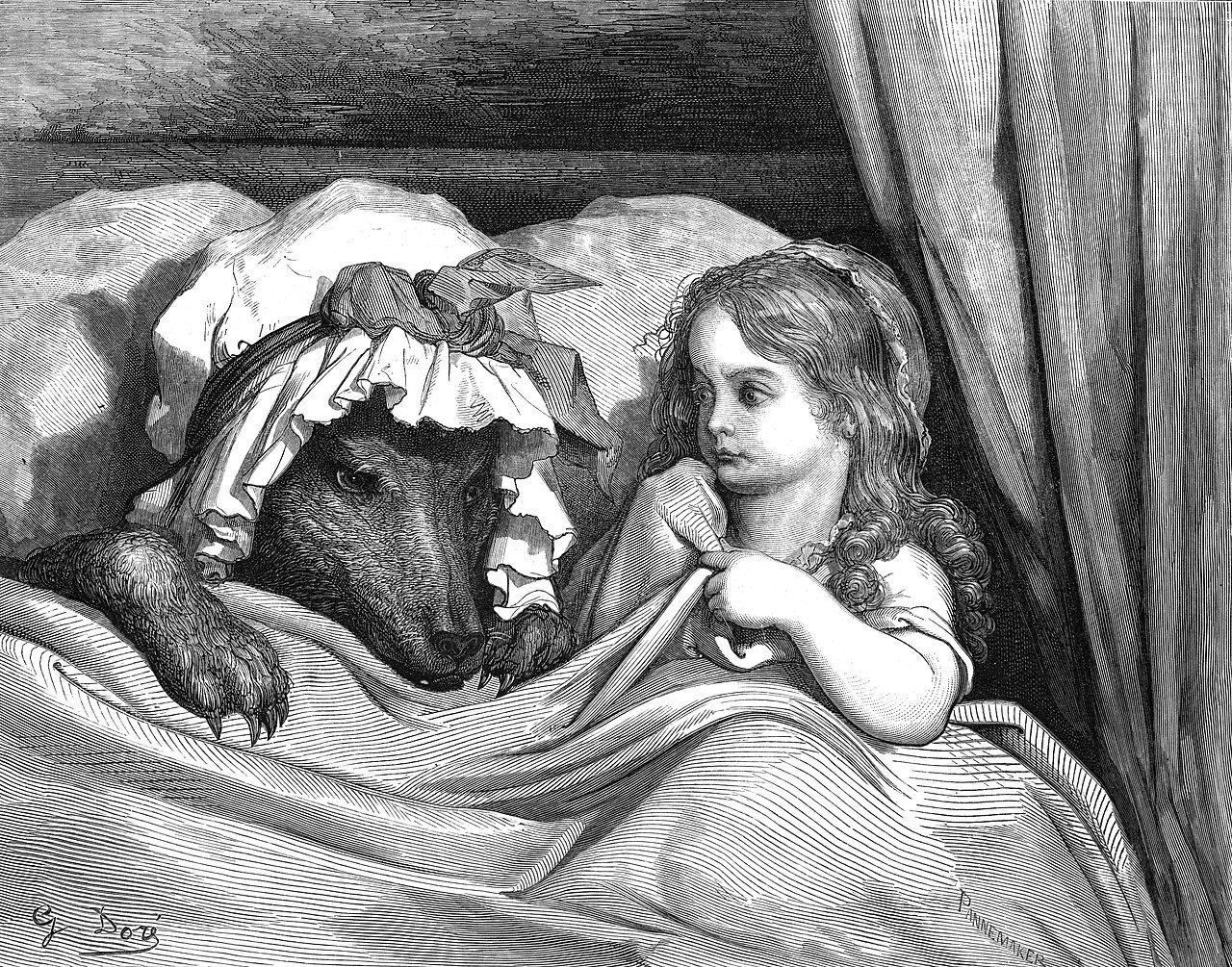
The story revolves around a girl named Little Red Riding Hood, named after the red hooded cape that she wears. The girl walks through the woods to deliver food to her sickly grandmother (wine and cake, depending on the translation). A stalking wolf wants to eat the girl and the food in the basket. After he asks where she is going, he suggests that she pick some flowers as a present for her grandmother. While she goes in search of flowers, he goes to the grandmother's house and gains entry by pretending to be Riding Hood. He swallows the grandmother whole, climbs into her bed, and waits for the girl, disguised as the grandmother. 1
When Riding Hood arrives, she notices the strange appearance of her "grandmother". After some back and forth, Riding Hood comments on the wolf's teeth, at which point the wolf leaps out of bed and eats her as well. In Charles Perrault's version of the story, the first to be published, the wolf falls asleep afterwards, whereupon the story ends. In later versions, the story continues: A woodcutter (German: Jäger, lit. 'hunter') in the Brothers Grimm and traditional German versions comes to the rescue with an axe, and cuts open the sleeping wolf. Little Red Riding Hood and her grandmother emerge shaken, but unharmed. They then fill the wolf's body with heavy stones. The wolf awakens and attempts to flee, but the stones cause him to collapse and die. 1
Relationship to other tales
The story displays similarities to stories from classical Greece and Rome. It resembles a legend recounted by Pausanias in which, each year, a virgin girl was offered to a malevolent spirit dressed in the skin of a wolf, who raped the girl. Then, one year, the Olympic boxer Euthymus of Locri came along, slew the spirit, and married the girl who had been offered as a sacrifice. There are various stories in Greek literature involving a woman named Pyrrha (literally "fire") and a man with a name meaning "wolf". The Roman poet Horace alludes to a tale in which a male child is rescued alive from the belly of Lamia, an ogress in classical mythology. The dialogue between the wolf and Little Red Riding Hood has analogies to the Norse Þrymskviða from the Elder Edda; the giant Þrymr had stolen Mjölnir, Thor's hammer, and demanded Freyja as his bride for its return. Instead, the gods dressed Thor as a bride and sent him. When the giants note Thor's unladylike eyes, eating, and drinking, Loki explains them as Freyja's not having slept, eaten, or drunk, out of longing for the wedding. A parallel to another Norse myth, the chase and eventual murder of the sun goddess by the wolf Sköll, has also been drawn. A similar story also belongs to the North African tradition, namely in Kabylia, where a number of versions are attested. 1
Earliest versions
The origins of the Little Red Riding Hood story can be traced to several likely pre-17th-century versions from various European countries. Some of these are significantly different from the currently known, Grimms-inspired version. It was told by French-speaking peasants in the 10th century and recorded by the cathedral schoolmaster Egbert of Liège. A 15th-century collection of folklore described an anecdote about a woman whose husband was a werewolf. However, it bears little resemblance to Perrault's text. In Italy, Little Red Riding Hood was told by peasants in the 14th century, where many versions exist, including La finta nonna (The False Grandmother), written among others by Italo Calvino in the Italian Folktales collection. It has also been called "The Story of Grandmother". It is also possible that this early tale has roots in very similar East Asian tales (e.g. "Grandaunt Tiger"). These early variations of the tale do differ from the currently known version in several ways. The antagonist is not always a wolf, but sometimes a 'bzou' (werewolf), making these tales relevant to the werewolf trials (similar to witch trials) of the time (e.g. the trial of Peter Stumpp). The wolf usually leaves the grandmother's blood and flesh for the girl to eat, who then unwittingly cannibalizes her grandmother. Furthermore, the wolf was also known to ask her to take off her clothing and throw it into the fire. In some versions, the wolf eats the girl after she gets into bed with him, and the story ends there. In others, she sees through his disguise and tries to escape, complaining to her "grandmother" that she needs to defecate and would not wish to do so in the bed. The wolf reluctantly lets her go, tied to a piece of string so she does not get away. 1
Charles Perrault version
The earliest known printed version was known as Le Petit Chaperon Rouge and may have had its origins in 17th-century French folklore. It was included in the collection Tales and Stories of the Past with Morals. Tales of Mother Goose (Histoires et contes du temps passé, avec des moralités. Contes de ma mère l'Oye), in 1697, by Charles Perrault. As the title implies, this version is both more sinister and more overtly moralized than the later ones. The redness of the hood, which has been given symbolic significance in many interpretations of the tale, was a detail introduced by Perrault. The story had as its subject an "attractive, well-bred young lady", a village girl of the country being deceived into giving a wolf she encountered the information he needed to find her grandmother's house successfully and eat the old woman while at the same time avoiding being noticed by woodcutters working in the nearby forest. Then he proceeded to lay a trap for Red Riding Hood. Little Red Riding Hood ends up being asked to climb into the bed before being eaten by the wolf, where the story ends. The wolf emerges as the victor of the encounter, and there is no happy ending. Charles Perrault explained the 'moral' at the end of the tale so that no doubt is left to his intended meaning: 1
From this story one learns that children, especially young lasses, pretty, courteous and well-bred, do very wrong to listen to strangers, And it is not an unheard thing if the Wolf is thereby provided with his dinner. 1
The Brothers Grimm version
In the 19th century two separate German versions were retold to Jacob Grimm and his younger brother Wilhelm Grimm, known as the Brothers Grimm, the first by Jeanette Hassenp… 1
The text above is adapted from the Wikipedia article “Little Red Riding Hood”, available under the Creative Commons Attribution-ShareAlike 4.0 licence. 1
Little Red Riding Hood is European fairy tale (ATU 333), according to the structured record cited below. This entry was generated automatically from that record and has not yet been reviewed by a person familiar with the tradition. 2
The source record links this tradition to 20 external registers, which can be verified through the citation. 2