The tradition & historical record
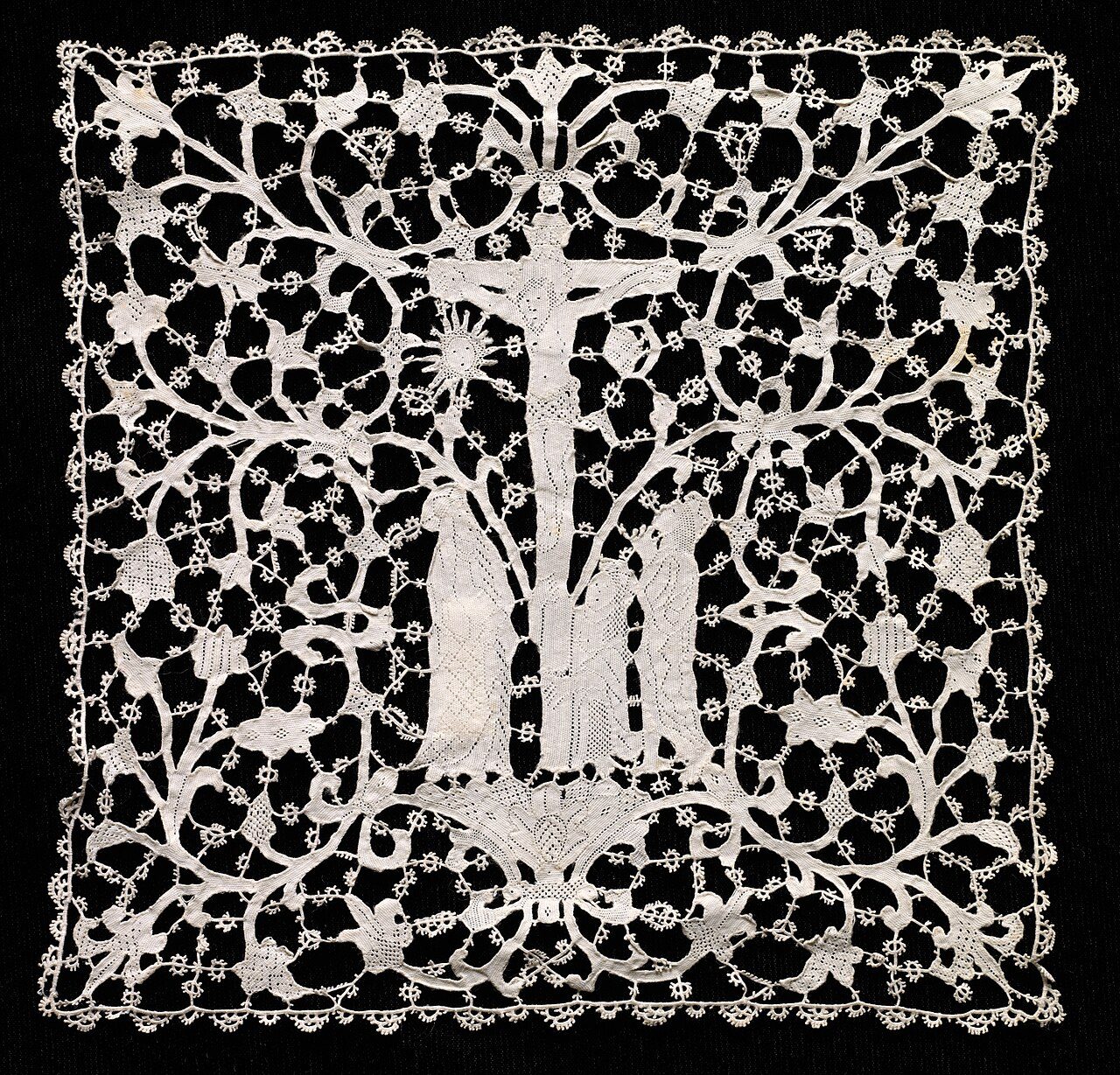
5 min read · 2 sourcesLiturgical lace refers to the use of lace as a form of liturgical ornamentation at the crossroads of religious art and decorative arts. 1
The Egyptian origin of liturgical lace
Though it is often believed that "no documentary evidence exists that lace was made before the 15th century", it has also been shown from ancient Egyptian nets that embroidered patterns from Antiquity could be found. The first trace of the use of lace in a liturgical context was found in the Egyptian sarcophagus. Bead-net dresses, mentioned in Egyptian literature since the Three Tales of Wonder (known also as the Tales from the Westcar Papyrus ) and depicted in Egyptian art as the costume sky goddess, Nut, from the third millennium BC, can be seen as the oldest form or liturgical lace. In fact, given that these dresses were too heavy to move in, and having been found solely within tombs, it seems like they primarily served a funerary and liturgical function. They were made by stringing beads together on a net which was then worn over a linen dress. This early design known as a square knotted mesh netting was, therefore, a geometric design similar to sprang. 1
The apostolic symbolism: from fishing nets to filet lace
Based on Ephesians 5 and the visions of the supper of the lamb in the book of Revelation, liturgical lace has been described as a way for the Church to symbolize itself as a virginal bride celebrating the divine marriage with the heavenly spouse. Liturgical lace has also been compared to the fishing nets of the apostles, especially as the Venetian lace is said to have originated from the Venetian sailors' art of knitting nets. 1
From Eastern monasticism to Franciscan lace
Liturgical lace may have been disseminated in the Catholic Church through the migration of monks from the East such as Nilus the Younger. Lace may have also evolved alongside realistic ornamentation from the gammalion and cross-shape lace to more figurative representations such as flowing scrolls and vine leaves, as found in manuscript ornamentation as monasticism developed both male and female convents under the lead of Benedict of Nursia and Scholastica. This pairing of male and female liturgical lace has its earliest representation with the linen alb of Francis of Assisi presumably made by Clare of Assisi. By the early 13th century, the Ancrene Wisse, an anonymous monastic rule for female anchoresses cautions nuns against devoting too much time to lace and ornamental work, to the detriment of work for the poor. 1
The Venetian renaissance of liturgical lace under the protection of Saint Francis Regis
Lace industries, which sprang up like mushrooms all over Europe during the sixteenth century, encouraged the addition of lace to embellish the Catholic liturgy. By the 1660s, Venetian needle lace became the most fashionable lace, with the patronage of the Catholic Church. Its characteristics with the exaggeration of three-dimensional qualities of needle lace; creating patterns which could be divided into parts allowed for the production of large-scale ecclesiastical items like vestments and church furnishings that were "conspicuously extravagant." 1
However, the major revolution to liturgical lace was sparked off by the invention of leaver lace which originated in Nottingham in England, early in the nineteenth century. Lace machines faced the opposition of the Luddites who had to be stopped in their vandalism by the Destruction of Stocking Frames, etc. Act 1812. Eventually, the machines made lace much more accessible and in the 1840s, lace prices fell dramatically, which meant that albs, rochets and surplices could be garnished with very high lace of 60 cm. or more. Through centuries, liturgical lace developed a style of its own across various cultures and even helped grow the industry, as in places such as Poland where bobbin laces were created for liturgical vestments and workshops bloomed across the country. 1
Liturgical lace under fire since the Church Discipline Act 1840
In England, after the Church Discipline Act 1840 (3 & 4 Vict. c. 86) which aimed to counter the rise of ritualism in the Anglican Church, Robert Liddell, then vicar of Saint Paul's Church in Knightsbridge, was taken to court by his churchwarden for the use of cloths edged with lace as well as altar crosses and credence tables. In 1854, while the courts refused him the use of an altar cross and of a credence table, lace was tolerated. By the mid-19th century in France, lace was considered something of the 18th century and was replaced by more affordable filet lace or tulle which originated in Tulle, a city in the southern central region of France which was criticized as liturgical vestments were meant to be in linen and not in cotton which was used to make the latter. 1
Meanwhile, lace flourished in Ireland. 1
Yet, the trend for more elaborate liturgical lace concerned some in the Catholic Church as well, already in 1880, Pio Martinucci as secretary of the Sacred Congregation for the Discipline of the Sacraments or Ceremonials, noted that the surplice has become merely an ornament whose excess elegance little becomes its sacred usage. 1
Superpelliceum, cuius forma nunc multiplex atque ad merum ornamentum redactum est, cavendum ne tum forma tum etiam nimia elegantia indecens sit. In 1912, the Benedictine monk Lambert Beaudoin recommended the use of lace and advised that the best liturgical lace was the one that was sown directly on the liturgical vestment. From the 1930s onwards, the Liturgical movement was particularly critical of the use of liturgical lace. 1
The text above is adapted from the Wikipedia article “Liturgical lace”, available under the Creative Commons Attribution-ShareAlike 4.0 licence. 1
Liturgical lace is textile ornamentation used in the Christian tradition, according to the structured record cited below. This entry was generated automatically from that record and has not yet been reviewed by a person familiar with the tradition. 2
The source record links this tradition to 1 external register, which can be verified through the citation. 2