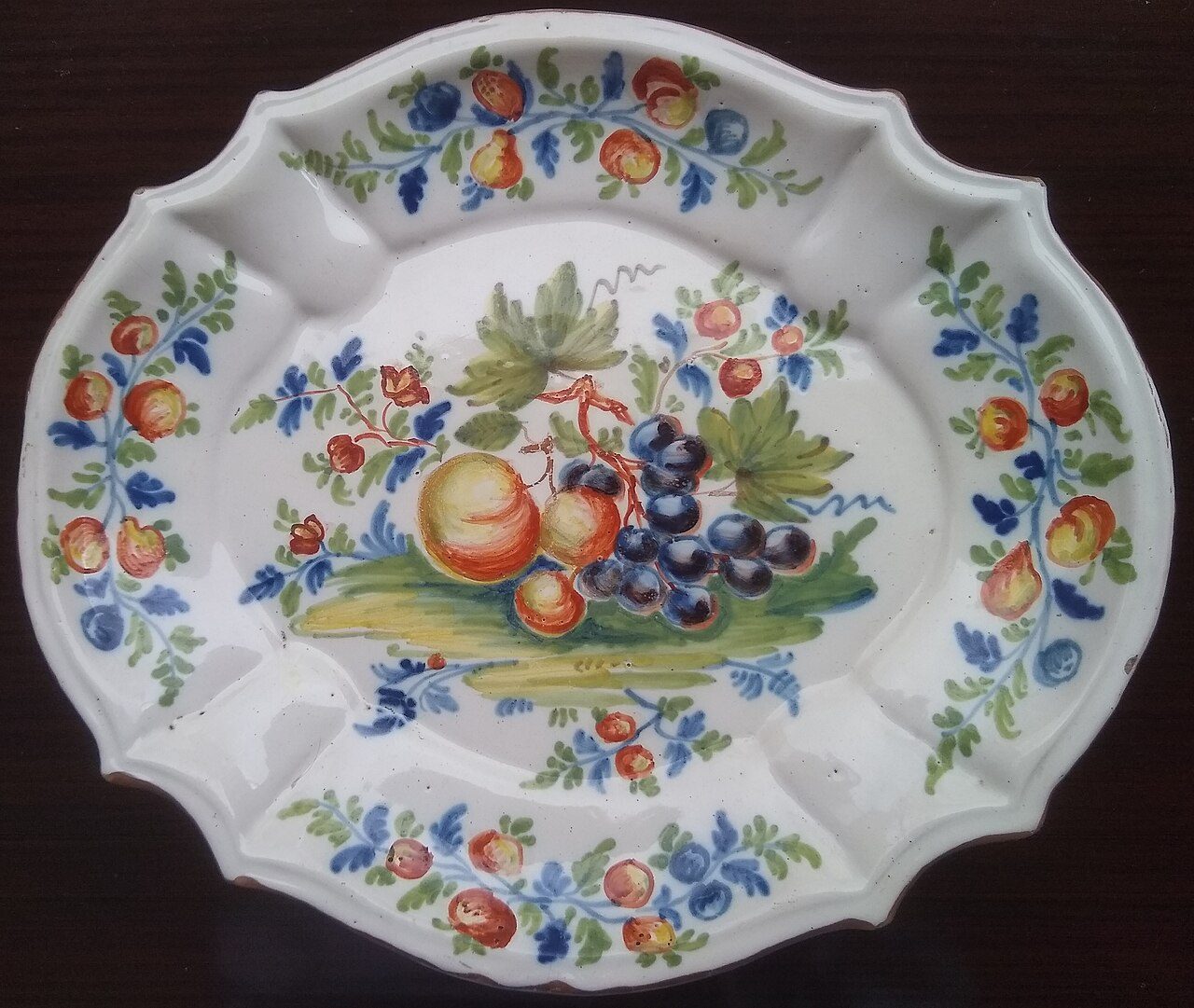
The tradition & historical record
6 min read · 2 sourcesLodi ceramics are ceramics produced in Lodi, a city in the Lombardy region of Northern Italy. Their artistic quality reached its peak in the 18th century. 1
From the origins to the 17th century
The production of ceramic in the Lodi region has ancient origins. Findings include fragments from pre-historic period and amphoras, little votive statues and lamps decorated in relief from the Roman period. A large production of terracotta for architectural decorations was developed in the 14th century, such as in the facades of the churches of Lodi, and in particular in the ornaments of the cloister of the Ospedale Maggiore, in the decorations of Palazzo Mozzanica, and in Piazza Broletto and Piazza Mercato. The first written documents testifying to the presence of furnaces in the Lodi area date back to the 16th century and then to the 17th century. The production of ceramics had little economic importance. This was due to the little dimension of the local market, which mostly required ceramics for ordinary use; moreover the production of ceramics was hindered by the many taxes, both on the import of the raw material, the earth from Stradella, and on the export of the products. Finally, furnaces could not be built in the city, because of fire risk and the nuisance of fumes. The presence of ceramics manufacture in the 16th century and of at least 3 furnaces in Lodi in the 17th century is well documented. These furnaces must have been capable of producing high quality ceramics, given the importance of some orders, such as that for the House of Gonzaga in 1526 and that by Cardinal Federico Borromeo in 1623. Furthermore, the ceramics of Lodi must have had a good reputation considering that Lodi ceramics workers are documented to be present in Savona in 1545, in Brescia and Como areas and in Veneto in the 17th century and given customs documents that certify the export of Lodi ceramics throughout the Duchy of Milan, up to Borgomanero. 1
18th and 19th century
Following the war of the Spanish Succession, at the beginning of the 18th century the territory of Lodi was annexed, with the Duchy of Milan, to the realm of the House of Habsburg of Austria. Economic reforms were introduced that boosted economy and trade. In the field of ceramics however many duties on raw materials and exports remained. In spite of these duties, a few factories were established in Lodi, including that of Coppellotti, already active in the 17th century, Rossetti and Ferretti, which produced ceramics of the highest quality in Lodi. Artists and decorators were able to move more freely than before and this enabled the production of ceramics in Lodi to acquire techniques and decorations from Northern Europe and France, such as the Bérain decoration and a third, lower temperature firing. Ceramics workers and artists, as well as products, were found in northern and central Italy, in particular in Bassano, the Modena area and Sassuolo, Piedmont and Pesaro. In 1796, the battle of Lodi between Napoleon Bonaparte and the Austrian troops marked the decline of ceramic production in Lodi, due both to the material damage suffered by the Ferretti factory located near the battleground by the Adda river, and to the economic decline during the period of the Napoleonic Wars and the following restoration. In 1823 the Ferretti furnace was taken over by Dossena, who managed it as a modern business. Ceramics were no longer handcrafted on commission, but produced to be sold on the market. After a period of success witnessed by exports to Ireland and Scotland and by the purchase of some ceramics by the House of Savoy, the furnace closed at the end of the 19th century. 1
Materials and techniques
The main material for the production of ceramics was the earth of Stradella, a clay rich in limestone, which, thanks to its malleability, made the ceramics very thin and light. The main component for the glaze was sand from San Colombano al Lambro, rich in silicon, but tin was also added to the glaze. Tin-glazing made the ceramics uniform. Having a tin based glaze, Lodi ceramics are to be considered maiolica. The firing technique was based on gran fuoco (double firing) or on piccolo fuoco (third firing). 1
Gran fuoco
The gran fuoco technique, also known as underglaze decoration, was the only one in use until the mid 18th century, but was still used even after the introduction of the piccolo fuoco (third fire) technique around 1750. Two firings were carried out at about 950 °C. With the first firing, the product was hardened and could then be glazed and painted, with the glaze not fixed yet by the second firing. The colours spread into the un-fired glaze. Since colours were painted over un-fired glaze, which was porous and absorbent, any errors could not be amended. Only those colours that could withstand the high temperature of the second firing could be used: manganese for violet, antimony for yellow, iron for a reddish colour, cobalt for blue, copper for green. Cobalt blue tended to spread to the glaze, creating blue hues, and this also happened when it was mixed with yellow to create green. Proper red colour was rare, given the high chances of burning during firing at high temperature. Strong shades of orange or manganese brown were often used instead 1
Piccolo fuoco
In the second half of the 18th century the technique of third fire – piccolo fuoco, also known as overglaze decoration, was introduced, which made it possible to obtain a greater range of more vibrant colours. After two firings at about 950 °C, identical to those of the technique of gran fuoco, the glaze, already vitrified, was painted with colours that would have degraded at higher temperature and a third firing was carried out at about 600-650 °C. The fact that colours were painted on a surface already vitrified meant that errors could be corrected. One of the new pigments that could be used thanks to the third firing was Purple of Cassius, a red obtained from gold chloride, which made it possible to introduce various shades of red, from pink to purple. The first European factory where the piccolo fuoco technique was developed was that of Paul Hannong in Strasbourg. Antonio Ferretti was one of the first artisans to introduce this technique in Italy 1
The text above is adapted from the Wikipedia article “Lodi ceramics”, available under the Creative Commons Attribution-ShareAlike 4.0 licence. 1
Lodi Ceramic is Italian ceramic, according to the structured record cited below. This entry was generated automatically from that record and has not yet been reviewed by a person familiar with the tradition. 2
The source record links this tradition to 1 external register, which can be verified through the citation. 2