The tradition & historical record
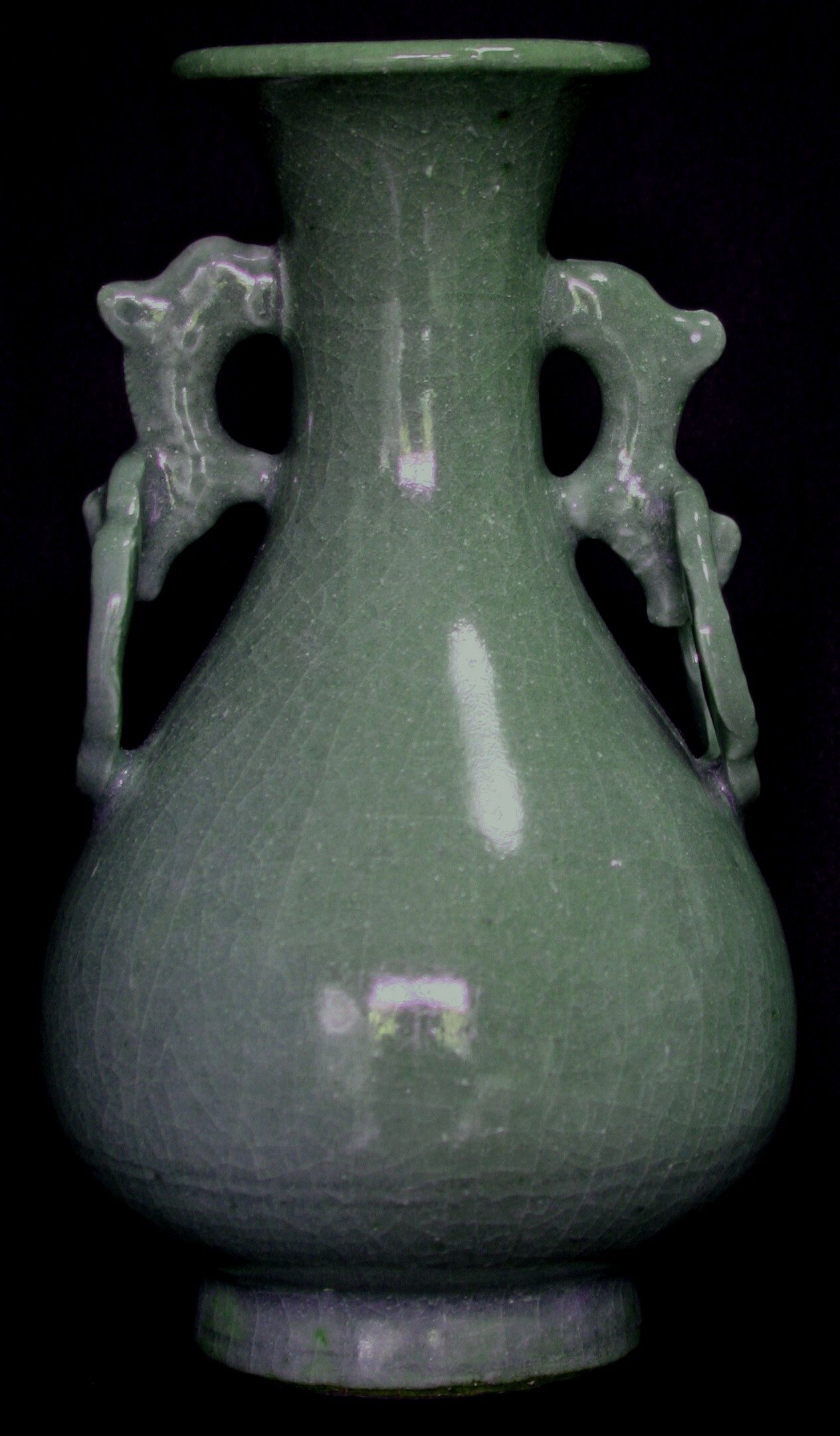
6 min read · 2 sourcesLongquan celadon (Chinese: 龙泉青瓷) is a type of green-glazed Chinese ceramic, known in the West as celadon or greenware, produced from about 950 to 1550. The kilns were mostly in Lishui prefecture in southwestern Zhejiang Province in the south of China, and the north of Fujian Province. Overall a total of some 500 kilns have been discovered, making the Longquan celadon production area one of the largest historical ceramic producing areas in China. "Longquan-type" is increasingly preferred as a term, in recognition of this diversity, or simply "southern celadon", as there was also a large number of kilns in north China producing Yaozhou ware or other Northern Celadon wares. These are similar in many respects, but with significant differences to Longquan-type celadon, and their production rose and declined somewhat earlier. Celadon production had a long history at Longquan and related sites, but it was not until the Northern Song (960–1127) period that large-scale production began, and the move of the capital to Hangzhou, close to Longquan, after the start of the Southern Song (1127–1279), was probably important in the great expansion of both quality and production there. Both continued at high levels in the Yuan (1271–1368) and the early part of the Ming (1368–1644) periods. Longquan celadons were an important part of China's export economy for over five hundred years, and were widely imitated in other countries, especially Korea and Japan. 1
Technical aspects and decoration
The body of Longquan celadon, as seen in fragments under glaze, varies from "a heavy, compact grey stoneware to an almost white porcellaneous material", but where fired at the surface this turns to a typical terracotta reddish brown, seen at the unglazed foot of many pieces, and when relief decoration is left unglazed (see below and illustration). This distinguishes Longquan from Northern Celadons. However, this may not be the case in pieces made from the most whitish, porcellanous, material, where the fired body may also "be translucent if thin enough". In Western sources, individual pieces are normally classified as stoneware, but some may be called porcelain; material translated from the Chinese is likely to describe all as "porcelain". The body was normally thrown on the potter's wheel, with large vases often thrown in sections and luted together. Templates were used, and sometimes moulds, including two-part moulds, and moulds including decoration. Unglazed biscuit relief sections were achieved either by sprigging the reliefs over a glazed area before firing, where the surface would be flat in the kiln, or by adding a resist of wax or grease before glazing, when the sides of a vase were decorated. The glaze colours vary across a wide spectrum of greyish to blueish greens, with some yellowish browns as well. The colour comes from iron oxide fired in a reducing atmosphere, and the colour varies with the temperature and the strength and timing of the reduction. Longquan celadon was fired in long dragon kilns, brick tunnels rising up a slope, with a series of chambers, and the best results came from the pots in the uppermost stages, which heated up more slowly and evenly. 1
Markets and later collecting
Unlike Northern Celadon, Longquan ware does not seem to have been used by the imperial court under the Song, although Longquan kilns were used to make the "official" Guan ware, apparently when the Guan kilns could not cope with orders. An important market seems to have been the literati or scholar-gentleman class. As well as wares for ordinary use, they were used on altars and sometimes in burials. Many shapes, especially in the early period, were based on ancient ritual bronze shapes, which were considered appropriate to religious functions, though these lacked the complex surface decoration of the bronze originals. These were also exported in great numbers and, at least in South-East Asian countries such as Japan and Korea, these associations could also be appreciated by local literati, and indeed clergy, as many of the best survivals are in temples. Japan was a large-scale and enthusiastic importer, and the beach at Kamakura, the capital during the height of Longquan production, had some 50,000 Longquan sherds, thought to have been broken pieces dumped at the end of the voyage from China. Japan soon began to imitate Longquan wares, and has continued to do so, both in mass-produced and studio pottery versions. There were also large quantities exported west to the Islamic world, and one of the most important collections today is the 1,300 pieces surviving from the collection of the Ottoman Emperors, most now in the Topkapi Palace in Istanbul. Their worth was increased by a belief in the Middle East and Europe that the pieces would break or change colour if poison was placed on them. 1
History
In the Northern Song period the Dayao (大窯) kiln site near Longquan city alone produced wares at twenty-three separate kilns; with Jincun nearby, these appear to have been the largest kiln complexes, and produced the best wares. The era of greatest ceramic production was not until the Southern Song (1127–1279), then continuing in the Yuan (1271–1368) and Ming (1368–1644) periods. A key event in the rise of Longquan celadon was the flight of the remaining Northern Song court to the south, after they lost control of the north in the disastrous Jin-Song wars of the 1120s. A new Southern Song court was based in Hangzhou, close to Longquan. The Northern Celadon kilns declined as Longquan greatly expanded production. Longquan wares were not from one of the Five Great Kilns later grouped by Chinese connoisseurs, and are rarely mentioned in early writing on the subject, although in the Qing dynasty careful imitations were made. A story repeated in many sources from the Yuan onwards, with uncertain significance, tells of two brothers called Zhang, both Longquan potters, perhaps in the Southern Song, though this is unclear. The elder brother developed a very special type of ware; rightly or wrongly the later sources say this was distinguished by crackled glaze, and Ge ware (meaning "elder brother ware") is supposed to be this type. The younger brother also developed a fine style of pottery, which is often taken to be the best quality early Longquan ware. The Southern Song period saw the finest quality, and a great range of colours, as well as a great expansion of production. A count in 1988 by a Chinese archaeologist of the starts of new kilns gave 39 from the Northern Song, 61 from the Southern Song, and over 70 from the Yuan. 1
The text above is adapted from the Wikipedia article “Longquan celadon”, available under the Creative Commons Attribution-ShareAlike 4.0 licence. 1
Longquan celadon is Historical Chinese ceramic type, according to the structured record cited below. This entry was generated automatically from that record and has not yet been reviewed by a person familiar with the tradition. 2
The source record links this tradition to 6 external registers, which can be verified through the citation. 2