The tradition & historical record
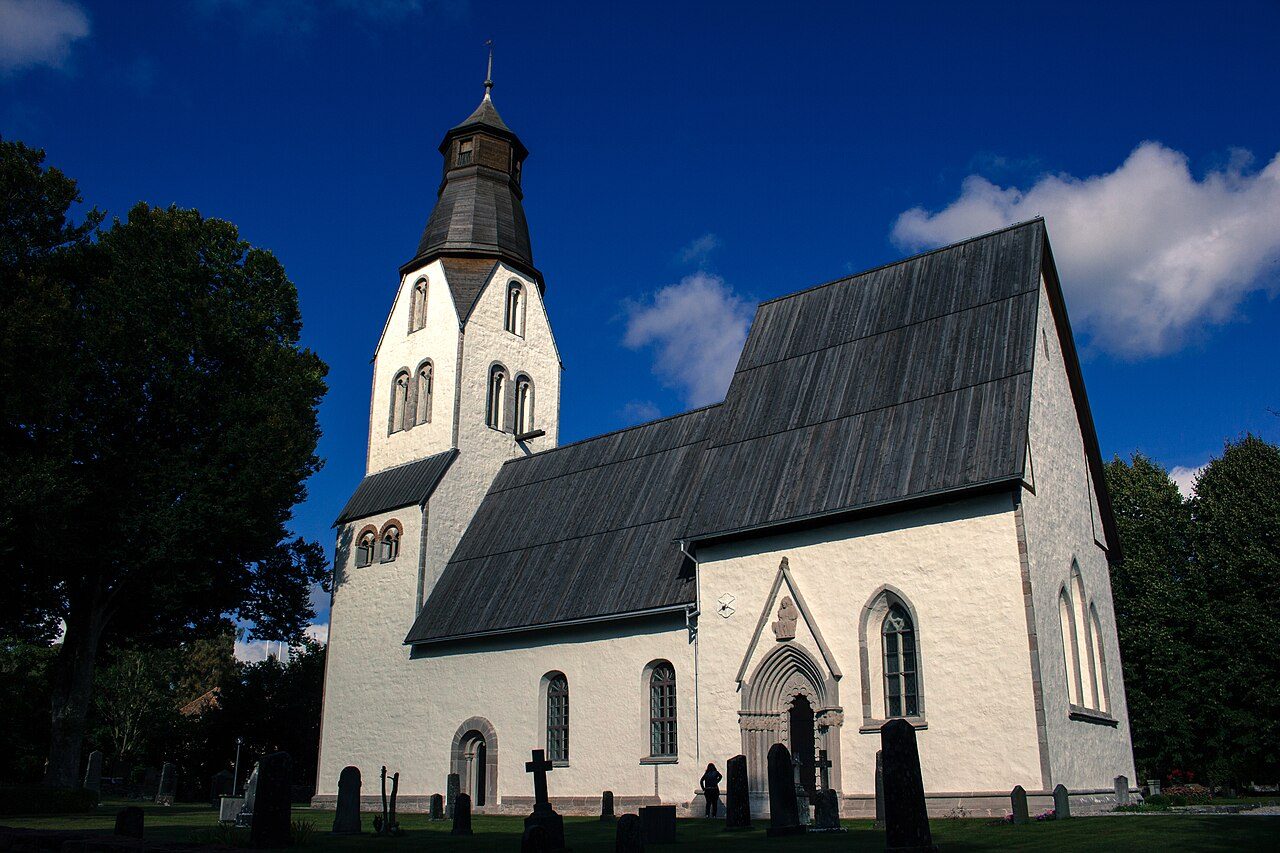
6 min read · 2 sourcesLye Church (Swedish: Lye kyrka) is a medieval church on Gotland, Sweden. The oldest parts of the church date from the last quarter of the 12th century, and the last major addition was the disproportionately large chancel, built during the second quarter of the 14th century by a workshop known by its notname as Egypticus. The workshop was also responsible for constructing the largest of the church portals, which is also decorated with Gothic stone sculpture. The tower portal contains sculptures attributed to the Romanesque sculptor Sigraf. The church has been little altered since the end of the Middle Ages. Lye Church contains the largest preserved set of medieval stained glass windows in the Nordic countries, and its interior is also decorated with medieval wall paintings, uncovered in the 1950s. The altarpiece is from 1496, and the church also contains a triumphal cross from the same period. 1
Location and surroundings
Lye Church is located c. 300 metres (330 yd) south of the main road between Hemse and Ljugarn, on south-eastern Gotland. The church lies surrounded by its old cemetery. A low (80 to 130 centimetres (2.6 to 4.3 ft)) stone wall, built sometime between 1765 and 1793 to replace an earlier wooden fence, limits the cemetery to the south, east and west. The northern part of the wall is partially demolished and opens up to a newer section of the cemetery, established north of the old one in 1944. The cemetery has four entrances. The formerly northern limit of the old cemetery is marked by a row of European ash and the younger part is bordered on all sides by small-leaved limes. A small storage building, constructed sometime before 1846, lies in the northwestern part of the old part of the cemetery. 1
History
Lye Church was built and to a large extent acquired its current appearance during the Middle Ages. No major alterations have been made since the 14th century. 1
Construction
The oldest part of the church, probably constructed during the last quarter of the 12th century, is the nave, built in a Romanesque style. The tower was erected during the first half of the 13th century. When the tower was built, the western wall of the nave was demolished so that the tower could be incorporated with the church building. The difference between the bases of the tower and the northern nave wall still indicate where the break was made. The Gothic chancel and sacristy are from the second quarter of the 14th century and replaced an earlier chancel, constructed at the same time as the nave. They were built by a workshop operating on Gotland which has been assigned the notname Egypticus. The portal of the former chancel was removed and reinstated in its present position as north entrance to the nave. The intention was probably to also rebuild the nave, but this was never done. The walls connecting the chancel and nave are still the provisional, thin walls without a marked base which were put in place in anticipation of further changes. 1
Later changes
The decorated wooden ceiling dates from the 18th century. The three windows of the nave probably all date from the 1850s and replaced earlier, much smaller windows. A major renovation of the interior of the church was carried out in 1891. The floors of the chancel and nave were renewed, and the pews replaced with new ones. The altar rail was replaced, as was the organ facade. Central heating was installed in 1932. In 1939, the presently visible roof of the tower was installed, modeled after an earlier roof possibly designed by architect Olof Tempelman and dating from 1779. Tempelman's designs were probably executed by builder Hans Hesselby, who also constructed the roof of the tower at Ala Church in 1780. The earlier roof may have resembled those at Garde or Burs churches. Another large-scale renovation was done in 1954–55 under the guidance of architects Erik Fant and Olle Karth. The main structural change was that the walls of the nave were heightened c. 1 metre (3.3 ft) with the dual purpose of exposing the top part of the arch connecting the chancel with the nave, and installing a modern, fire-proof ceiling above the wooden ceiling. The walls of the nave and chancel were at the same time cleaned, and the medieval paintings found under layers of whitewash restored. Wall paintings from the 18th century were removed, and some of the furnishings renovated. The exterior was renovated and the presently visible roofs were put in place in 1968. 1
Exterior
The walls of Lye Church are constructed of mainly grey, tufted limestone, whitewashed on the outside. A few details are made of brick and of limestone of a different colour. The portals, bases and skirtings around some of the windows are of dressed limestone, as are the corners of the chancel and tower. In broad outlines, the nave and tower are Romanesque in style while the chancel is Gothic. The disproportionate aspect of the church is derived from the fact that the rebuilding of the church during the Middle Ages was never finished, hence the later and larger chancel dominates the east end of the church. The shape, not uncommon among churches on Gotland, has been compared to that of a pack saddle. The tower is the most well-preserved Romanesque part of the church. On the north and south side of the first storey there are galleries accessible from inside the tower, each with two openings in the form of round arches separated by a small column. The outer archivolts of these openings are made of alternating limestone and brick, an unusual construction material on Gotland during the Middle Ages. The upper level contains the church bell, which dates from 1650 and was made in Stockholm. There are three openings for the bell on each side of the square tower. All of them with have round arches and each opening is divided in two by a central, wooden column. 1
The text above is adapted from the Wikipedia article “Lye Church”, available under the Creative Commons Attribution-ShareAlike 4.0 licence. 1
Lye Church is building on Gotland, Sweden, according to the structured record cited below. This entry was generated automatically from that record and has not yet been reviewed by a person familiar with the tradition. 2
The source record links this tradition to 9 external registers, which can be verified through the citation. 2