The tradition & historical record
6 min read · 2 sourcesMāori traditional textiles are the indigenous textiles of the Māori people of New Zealand. The organisation Te Roopu Raranga Whatu o Aotearoa, the national Māori weavers' collective, aims to preserve and foster the skills of making and using these materials. Textiles made from locally sourced materials were developed by Māori in New Zealand after migration from tropical Polynesia as plants brought with them, especially the pandanus, did not grow well in New Zealand's temperate climate. In traditional Māori weaving of garments the main fibre is called muka and is made from harakeke. The Māori language terms for different types of weaving are commonly named as raranga, whatu and whiri. Raranga is a plaiting technique used for making baskets and mats; whatu is a pre-European finger weft twining weaving method used to make cloaks; and whiri is braiding to make cord. Most people weaving traditional Māori textiles were and are women. Traditionally, to become expert a young woman was initiated into Te Whare Pora (The House of Weaving). This has been described as a literal building but also as a state of being. There are certain practices for people in Te Whare Pora, and their work output includes nurturing and gathering plants for use in weaving, preparing fibre and dyeing, and creating garments including fine cloaks, mats, kete (baskets and bags) and tukutuku panels (used in architecture). 1
Weaving process
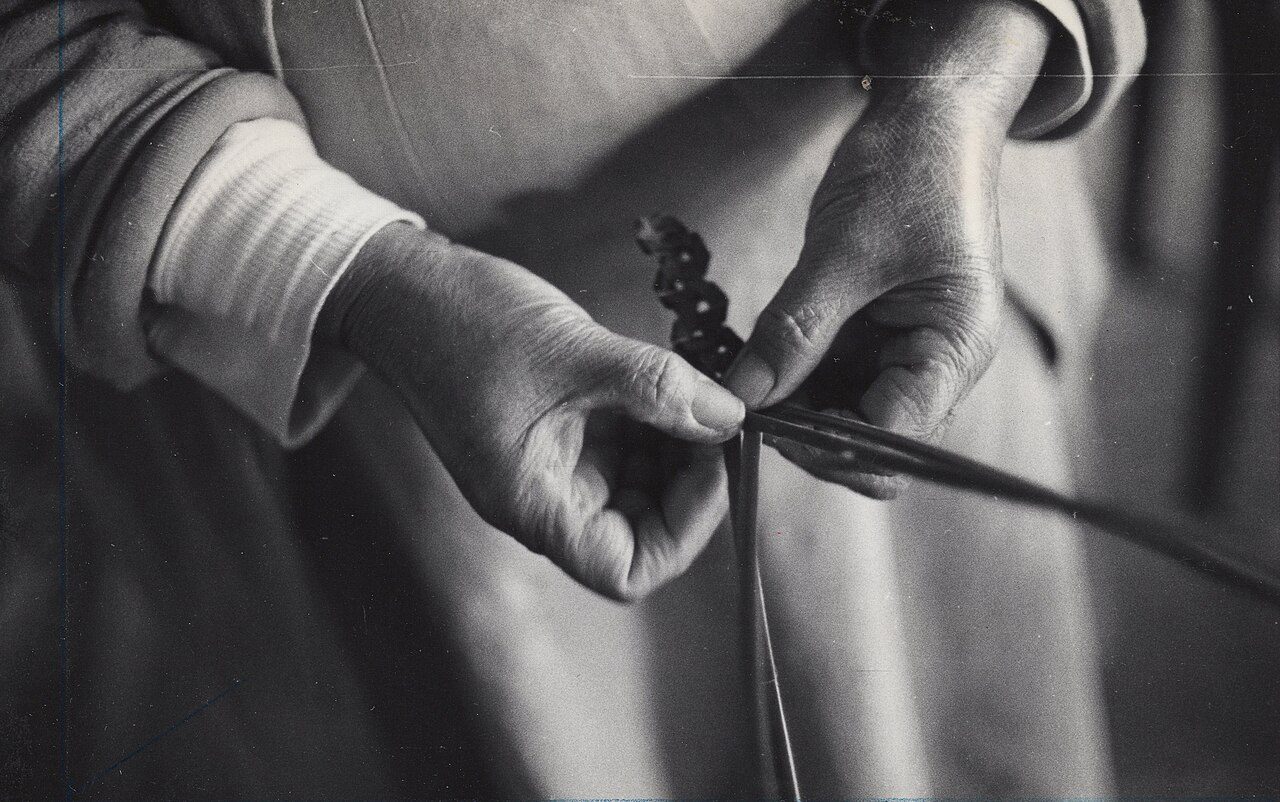
The weaving process (whatu) for clothing was performed not with a loom and shuttle but with the threads being manipulated and tied with fingers. A strong thread is fastened tautly in a horizontal position between two or four upright weaving sticks (turuturu). To this thread (tawhiu) are attached the upper ends of the warp or vertical threads (io). The warp is arranged close together. The weaving process consisted of working in cross-threads from left to right. The closer these threads are together, the tighter the weave, and the finer the garment. In the case of fine garments four threads are employed in the forming of each aho. The weaver passes two of these threads on either side of the first io or vertical thread, enclosing it. In the continuing the process the two pairs of threads are reversed, those passing behind the first vertical thread would be brought in front of the next one, then behind the next and so on. Each of the down threads would be enclosed between two or four cross-threads every half inch or so. 1
Tāniko
Tāniko (or taaniko) refers to any ornamental border typically found on mats and clothes. Tāniko patterns are very geometric in form because they can be reduced down to small coloured squares repeated on a lattice framework. These base square forms, articulated in the hands of a weaver, constitute the larger diamond and triangle shapes that are visible in all traditional weaving crafts. 1
Pātiki or pātikitiki designs are based on the lozenge or diamond shape of the flounder. They can be quite varied within the basic shape. The kaokao (side or rib) pattern is formed by zigzag lines that create chevrons. These can be horizontal or vertical, open with spaces or closed repetitive lines. The design is sometimes interpreted as the arms of warriors caught in haka (fierce rhythmic dance) action. The niho taniwha (taniwha tooth) pattern is a notched-tooth design found on all types of objects, mats, woven panels, belts, and clothing. The poutama is a stepped design signifying the growth of man, striving ever upwards. Tahekeheke (striped) designs refer to any distinct vertical patterning. The whetū (stars), purapura whetū (weaving pattern of stars) or roimata (teardrop) pattern is a geometric design using two colours and alternating between them at every stitch. This design is associated with the survival of an iwi (tribe), hapū (sub-tribe), or whānau (extended family), the idea being that it is vital to have a large whanau, just as there are many stars in the Milky Way. 1
Fibres and dyes
Māori made textiles and woven items from a number of plants, including harakeke (New Zealand flax), wharariki, tī kōuka, tōī, pīngao, kiekie, nīkau and toetoe. Traditional Polynesian methods to create tapa barkcloth were introduced by Māori, who knew it as aute. Oral histories describe the paper mulberry tree as being introduced to New Zealand by the Ōtūrereao, Tainui and Aotea waka. The tree was mostly grown around North Auckland and the Waikato, and did not thrive in southern areas, or grow as well as plants in the Pacific had done. The tree was commonly seen during the voyages of James Cook in the 1770s, primarily used to create a soft, white cloth used for fillets or in ear piercings by high status men, however were rarely seen. Barkcloth textiles disappeared from use in the early 19th Century, coinciding with the tree's disappearance from New Zealand. Oral histories tell of early experiments to create felted material similar to aute from houhere (Hoheria populnea), however attempts were unsuccessful. The bark of other plants such as houhi (Hoheria angustifolia) manatu (Plagianthus regius), autetaranga (Pimelea villosa) and houi (Hoheria glabrata or Hoheria lyallii) have been used in traditional textiles such as fishing nets. The prepared fibre (muka) of the New Zealand flax (Phormium tenax) became the basis of most clothing. The flax leaves were split and woven into mats, ropes and nets but clothing was often made from the fibre within the leaves. The leaves were stripped using a mussel shell, rolled by hand into two-ply Z-twist cords and twisted gently while it dries, dressed by soaking and pounding with stone pounders, (patu muka), to soften the fibre, spun by rolling the thread against the leg, and woven. 1
Garments
There were two types of garments that were worn and woven: 1
A knee-length kilt-like garment worn around the waist and secured by a belt A rectangular garment worn over the shoulders. This might be a cape-like garment or a long cloak-like garment of finer quality. Men's belts were known as tātua and women's as tū. The man's belt was usually the more ornate. Belts were usually made of flax but occasionally other materials were used such as kiekie and pīngao. Flax belts were often plaited in patterns with black and white stripes. The belts were secured with a string tie. Women often wore a belt composed of many strands of plaited fibre. 1
Pākē / Hieke
To meet the cold and wet conditions of the New Zealand winter, a rain cloak called pākē or hieke was worn. It was made from tags of raw flax or Cordyline partly scraped and set in close rows attached to the muka or plaited fibre base. In 2000 a cloak-weaving event called Ngā Here o te Ao at Te Papa Tongarewa, the national museum of New Zealand, Dawn Schuster-Smith created a pākē which Te Papa now hold in their collection. 1
The text above is adapted from the Wikipedia article “Māori traditional textiles”, available under the Creative Commons Attribution-ShareAlike 4.0 licence. 1
Maori traditional textiles is indigenous textiles of the Māori people of New Zealand., according to the structured record cited below. This entry was generated automatically from that record and has not yet been reviewed by a person familiar with the tradition. 2
The source record links this tradition to 1 external register, which can be verified through the citation. 2