The tradition & historical record
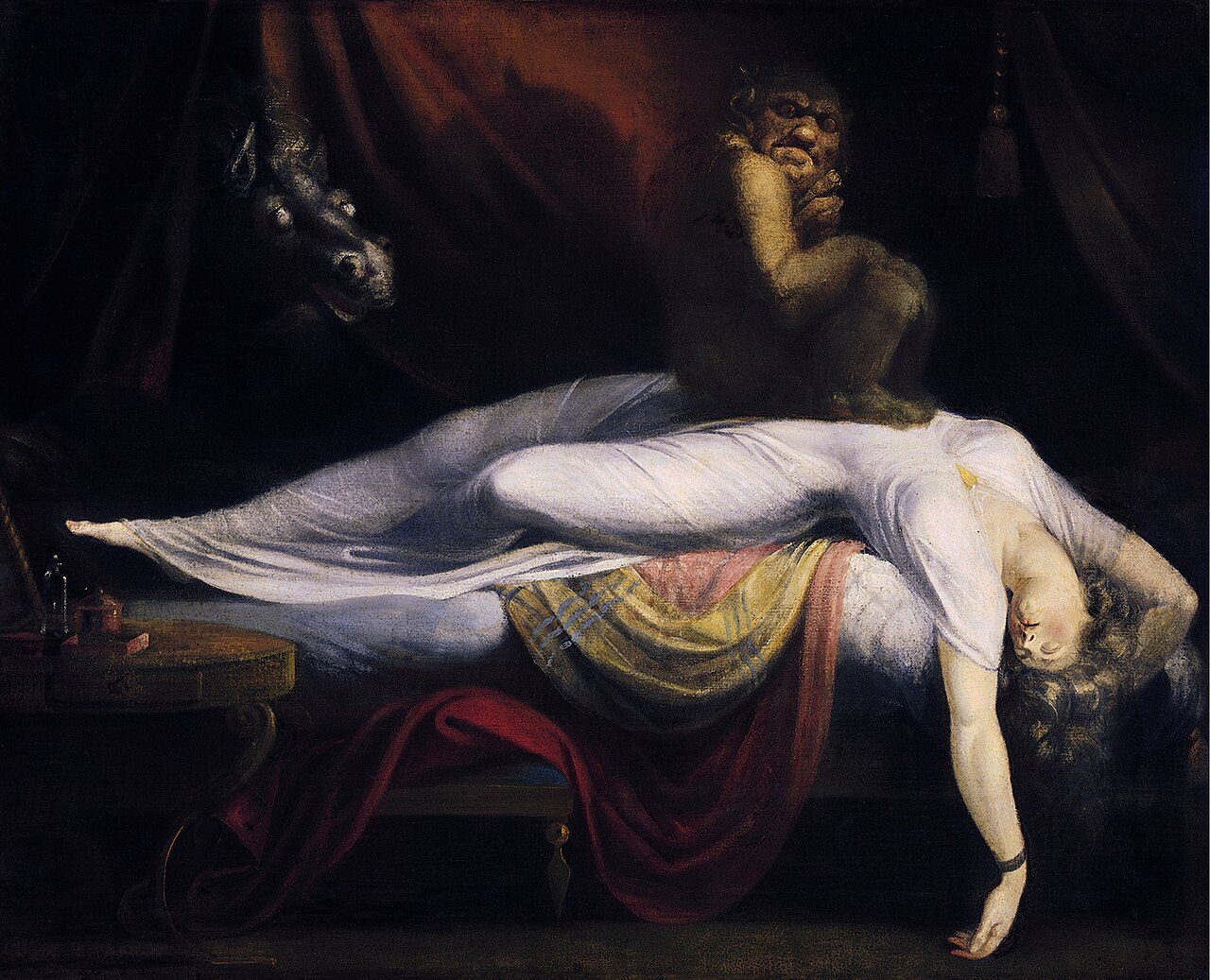
6 min read · 2 sourcesA mare (Old English: mære; Danish, Norwegian: mare; Swedish: mara; Polish: mara, zmora; among many others) is a malicious entity in Germanic and Slavic folklore that sits, walks, or "rides" on people's chests while they sleep, bringing on nightmares. When placed on the victim's chest, it is said to have a suffocating effect, and can lead to cold sweats or sleep paralysis. It is often a female being with magical abilities for haunting its victim, including the ability to shapeshift. 1
Etymology
The word mare, through Middle English mare, comes from the Old English feminine noun mære, which had numerous variants: mare, mere, mær, etc. It is etymologically unrelated to its homonym mare, meaning female horse. Cognates in other languages includes: 1
Norse: Old Norse: mara → Danish: mare, Faroese: marra, Icelandic: mara, Norwegian: mare, mara, Swedish: mara Dutch: Old Dutch: mare → merrie (Dutch: nachtmerrie) Low German: Low German: mahrt, mårt, môr High German: Old High German: mahr, mara (glossed in Latin as "incuba") → Middle High German: mar, mare → German: Mahr (Nachtmahr), Mare, Mara These in turn come from Proto-Germanic *marōn. The -mar in French cauchemar ('nightmare') is borrowed from the Germanic through Old French mare. Most scholars trace the word back to the reconstructed Proto-Indo-European root *mer-, associated with crushing, pressing and oppressing, or according to other sources 'to rub away' or 'to harm'. Compare this to Finnish and Karelian, where the creature is roughly called "pressinger" (Finnish: painajainen, Karelian: painajaini), or "ridinger" (Finnish: ajajainen). Further, in Danish and Norwegian, the word for 'nightmare' is "mare ride" (Danish: mareridt, Norwegian: mareritt); in Icelandic, the word for 'nightmare' is "mare tread", or "mare trample" (Icelandic: martröð); whereas in Swedish and Finnish, the word for 'nightmare' is "mare dream" (Swedish: mardröm, Finnish: painajaisuni). However, other etymologies have been suggested. For example, Éva Pócs saw the term as being cognate with the Greek term Moros (μόρος, from Proto-Indo-European *móros) meaning "doom". There is no definite answer among historians about the time of origin of the word. 1
Beliefs
The mare was believed to ride horses, which left them exhausted and covered in sweat by the morning. She could also entangle the hair of the sleeping man or beast, resulting in "marelocks", called marflätor ('mare-braids') or martovor ('mare-tangles') in Swedish or marefletter and marefloker in Norwegian. The belief probably originated as an explanation to the Polish plait phenomenon, a hair disease. Even trees were thought to be ridden by the mare, resulting in branches being entangled. The undersized, twisted pine-trees growing on coastal rocks and on wet grounds are known in Sweden as martallar ('mare-pines') or in German as Alptraum-Kiefer ('nightmare pine'). According to Paul Devereux, mares included witches who took on the form of animals when their spirits went out and about while they were in trance (see the Icelandic example of Geirrid, below). These included animals such as frogs, cats, horses, hares, dogs, oxen, birds and often bees and wasps. 1
German folklore
In German folklore, the mare is related or analogous to the alp, a supernatural creature of similar nature; the German word for nightmare being Albtraum (lit. 'alp dream', or Alptrück (lit. 'alp pressure'). In High German, the mare is known as Mara, Mare, or Mahr (masculine noun, i.e. "der Mahr"); in Low German as mårt, Mahrt, or de môr in Pomerania and Rügen. It rides on sleepers, making it hard to breathe, or it lies over his chest, making its victim drenched with sweat, whereby the victim is able to groan but otherwise rendered speechless and spellbound, and unable to waken unless he is called by his baptismal name. While the mårt is usually a girl with a bad foot according to one source (a certain daughter of a smith in the village of Bork near Stargard having that reputation), there are tales of the môr either male or female (see below). The môr enters a house through a hole the carpenter forgot to plug, and can be captured by plugging the hole. A male môr who had been tormenting a woman was caught by this method in one tale; he became her husband, fathering her children, but left after being told about the hole, returning just once a year. In another tale, a female môr was caught by the method of applying green paint on the hands, and the captor set her permanently on an oak which withered but always shivered. The môr also rides a horse and makes its mane matted and impossible to untangle (folklore collected from Rügen). It is also said that to prevent a Mahrt from returning, a man who sees it after being visited should offer it a cold bowl and buttered bread for breakfast in the morning, after which she will cease to visit. 1
Nordic folklore
The Scandinavian mare is normally a female being which "rides" the victims chest, called "mare riding" (Danish: mareridt, Norwegian: mareritt, Swedish: marritt), causing severe anxiety and feelings of suffocation. It assaults both people and animals, and is often said to be a young beautiful woman, although she could also be depicted as a nasty older lady. It has the ability to shapeshift, and can also appear as a man, or a furry animal, sometimes a cat, sometimes a dog; in a couple of cases, even a bird, most often an owl. The given basis for mares are many and varied. Some legends speak of mares as the soul of a person, alive or dead (see hamr), such as a sinful woman, someone wronged, or someone who died unmarried. The mare is attested as early as in the Norse Ynglinga saga from the 13th century. Here, King Vanlandi Sveigðisson of Uppsala lost his life to a nightmare (mara) conjured by the Finnish sorceress Huld or Hulda, hired by the king's abandoned wife Drífa. The king had broken his promise to return within three years, and after ten years had elapsed the wife engaged the sorceress to either lure the king back to her, or failing that, to assassinate him. Vanlandi had scarcely gone to sleep when he complained that the nightmare "rode him"; when the men held the king's head it "trod on his legs" on the point of breaking, and when the retinue then "seized his feet", the creature fatally "pressed down on his head". 1
Slavic folklore
Polish mora and Czech můra denotes both a kind of elf (alp, nightmare) as well as a moth. Other Slavic languages with cognates that have the double meaning of moth are: Kashubian mòra/mora, and Slovak mora. The Polish term nocnice attested in the 15th century means an illness condition of a child, who suffers from spasmodic crying, for which demons were sometimes blamed. This is precursor to the related term nocnica referring to the adult condition of "nightmare oppression" (German: Alpdruck); note that nocnica could also mean "night moth". In Croatian, mora refers to a 'nightmare'. 1
The text above is adapted from the Wikipedia article “Mare (folklore)”, available under the Creative Commons Attribution-ShareAlike 4.0 licence. 1
Mare is malicious entity in folklore, according to the structured record cited below. This entry was generated automatically from that record and has not yet been reviewed by a person familiar with the tradition. 2
The source record links this tradition to 3 external registers, which can be verified through the citation. 2