The tradition & historical record
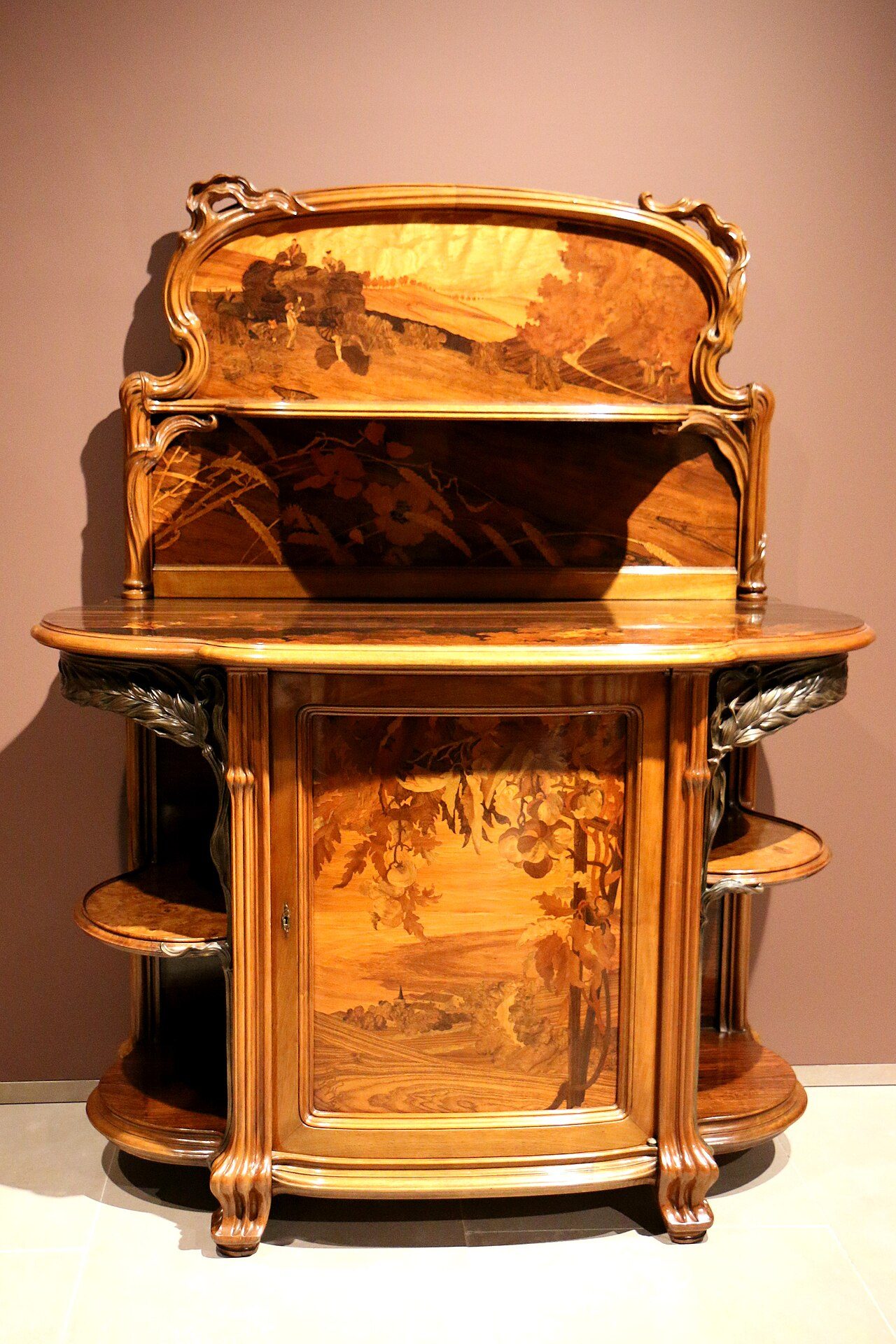
5 min read · 2 sourcesMarquetry (also spelled as marqueterie; from the French marqueter, to variegate) is the art and craft of applying pieces of veneer to a structure to form decorative patterns or designs. The technique may be applied to case furniture or even seat furniture, to decorative small objects with smooth, venerable surfaces or to freestanding pictorial panels appreciated in their own right. Marquetry differs from the more ancient craft of inlay, or intarsia, in which a solid body of one material is cut out to receive sections of another to form the surface pattern. The word derives from a Middle French word meaning "inlaid work". 1
Materials
The veneers used are primarily woods, but may include bone, ivory, turtle-shell (conventionally called "tortoiseshell" regardless of its source), mother-of-pearl, pewter, brass or fine metals. Marquetry using colored straw was a specialty of some European spa resorts from the end of the 18th century. Many exotic woods as well as common varieties can be employed, from the near-white of boxwood to the near-black of ebony; colors not found in nature can be achieved by applying dye to a veneer that retains stains well, such as sycamore. 1
The French cabinet maker André-Charles Boulle (1642–1732) specialized in furniture using metal and either wood or tortoiseshell together, the latter acting as the background. The simplest kind of marquetry uses only two sheets of veneer, which are temporarily glued together and cut with a fine saw, producing two contrasting panels of identical design, (in French called partie and contre-partie, "part" and "counterpart"). Marquetry as a modern craft most commonly uses knife-cut veneers. However, the knife-cutting technique usually requires a lot of time. For that reason, many marquetarians have switched to fret or scroll saw techniques. Other requirements are a pattern of some kind, some brown gummed tape (this kind of tape is used because as its moistened glue dries the tape shrinks, pulling the veneer pieces closer together), PVA glue and a base-board with balancing veneers on the alternate face to compensate stresses. Finishing the piece will require fine abrasive paper, always backed by a sanding block. 1
History
Furniture inlaid with precious woods, metals, glass and stones is known from the ancient world, as in Sumeria and Egypt. Roman examples have been recovered from the first century sites of Pompeii and Herculaneum demonstrating that the technique was highly advanced. The revival of the technique of veneered marquetry had its inspiration in 16th century Florence and at Naples ultimately from classical inspiration. Marquetry elaborated upon Florentine techniques of inlaying solid marble slabs with designs formed of fitted marbles, jaspers and semi-precious stones. This work, called opere di commessi, has medieval parallels in Central Italian "Cosmati"-work of inlaid marble floors, altars and columns. The technique is known in English as pietra dura, for the "hardstones" used: onyx, jasper, cornelian, lapis lazuli and colored marbles. In Florence, the Chapel of the Medici at San Lorenzo is completely covered in a colored marble facing using this demanding jig-sawn technique. 1
Techniques of wood marquetry were developed in Antwerp and other Flemish centers of luxury cabinet-making during the early 16th century. The craft was imported full-blown to France after the mid-seventeenth century, to create furniture of unprecedented luxury being made at the royal manufactory of the Gobelins, charged with providing furnishings to decorate Versailles and the other royal residences of Louis XIV. Early masters of French marquetry were the Fleming Pierre Gole and his son-in-law, André-Charles Boulle, who founded a dynasty of royal and Parisian cabinet-makers (ébénistes) and gave his name to a technique of marquetry employing tortoiseshell and brass with pewter in arabesque or intricately foliate designs. Boulle marquetry dropped out of favor in the 1720s, but was revived in the 1780s. 1
New techniques
During the 1980s Georges Vriz developed a technique called VRIZ, layering two veneer layers on top of each other and sanding through the top one, to the point of fiber transparency. This has been used mainly in France, by professionals and marquetry students of the École Boulle. With its technique, Georges Vriz promoted a resurgence of the marquetry he called RENAISSANCE. He launched the contemporary marquetry. In the US the technique has been used at the American School of French Marquetry by one of the teachers, artist Patrice Lejeune. The school staff is also proposing a new name for it: "Given that 'piercing' is an unfortunate mistake in the veneering world, we chose to use the word "Fusion" instead, by which term the artist expresses his intention of sanding through the veneer as a decorative, textural effect, not as a mistake." Cutting-edge tech has also been applied to marquetry. Among these is laser cutting, where the design is drawn or imported as a CAD or vector file and each piece is cut separately; each different species of wood-and thickness-may need a specific adjustment of the beam power; the offset will determine the gap between the pieces. In some cases, the beam will leave a dark edge due to the high heat required by the process. 1
The text above is adapted from the Wikipedia article “Marquetry”, available under the Creative Commons Attribution-ShareAlike 4.0 licence. 1
marquetry is technique of inlaying small pieces of wood, ivory, etc. into a suface of decorative veneer, according to the structured record cited below. This entry was generated automatically from that record and has not yet been reviewed by a person familiar with the tradition. 2
The source record links this tradition to 23 external registers, which can be verified through the citation. 2