The tradition & historical record
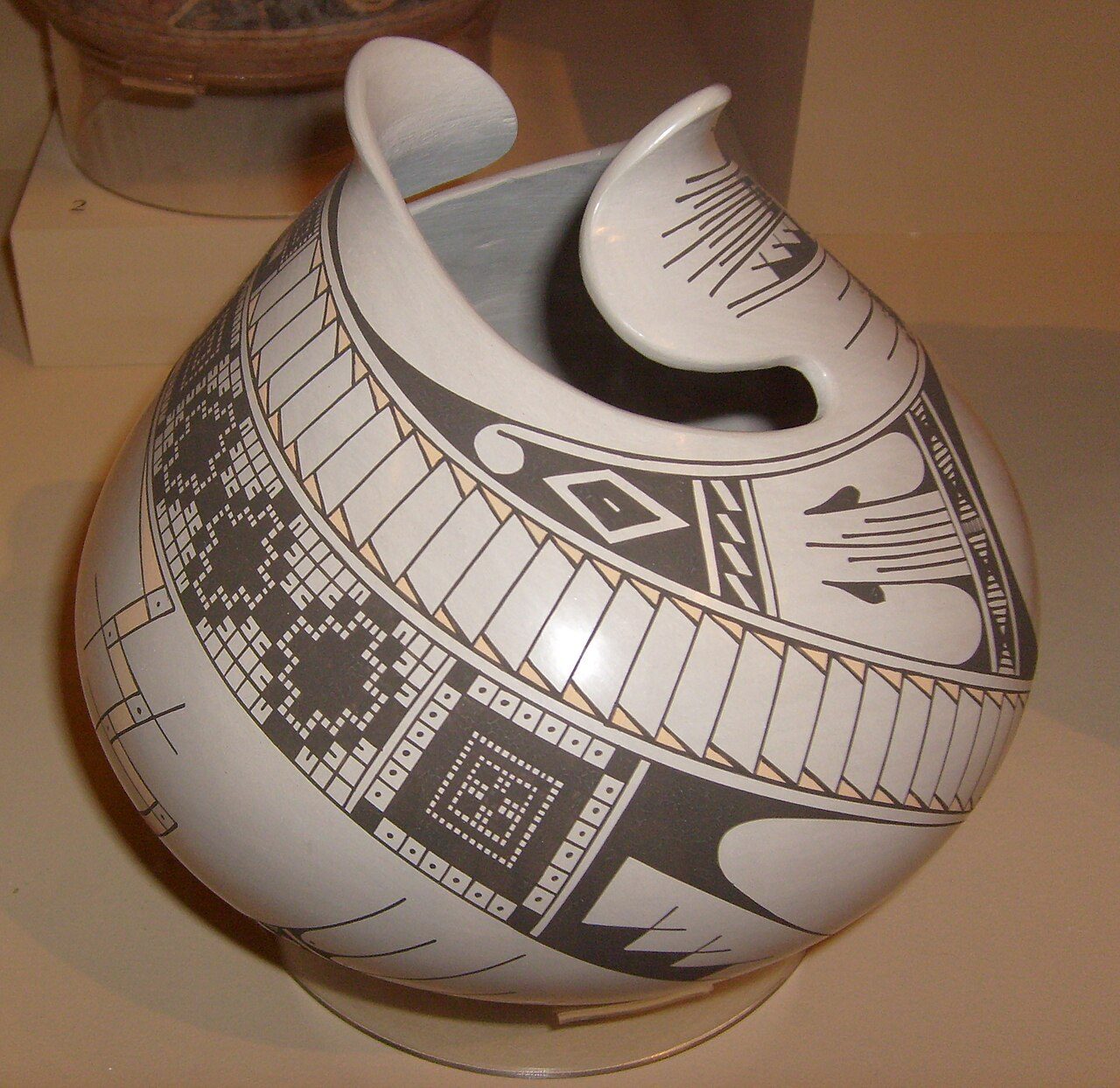
7 min read · 2 sourcesMata Ortiz pottery is a recreation of the Mogollon pottery found in and around the archeological site of Casas Grandes (Paquimé) in the Mexican state of Chihuahua. Named after the modern town of Mata Ortiz, which is near the archeological site, the style was propagated by Juan Quezada Celado. Quezada learned on his own to recreate this ancient pottery and then went on to update it. By the mid 1970s, Quezada was selling his pottery and teaching family and friends to make it and the pottery was able to penetrate the U.S. markets thanks to efforts by Spencer MacCallum and later Walt Parks along with Mexican traders. By the 1990s, the pottery was being shown in museums and other cultural institutions and sold in fine galleries. The success of the pottery, which is sold for its aesthetic rather than its utilitarian value, has brought the town of Mata Ortiz out of poverty, with most of its population earning income from the industry, directly or indirectly. 1
The town
Mata Ortiz is located the Mexican state of Chihuahua about 4.5 hours south and west of El Paso, Texas, United States. It is a small town with adobe dwellings at the foothills of the Sierra Madre Occidental, along the banks of the Palanganas River. Despite Mata Ortiz’s success the creation of pottery has not spread to surrounding towns. 1
Paquimé archeological site
One critical element to the development of ceramics in Mata Ortiz is its proximity to the Paquimé or Casa Grandes archeological site. Paquimé is one of the most important archeological sites in northwest Mexico/southwest U.S. region and center of the Mogollon culture . This culture reached its peak around 1400, with evidence of its influence hundreds of kilometers from its center in present-day Chihuahua state. Excavations of Paquimé were undertaken between 1958 and 1961 by archeologist Charles C. Di Peso, which sparked local interest in the site. However, by the time the pottery revival began in Mata Ortiz, Paquimé had not been studied as well as other desert cultures in the region and there was little expert knowledge about its pottery. Since then, the Museo de las Culturas del Norte was opened at Paquimé in 1997 and it was declared a UNESCO World Heritage Site in 1998. Paquimé pottery is closely related to the larger family of Pueblo pottery, showing influence from Arizona, New Mexico and central Mexico along with elements which are distinctive to the area. Various colors appear in the works including a nearly white ivory, a reddish color and black. Paquimé pottery was traded throughout North America. 1
Juan Quezada
The pre Hispanic pottery tradition had been completely lost, but clay was still abundant in the area. Juan Quezada is credited for the revival and development of pottery making in the area. In the early 1960s, he was a very poor farmer who also collected firewood in the area of the Paquimé archeological site. He found fragments of Paquimé pottery and the even older Mimbres style, characterized by bold black-on-white zoomorphic designs. He also found local clay deposits and began experiments to determine how the ancient pottery was made. Unlike pottery revivals in Arizona and New Mexico, which depended on the help of experts, Quezada revived Paquimé pottery all on his own. For example, he found that vessels of pure clay were too brittle and after studying the edges of the broken old pottery, he discovered the use of sand and other coarse material as a temper. He also discovered that dried cow dung made an excellent, inexpensive firing fuel. By 1971 he had perfected a kind of polychrome pottery. Despite never receiving formal instruction, he succeeded in turning out high-quality vessels. His experiments have gone beyond recreated old style pottery. For example, one of his goals was to find a rich source of white clay, hard to find since it is untainted by other minerals. He finally found it when he looked at an anthill and noticed that the ants were bringing up small balls of white clay. This deposit happened to be on Quezada’s property but despite this, he allows other pottery to take advantage of it. However, the main innovations have been with the design and decoration of the pots, rather than the materials or the crafting process. He created new vessel shapes and modified the traditional painted designs to create a more fluid look. 1
Innovation and marketing
By the mid 1970s, Mata Ortiz pots by Juan Quezada were selling for several dollars apiece including to traders from El Paso, prompting him to teach the craft to his brothers and sisters. This includes Mata Ortiz’s most prominent female potter, sister Lydia Quezada Celado de Talavera, who is the first to have gained international prominence. They taught it to the next generation and then to friends and neighbors. Following Quezada's lead, other potters moved quickly from copying designs from prehistoric potsherds to creating original motifs. While Quezada was interested in making all pottery from Mata Ortiz have a certain level of quality not all agreed. The Felix Ortiz family was the first to work on simpler pots of lesser quality but would still sell. They also created different designs and formed a new hub of pottery making in the El Porvenir neighborhood which then produced various other potters of various skill levels. In the 1980s, others began to learn pottery without the help of either the Quezada or Ortiz families. A number of husband-wife teams developed who formed their own signature styles. Quezada's departure from original ancient styles and with a large number of people now working on the pottery, further innovations have occurred. Quezada’s brother Reynaldo is credited with introducing mixed clays, giving a marbled effect. His sister Lydia began to paint bright colors on the popular black-on-black ceramics. Around 1982, Macario Ortiz began to apply graphite to the surface, which after firing becomes a smooth shiny surface. 1
Process and final product
Mata Ortiz potters generally work in their homes, with bedrooms often doubling as studios. The work space generally consists of just a table, with simple tools such as a hacksaw blade, a butter knife, broken spoons, sandpaper, a small stone and paintbrushes generally made from clippings of children’s hair, sometimes just four or five strands tied on a stick. The shaping of the clay is relatively faithful to the original Paquimé techniques, but each potter has their own variation in how they make their pots. However, they are generally based on Quesada’s single-coil method, using the gray, yellow, orange, red and white clays from the area just as those in Paquimé did. The paints are made from clay or from crushed minerals such as manganese, also mined locally. The formation of the vessel is done without a potter’s wheel; instead it is a kind of wheel throwing making them essentially pinch pots. To begin, a ball of clay is pressed into a round flat shape, which is called a “tortilla.” This tortilla is pressed into a bowl to help it keep its shape as the bottom of the vessel. 1
The text above is adapted from the Wikipedia article “Mata Ortiz pottery”, available under the Creative Commons Attribution-ShareAlike 4.0 licence. 1
mata oriz is Type of Mexican pottery based on ancient Mogollon pottery, according to the structured record cited below. This entry was generated automatically from that record and has not yet been reviewed by a person familiar with the tradition. 2
The source record links this tradition to 1 external register, which can be verified through the citation. 2