The tradition & historical record
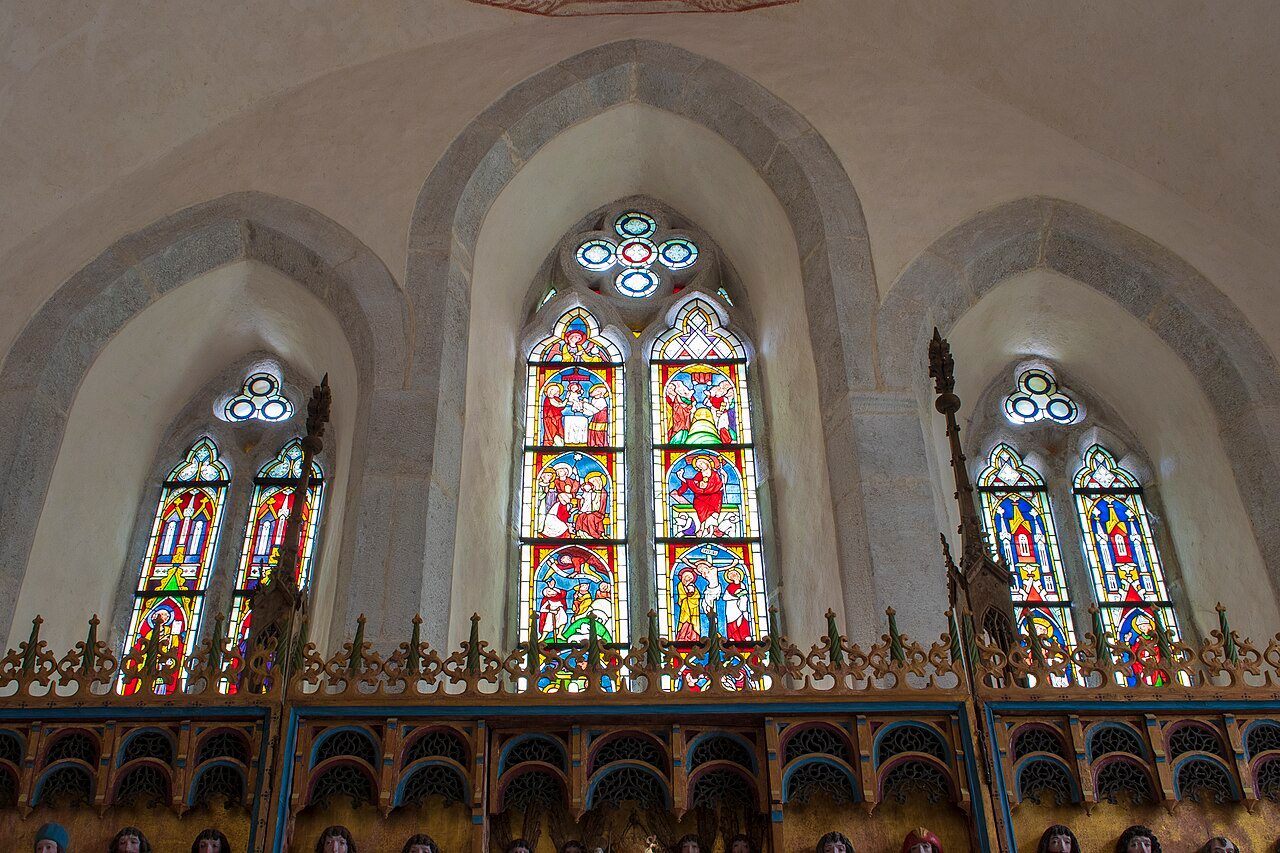
6 min read · 2 sourcesThe surviving amount of medieval stained glass in Sweden is relatively small, compared to some other European countries. There are in total 165 medieval stained glass panes with figurative depictions surviving in 37 churches, constituting a total area of about 60 square metres (650 sq ft), a fraction of the original amount but still the largest amount found in any of the Nordic countries. Archaeological evidence and old drawings indicate that many more once existed. The majority of the surviving glass paintings date from between approximately 1225 and 1350 and can be found mainly on Gotland. These stained glass windows can be roughly divided into groups on stylistic grounds. The oldest surviving stained glass windows can be found in Dalhem Church, and show influences from Byzantine art, probably conveyed via Germany, while the most recent date from the 15th and 16th centuries and are found in mainland Sweden. As elsewhere in Catholic Europe throughout the Middle Ages, stained glass was used to convey Christian themes through images to the churchgoers. A serious study of the medieval stained glass of Sweden by art historians began in the 19th century. In 1964, a complete catalogue of all preserved medieval stained glass in Sweden was published. 1
History
Although the technique of making stained glass had been known since before the Middle Ages, the practice of decorating churches with stained glass windows became widespread in the territory of what is today Sweden first from the 1230s. On Gotland, where the vast majority of the remaining stained glass windows come from, stained glass windows were produced during a comparatively short time span of about a century and a half, from the second quarter of the 13th century to the end of the 14th century. This was a time of expansive church building and rebuilding on the island, which had grown rich from foreign trade. With the end of the 14th century, this period came to an end and church building, and with it the manufacturing of stained glass, ceased. Surviving stained glass windows from mainland Sweden date mainly from the 14th century and later, and there is no coherence in the body of surviving pieces comparable to that on Gotland. Furthermore, some of the medieval window panes today found on the mainland were originally from Gotland. Judging from both written sources and archaeological discoveries, it was common to decorate churches lying within the current borders of Sweden with stained glass during the entire Middle Ages. In general, churches were equipped with stained glass windows when they were built. It is known from at least one occasion that a stained glass window was donated to a church by a clergyman, but contemporary written evidence of window production or acquisition is generally scarce. In cases where no actual windows remain, knowledge about their existence has been deduced from other sources. Some are known through earlier depictions, like the drawings made by Johan Peringskiöld of the stained windows of the church in Gamla Uppsala. 1
Study and inventory
Attempts at a more systematic study of medieval stained glass in Sweden began in the 19th century. A comprehensive study of the collected preserved medieval stained glass on Gotland was carried out during the 1940s. While Sweden remained neutral during World War II and avoided direct warfare, the Swedish National Heritage Board in 1939 ordered all medieval stained glass windows on Gotland to be removed and brought to the mainland for safekeeping as a precautionary measure in case of war. A research team under the leadership of art historian Johnny Roosval took this opportunity to make a close study of all of the window panes, and published the results in a book in 1950. Roosval grouped the windows together and assigned notnames to the assumed artists or workshops on stylistic grounds. All in all, Roosval claimed to have identified 19 workshops, schools or artists producing stained glass for the churches of Gotland. In 1964, art historian Aron Andersson published a complete inventory of all known medieval stained glass windows in Sweden. Andersson acknowledges the notnames of Roosval but uses them only sparingly. He also highlights the difficulties in determining the artistic influences different workshops may have had on each other and whether some works came from different workshops or from different artists within the same workshop. He also points out problems determining a chronology between these supposed workshops, and raises the question of how difficult it is to convincingly show that there were any independent glass workshops on Gotland at all, given the lack of written sources. 1
Style and development
Although stemming from a relatively short period of time, and despite the fact that a reduced number of window panes remain, certain stylistic characteristics and trends can be identified among the stained glass from Sweden. Particular attention has been paid to the churches on Gotland, since the by far largest amount of medieval stained glass comes from there. It has been assumed that the windows in these countryside churches were made by workshops operating in Visby. However, with the exception of Visby Cathedral, all the medieval churches of Visby are today in ruins, so there are no windows in Visby to compare the surviving windows with. 1
Early stained glass
The oldest stained glass windows preserved in situ in Sweden are found in Dalhem Church on Gotland. Five of the thirteen window panes in the eastern choir window are original; the rest date from a restoration done in a medieval revival style 1899–1914. Each window pane is approximately 50 centimetres (20 in) by 60 centimetres (24 in) large. These five windows probably date from c. 1230–1250; a somewhat later window in one of the northern choir walls (c. 1250–1280) show similar stylistic traits. These early works are characterised by an influence from Byzantine art. Stylistically related works can be found in Western Germany, particularly Westphalia, and notably in St. Elizabeth's Church, Marburg. Comparisons have also been made with windows in Barfüßerkirche in Erfurt and Neukloster monastery. The Byzantine influence, as seen e.g. in the representation of Christ Pantocrator in Dalhem, thus probably arrived with craftsmen from western Germany, who are also known to have been active as tradesmen on the island at this time. A clearly Western element in the aforementioned representation of Christ is thus e.g. the cross flag that Christ holds. Roosval also notes that a particular way of depicting the hair of Christ can be seen in the window in Dalhem, in Marburg and in the Byzantine mosaics in Cefalù Cathedral on Sicily; his conclusion is that the stylistic influence from Sicily may have reached Germany perhaps via the court of Emperor Frederick II, and from Germany to Gotland. Apart from Dalhem, window panes of broadly the same style and age are also known from Atlingbo, Barlingbo, Eksta, Endre, Lojsta, Rone, Sjonhem and Väskinde churches. 1
Early Gothic
During the period c. 1270–1310 stai… 1
The text above is adapted from the Wikipedia article “Medieval stained glass in Sweden”, available under the Creative Commons Attribution-ShareAlike 4.0 licence. 1
Medieval stained glass in Sweden is Overview of medieval stained glass in Sweden, according to the structured record cited below. This entry was generated automatically from that record and has not yet been reviewed by a person familiar with the tradition. 2