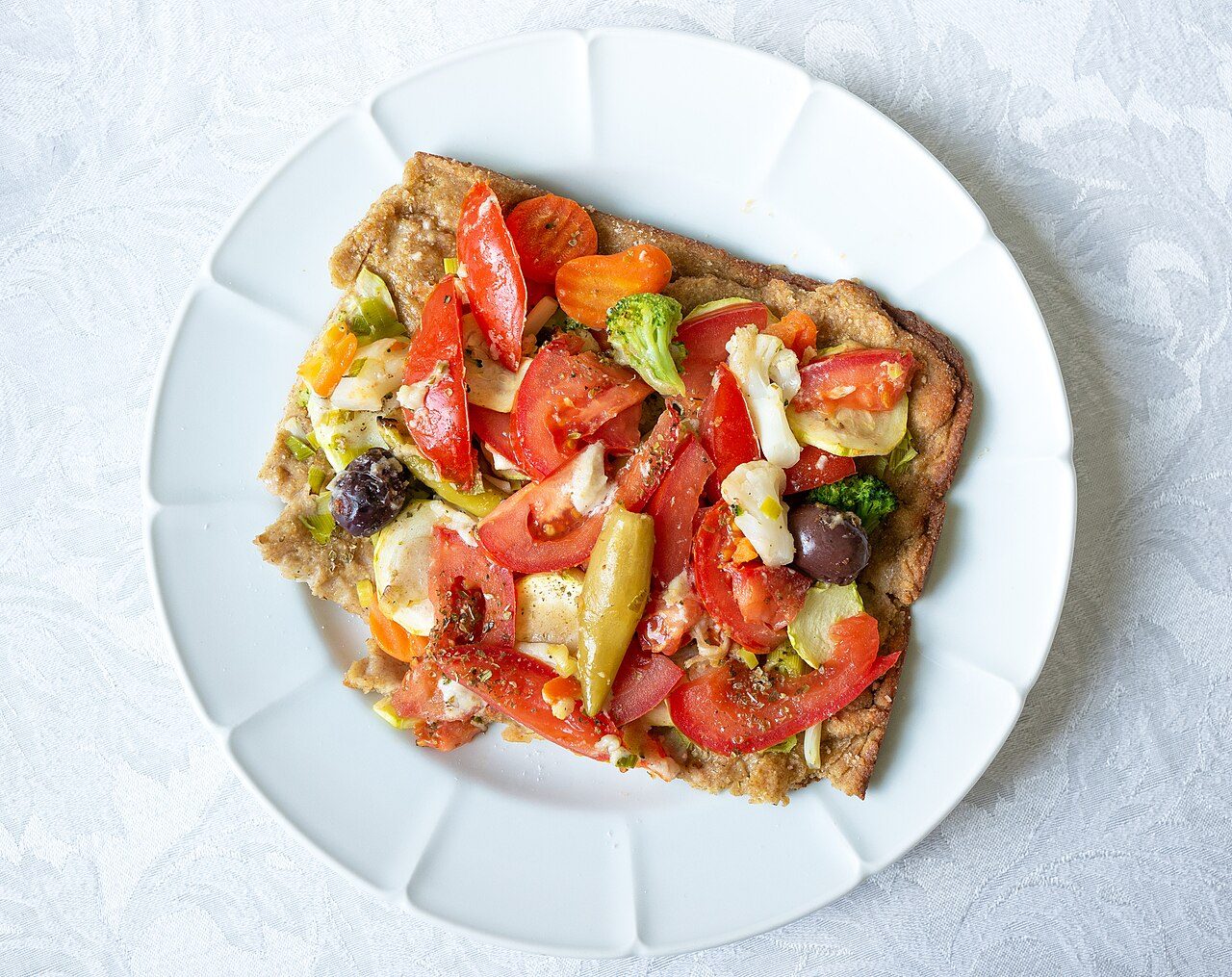
The tradition & historical record
5 min read · 2 sourcesMediterranean cuisine is the food and methods of preparation used by the people of the Mediterranean basin. The idea of a Mediterranean cuisine originates with the cookery writer Elizabeth David's A Book of Mediterranean Food (1950), and was amplified by other writers working in English. Many writers define the three core elements of the cuisine as the olive, wheat, and the grape, yielding olive oil, bread and pasta, and wine; other writers deny that the widely varied foods of the Mediterranean basin constitute a cuisine at all. A common definition of the geographical area covered, proposed by David, follows the distribution of the olive tree. The region spans a wide variety of cultures with distinct cuisines, in particular (going anticlockwise around the region) the Moroccan, Algerian, Tunisian, Libyan, Egyptian, Levantine, Ottoman (Turkish), Greek, Italian, French (Provençal), and Spanish, although some authors include additional cuisines. Portuguese cuisine, in particular, is partly Mediterranean in character. The historical connections of the region, as well as the impact of the Mediterranean Sea on the region's climate and economy, mean that these cuisines share dishes beyond the core trio of oil, bread, and wine, such as roast lamb or mutton, meat stews with vegetables and tomato (for example, Spanish andrajos), vegetable stews (Provençal ratatouille, Spanish pisto, Italian ciambotta), and the salted cured fish roe, bottarga, found across the region. 1
Geography
Various authors have defined the scope of Mediterranean cooking either by geography or by its core ingredients. Elizabeth David, in A Book of Mediterranean Food (1950), defines her scope as "the cooking of the Mediterranean shores" and sketches out the geographical limits: 1
from Gibraltar to the Bosphorus, down the Rhone Valley, through the great seaports of Marseille, Barcelona, and Genoa, across to Tunis and Alexandria, embracing all the Mediterranean islands, Corsica, Sicily, Sardinia, Crete, the Cyclades, Cyprus (where the Byzantine influence begins to be felt), to the mainland of Greece and the much disputed territories of Syria, the Lebanon, Constantinople, and Smyrna. Despite this definition, David's book focuses largely on Spain, France, Italy, and Greece. 1
She defines this region as coextensive with the range of the olive tree: "those blessed lands of sun and sea and olive trees." The olive's natural distribution is limited by frost and by availability of water. It is therefore constrained to a more or less narrow zone around the Mediterranean Sea, except in the Maghreb and in the Iberian Peninsula, where it is distributed more widely, and on the islands of the Mediterranean, where it is widespread. The Tunisian historian Mohamed Yassine Essid similarly defines the region by the olive's presence, along with bread, wheat, and the grape as the "basic products of Mediterranean folk cuisine": 1
Mediterranean cuisine is defined by the presence of fundamental elements which are said to play a more important role than others, reflecting a community of beliefs and practices which transcend religions, languages and even societies. 1
Key ingredients
Essid identifies the "trinity" of basic ingredients of traditional Mediterranean cuisine as the olive, wheat, and the grape, yielding oil, bread, and wine respectively. The archaeologist Colin Renfrew calls this the "Mediterranean triad". 1
Olive
The olive appears to come from the region of Persia and Mesopotamia, at least 6,000 years ago. It spread from there to nearby areas, and has been cultivated since the early Bronze Age (up to 3,150 BC) in southern Turkey, the Levant, and Crete. The ten countries with the largest harvests (in 2011) are all near the Mediterranean (Portugal being the tenth largest): together, they produce 95% of the world's olives. The olive yields bitter fruits, made edible by curing and fermentation, and olive oil. Some 90% of the fruit production (1996) goes into olive oil. The Mediterranean region accounts for the world's highest consumption of olive oil: in 2014, the highest-consuming country, Greece, used 17 kg per head; Italy, 12 kg, Spain, 13 kg; the United States for comparison used only 1 kg per head. 1
Wheat
Wheat was domesticated in the Fertile Crescent, in and near the Levant some 10,000 years ago. Its ancestors include wild emmer wheat; this was hybridised, harvested and sown to create domestic strains with larger grains, in ears that shatter less readily than wild forms. It was spread across the Mediterranean region as far as Spain by 5,000 BC. Wheat is a staple food in the Mediterranean region. Wheat bread was already critically important in the empire of ancient Rome, which included the entire region; at that time, around 2,000 years ago, North Africa was the "breadbasket" of the empire. Other staple wheat-based Mediterranean foods include pasta and semolina (wheat middlings) products such as couscous and bulgur. In turn, these are made into dishes such as the Greek dessert galaktoboureko (milk börek), consisting of filo pastry parcels around a custard made with semolina. A widespread wheat dish from Turkey and the Levant to Iran and India is halva, a dessert of sweetened semolina with butter, milk, and pine kernels. 1
Grape
The grape was domesticated between 7,000 and 4,000 BC between the Black Sea and Persia; archaeological evidence shows that wine was being made there by 6,000 BC, reaching Greece and Crete in the fifth millennium BC and Spain by the last millennium BC. Winemaking started in Italy in the ninth century BC, and in France around 600 BC. Grapes are mostly grown for making wine and vinegar as basic components of the Mediterranean diet, as well for drying as raisins or for eating as table grapes. Raisins and table grape varieties are chosen for their flavour. 1
The text above is adapted from the Wikipedia article “Mediterranean cuisine”, available under the Creative Commons Attribution-ShareAlike 4.0 licence. 1
Mediterranean cuisine is culinary traditions of the Mediterranean, according to the structured record cited below. This entry was generated automatically from that record and has not yet been reviewed by a person familiar with the tradition. 2
The source record links this tradition to 14 external registers, which can be verified through the citation. 2