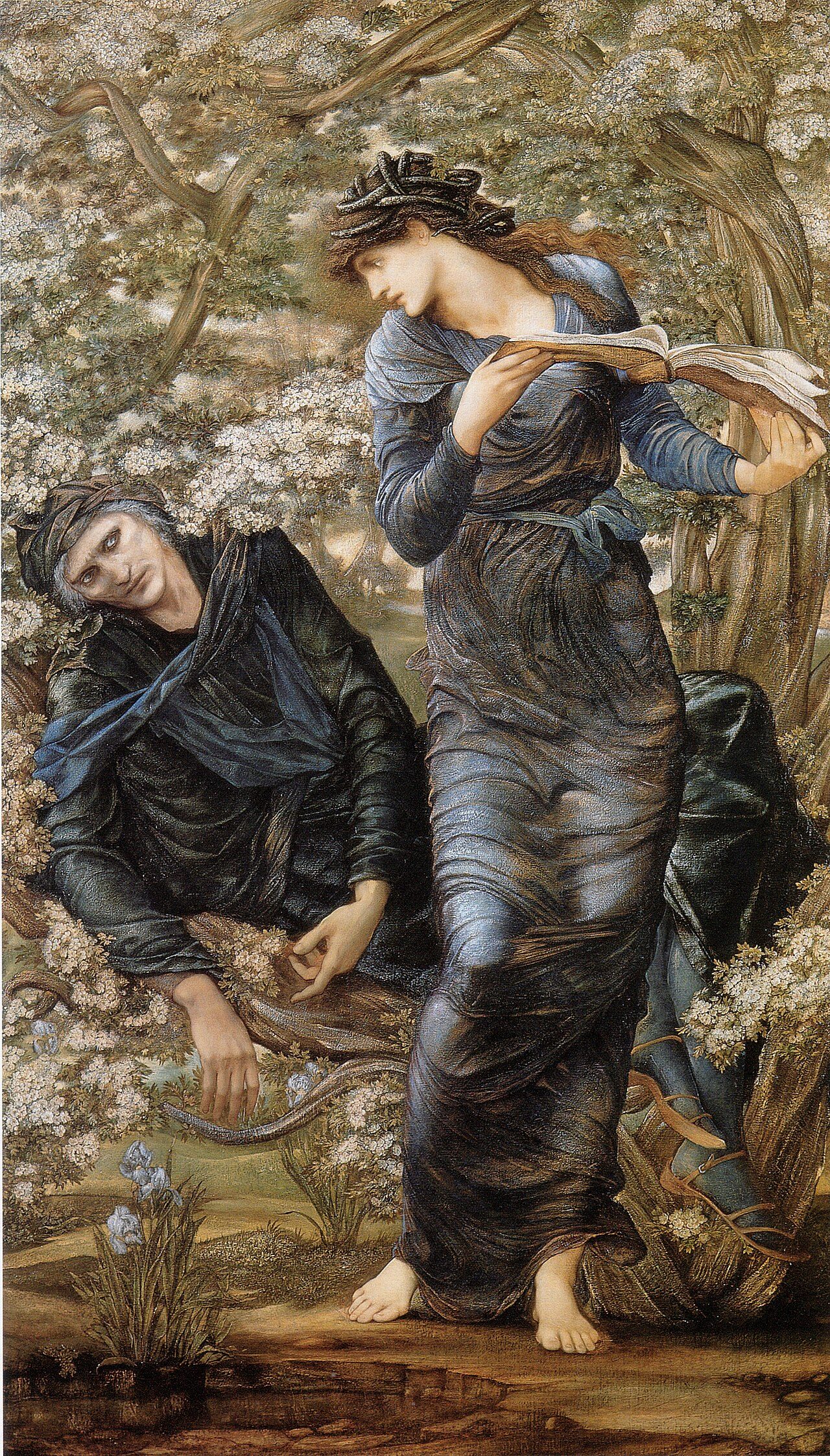
The tradition & historical record
6 min read · 2 sourcesMerlin (Welsh: Myrddin) is a mythical figure prominently featured in the legend of King Arthur and best known as a prophet and a magician, along with several other main roles. The familiar depiction of Merlin, based on an amalgamation of historical and legendary figures, was introduced by the 12th-century Catholic cleric Geoffrey of Monmouth and then built on by the French poet Robert de Boron and prose successors in the 13th century. Geoffrey's account presented Merlin as a prophet and royal advisor to Arthur's father, Uther Pendragon. Geoffrey seems to have combined earlier Welsh tales of Myrddin and Emrys (Ambrosius), two legendary Briton prophets with no connection to Arthur, to form the composite figure that he called Merlinus Ambrosius. His rendering of the character became immediately popular, especially in Wales. Later chronicle and romance writers in France and elsewhere expanded the account to produce a more full, multifaceted character, creating one of the most important figures in the imagination and literature of the Middle Ages. Today, he continues to be highly popular in the modern era (see also the article fiction featuring Merlin). Merlin's traditional biography casts him as an often-mad cambion, born of a mortal woman and an incubus, from whom he inherits his supernatural powers and abilities. His most notable abilities commonly include prophecy and shapeshifting. Merlin matures into an ascendant sage and engineers Arthur's birth through magic and intrigue. 1
Name
The name Merlin is derived from the Welsh name of the legendary bard Myrddin that Geoffrey of Monmouth Latinised to Merlinus in his works. Medievalist Gaston Paris suggests that Geoffrey chose the form Merlinus rather than the expected *Merdinus to avoid a resemblance to the Anglo-Norman word merde (from Latin merda) for feces. Henri d'Arbois de Jubainville reduced it to the result of the "tendency of d to change into l in Indo-European languages." 'Merlin' may also be an adjective, in which case he should be called "The Merlin", from the French merle meaning common blackbird (Turdus merula). An association with this bird in French was deemed logical by Philippe Walter. According to Martin Aurell, the Latin form Merlinus is a euphony of the Welsh form Myrddin to bring him closer to the white blackbird (merle blanc) into which he could metamorphose through his shamanic powers, as was notably the case for Merlin's Irish counterpart. Folklorist Jean Markale proposed that the name of Merlin is of French origin and means 'little blackbird', an allusion to the mocking and provocative personality usually attributed to him in medieval stories. According to Jean-Charles Berthet, however, the analogies between Merlin and the blackbird are more akin to a later establishment than to a real etymology, since the French name of Merlin is later than the other forms. Myrddin may be a combination of *mer (mad) and the Welsh dyn (man), to mean 'madman'. It may also mean '[of] many names' if it was derived from the Welsh myrdd, myriad. In his Myrdhinn, ou l'Enchanteur Merlin (1868), La Villemarqué derived Marz[h]in, which he considered the original form of Merlin's name, from the Breton word marz (wonder) to mean 'wonder man'. 1
Overview
Commonly in his medieval appearances, Merlin guides, helps, saves, predicts, and judges through his great wisdom. According to Gaëlle Zussa, "Merlin's literary legend presents itself as a sort of great dump in which pieces of the myth are scattered. Contemporary authors come to draw their ideas and recycle this debris to recreate an ever-new Merlin, in motion." For Berthet and Walter, the legend was constructed in stages as the ancient Celtic character was continuously reinterpreted and reinvented by Christianity, with Merlin's messianism testifying to this religious influence. Villemarqué attempted to synthesize the known information around Merlin, beginning as a figure of bard gifted with prophecy. While Merlin's prototypes were originally those of both poet and warrior king, the familiar character from the French romances became the master of amazing magical knowledge. According to a summary of the legend by Danielle Quéruel of the Bibliothèque nationale de France, 1
R. Howard Bloch described Merlin's character throughout the legend: 1
Geoffrey and his sources
Geoffrey of Manmouth's composite Merlin, imagined primarily as a prophet, is fundamentally based on the North Brythonic poet and seer Myrddin Wyllt, that is Myrddin the Wild (known as Merlinus Caledonensis or Merlin Sylvestris in later texts influenced by Geoffrey), in turn inspired by either real or legendary figure from the Welsh oral tradition that appears in 12th-century written poems such as "Afallennau Myrddin" ("Myrddin's Apple Trees") or "Yr Oianau" ("The Piglet"). Myrddin's legend has parallels with a northern Welsh and southern Scottish story of the mad prophet Lailoken (Laleocen), probably the same as Myrddin son of Morfryn (Myrddin map Morfryn) mentioned in the Welsh Triads, and with Buile Shuibhne, an Irish tale of the wandering insane king Suibihne mac Colmáin (often Anglicised to Sweeney), set after the 637 Battle of Moira. In Welsh poetry, Myrddin was a bard who was driven mad after witnessing the horrors of war and subsequently fled civilisation to become a wild man of the wood in the 6th century. He roamed the Caledonian Forest until he was cured of his madness by Kentigern, also known as Saint Mungo. Geoffrey had Myrddin in mind when he wrote his earliest surviving work, the Prophetiae Merlini ("Prophecies of Merlin", c. 1130), a collection of prophecies consist of a long series of predictions concerning the reign of the Saxons and the independence of Britain, which he claimed were the actual words of the legendary poet (including some distinctively apocalyptic prophecies for Geoffrey's contemporary 12th century). 1
Romance reimagination
Around the turn of the 13th century, Robert de Boron retold and expanded on this material in Merlin, an Old French epic poem inspired by Wace's Roman de Brut, an Anglo-Norman creative adaptation of Geoffrey's Historia, but not based directly on it. The work presents itself as the story of Merlin's life as told by Merlin himself to be written down by the "real" author, while the actual author claimed merely to translate the story into French. Only a few lines of what is believed to be the original text have survived, but a popular prose version had a great influence on the emerging genre of Arthurian-themed chivalric romance. The French Merlin links the two British traditions, that of the fatherless child prophet and that of the wild man. As in the Historia, Merlin is created as a demon spawn, but in Robert's account, he is explicitly to become the Antichrist intended to reverse the effect of the Harrowing of Hell. 1
Other aspects and developments
As the Arthurian myths were retold, Merlin's prophetic "seer" aspects were sometimes de-emphasised (or even seemingly vanish entirely, as in the fragmentary and more fantastical Livre d'Artus) in favor of portraying him as a wizar… 1
The text above is adapted from the Wikipedia article “Merlin”, available under the Creative Commons Attribution-ShareAlike 4.0 licence. 1
Merlin is legendary British wizard, according to the structured record cited below. This entry was generated automatically from that record and has not yet been reviewed by a person familiar with the tradition. 2
The source record links this tradition to 55 external registers, which can be verified through the citation. 2