The tradition & historical record
5 min read · 2 sourcesMerrow (from Irish murúch, Middle Irish murdúchann or murdúchu) is a mermaid or merman in Irish folklore. The term is anglicised from the Irish word murúch. The merrows supposedly require a magical cap (Irish: cochaillín draíochta; anglicised: cohuleen druith) in order to travel between deep water and dry land. 1
Overview
The term appears in two tales set in Ireland published in the 19th century: "Lady of Gollerus", where a green-haired merrow weds a local Kerry man who deprives her of the "magical red cap" (cohuleen druith); and "The Soul Cages" where a green-bodied grotesque male merrow entertains a fisherman at his home under the sea. These tales with commentary were first published in T. C. Croker's Fairy Legends (1828). William Butler Yeats and others writing on the subject borrowed heavily from this work. "The Soul Cages" turned out not to be a genuine folktale, but rather a piece of fiction fabricated by Thomas Keightley. A number of other terms in Irish are used to denote a mermaid or sea-nymph, some tracing back to mythological tracts from the medieval to the post-medieval period. The Middle Irish murdúchann is a siren-like creature encountered by legendary ancestors of the Irish (either Goidels or Milesians) according to the Book of Invasions. This, as well as samguba and suire are terms for the mermaid that appear in onomastic tales of the Dindsenchas. A muirgheilt, literally "sea-wanderer", is the term for the mermaid Lí Ban. 1
Etymology
Current scholarship regards merrow as a Hiberno-English term, derived from Irish murúch (Middle Irish murdhúchu or murdúchann) meaning "sea singer" or "siren". But this was not the derivation given by 19th century writers. According to Croker, "merrow" was a transliteration of modern Irish moruadh or moruach, which resolved into muir "sea" + oigh "maid". This "Gaelic" word could also denote "sea monster", and Croker remarked that it was cognate with Cornish morhuch, a "sea hog". Yeats added murrúghach as an alternative original, as that word is also synonymous with mermaid. The corresponding term in the Scots dialect is morrough, derived from the Irish, with no original Scottish Gaelic form suggested. The Middle Irish murdúchann, (from muir + dúchann "chant, song") with its singing melodies that held sway over seamen was more characteristic of the sirens of classical mythology, and was imported into Irish literature via Homer's Odyssey. 1
Synonyms
The terms muirgeilt, samguba, and suire been listed as synonymous to "mermaid" or "sea nymph". These are Old or Middle Irish words, and usage are attested in medieval tracts. Other modern Irish terms for mermaid are given in O'Reilly's dictionary (1864); one of them, maighdean mhara ("sea-maiden"), being the common term for "mermaid" in Irish today (cf. de Bhaldraithe's dictionary, 1959). The term muirgeilt, literally "sea-wanderer", has been applied, among other uses, to Lí Ban, a legendary figure who underwent metamorphosis into a salmon-woman. Strictly speaking, the term samguba in the Dindsenchas example signifies "mermaid's melody". However, O'Clery's Glossary explains that this was rhetorically the "name of the nymphs that are in the sea". The term suire for "mermaid" also finds instance in the Dinsenchas. Croker also vaguely noted that suire has been used by "romantic historians" in reference to the "sea-nymphs" enountered by Milesian ships. 1
Folk tales
Thomas Crofton Croker's Second Volume to the Fairy Legends (1828) laid the groundwork for the folkloric treatment of the merrow. It was immediately translated into German by the Brothers Grimm. Croker's material on the merrow was to a large measure rehashed by such authors on the fairy-kind as Thomas Keightley, John O'Hanlon, and the poet William Butler Yeats. A general sketch of the merrow pieced together by such 19th century authors are as follows. 1
Characteristics
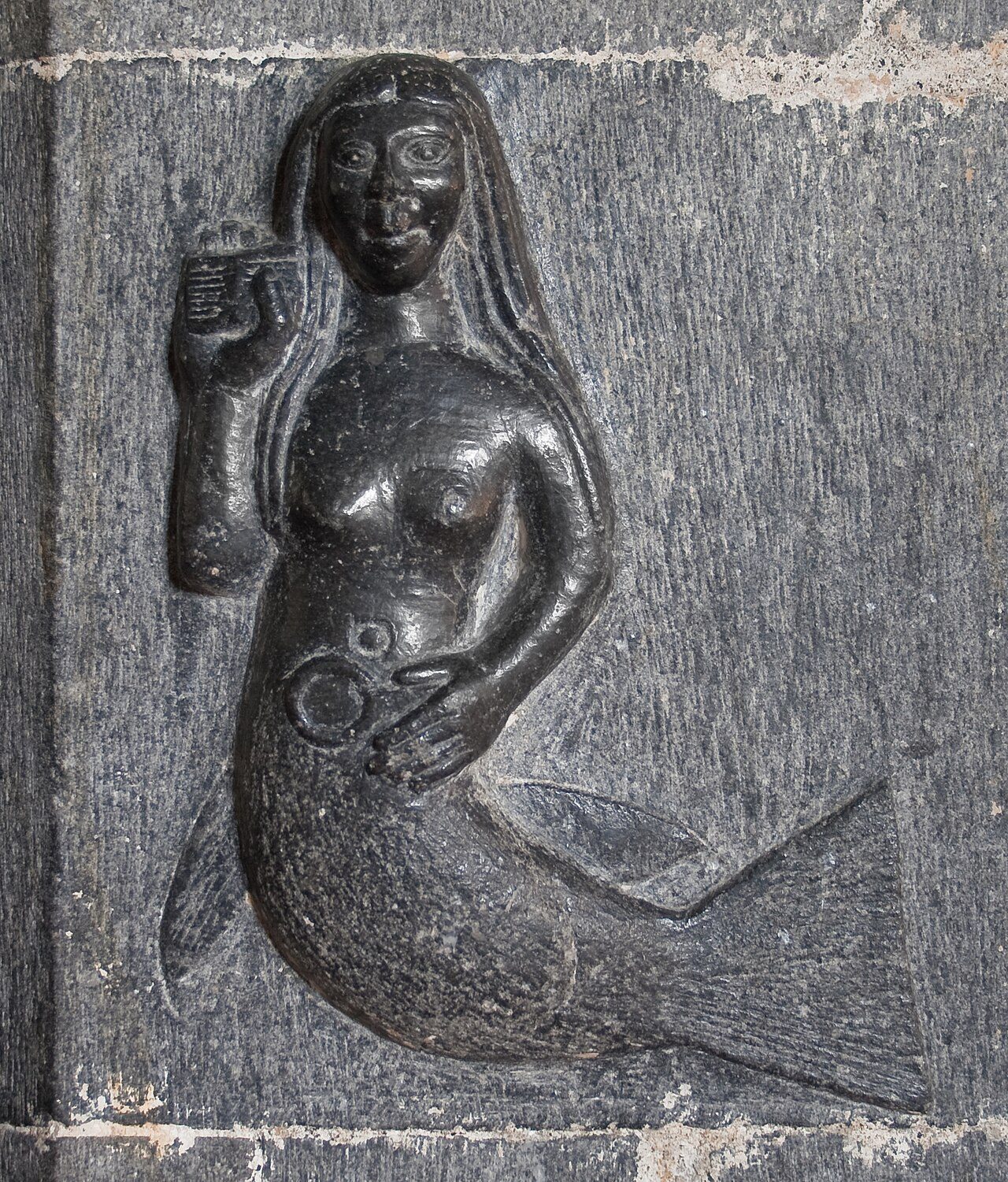
The merrow-maiden is like the commonly stereotypical mermaid: half-human, a gorgeous woman from waist up, and fish-like waist down, her lower extremity "covered with greenish-tinted scales" (according to O'Hanlon). She has green hair which she fondly grooms with her comb. She exhibits slight webbing between her fingers, a white and delicate film resembling "the skin between egg and shell". Said to be of "modest, affectionate, gentle, and [benevolent] disposition", the merrow is believed "capable of attachment to human beings", with reports of inter-marriage. One such mixed marriage took place in Bantry, producing descendants marked by "scaly skin" and "membrane between fingers and toes". But after some "years in succession" they will almost inevitably return to the sea, their "natural instincts" irresistibly overcoming any love-bond they may have formed with their terrestrial family. And to prevent her acting on impulse, her cohuleen druith (or "little magic cap") must be kept "well concealed from his sea-wife". O'Hanlon mentioned that a merrow may leave her outer skin behind in order to transform into other beings "more magical and beauteous", But in Croker's book, this characteristic isn't ascribed to the merrow but to the merwife of Shetlandic and Faroese lore, said to shed their seal-skins to shapeshift between human form and a seal's guise (i.e., the selkie and its counterpart, the kópakona). Another researcher noted that the Irish merrow's device was her cap "covering her entire body", as opposed to the Scottish Maid-of-the-Wave who had her salmon-skin. Yeats claimed that merrows come ashore transformed into "little hornless cows". 1
The text above is adapted from the Wikipedia article “Merrow”, available under the Creative Commons Attribution-ShareAlike 4.0 licence. 1
merrow is creature in Irish mythology, according to the structured record cited below. This entry was generated automatically from that record and has not yet been reviewed by a person familiar with the tradition. 2
The source record links this tradition to 2 external registers, which can be verified through the citation. 2