The tradition & historical record
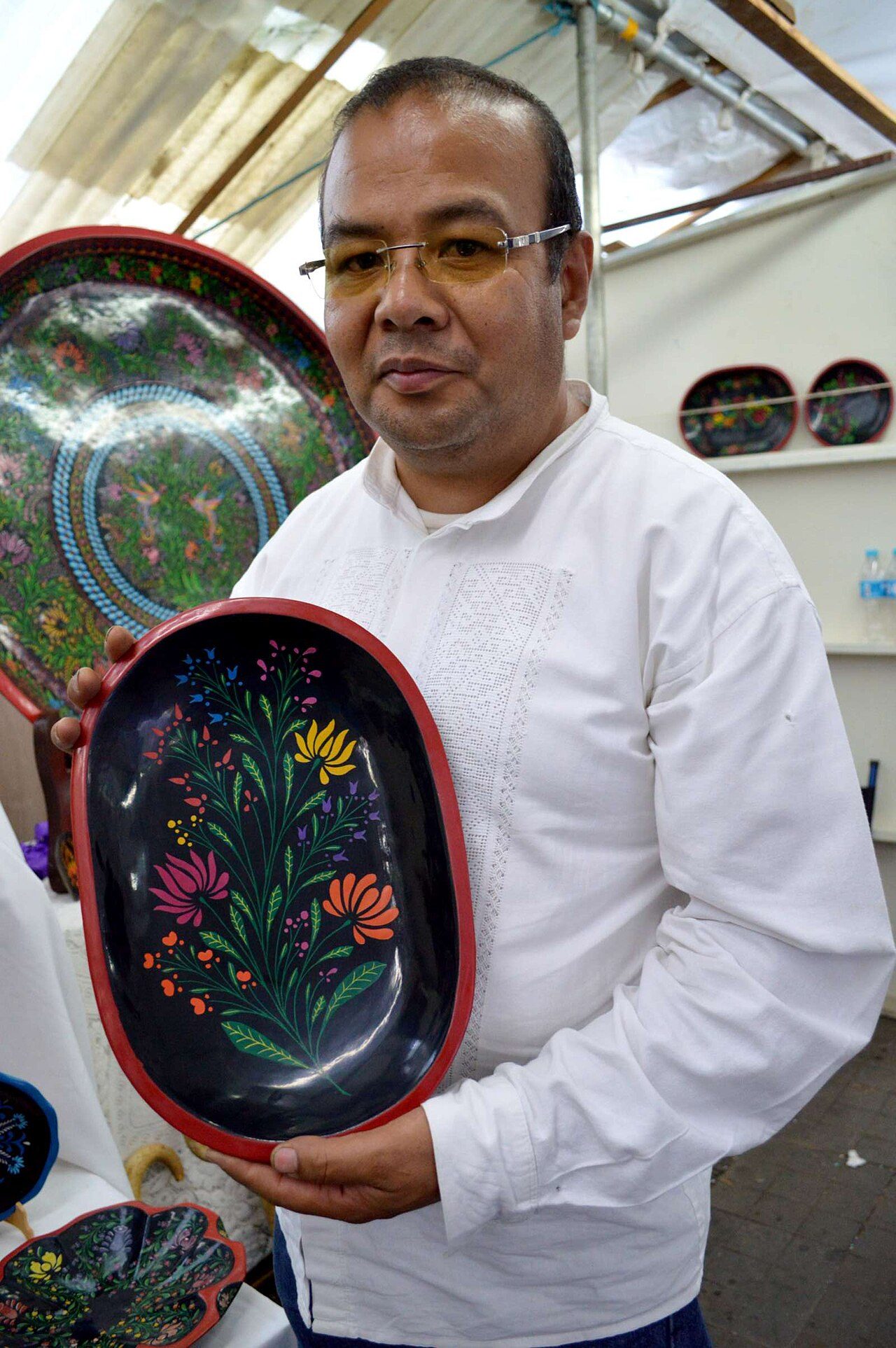
6 min read · 2 sourcesMexican lacquerware (laca or maque in Mexican Spanish) is one of the country's oldest crafts, having independent origins from Asian lacquerware. In the pre-colonial period, a greasy substance from the aje larvae and/or oil from the chia seed were mixed with powdered minerals to create protective coatings and decorative designs. During this period, the process was almost always applied to dried gourds, especially to make the cups that Mesoamerican nobility drank chocolate from. After the Conquest, the Spanish had indigenous craftsmen apply the technique to European style furniture and other items, changing the decorative motifs and color schemes, but the process and materials remained mostly the same. In the 19th and 20th centuries, the craft waned during armed conflicts and returned, both times with changes to the decorative styles and especially in the 20th century, to production techniques. Today, workshops creating these works are limited to Olinalá, Temalacatzingo and Acapetlahuaya in the state of Guerrero, Uruapan and Pátzcuaro in Michoacán and Chiapa de Corzo in Chiapas. 1
Olinalá
The Mexican state of Guerrero is located to the southwest of Mexico City and is home to three towns that make lacquered products, Olinalá, Temalacatzingo and Acapetlahuaya. The state has a large indigenous population and a strong handcraft tradition. Lacquerware from the state includes utensils, gourds, chests and other furniture, storage boxes, toy cars and helicopters, trays and even musical instruments. Guerrero lacquerware from Olinalá and to some extent Temalacatzingo became popularized in the 1970s, and its success has allowed many migrant workers to return home to the town, but there are still high rates of migration out, especially young people, to Mexico City and the United States. The town of Olinalá is located in the mountains of the Sierra Madre del Sur, and its wares are the most widely known. While pieces are 10 to 50% cheaper in Olinalá, the town is hard to get to. Instead wares are sold in many areas of Mexico and are featured at an important craft fair in Tepalcingo, Morelos, held the third week of Lent, the San Juan Market in Mexico City, and have been exhibited in New York and Japan. Although documented in the 1920s by Rene d’Harmoncourt, the craft almost disappeared from Olinalá by the 1960s, with only twenty master craftsmen left. In the 1970s, writer Carlos Espejel popularized it through his work. Today almost all the families in the town are involved in production, and it is the main producer of lacquerware in Mexico. The craft is the main source of income for the town, producing chests, trays, platters, boxes, paneled screens and furniture (usually done on commission). 1
Temalacatzingo and Acapetlahuaya
The village of Temalacatzingo is located in the municipality of Olinalá. It has a population of about 3,000, most of whom are dedicated to lacquerware along with agriculture. Like Olinalá, lacquer is an industry and sold widely in Mexico, but the production is not as sophisticated in design. These wares often have a bright red background due to the use of a commercial oil paint, and include toys, gourds and gourd pieces used to create carrying apparatus and jewelry. Acapetlahuaya is located just off the road between Iguala and Ciudad Altamirano, near Teloloapan. Acapetlahuaya's production is only for local use, and is limited to gourds. These are in the same style as those of Olinalá and do not use commercial pigments. 1
Michoacán
In the state of Michoacán, west of Mexico City, the making of lacquerware can be found in Uruapan, Pátzcauro and Quiroga. One distinctive element of Michoacán traditional lacquerware is the use of “aje,” the larvae of the (coccus axin) insect, from which a waxy substance is extracted. This is mixed with chia or linseed to create the lacquer. The center of lacquerware in this state is the city of Uruapan, founded by missionary Juan de San Miguel. Like contemporary Vasco de Quiroga in nearby Pátzcuaro, he worked to protect the local indigenous and organized handcraft production, the origin of this specialization. Today, the city still makes the most intricate of designs, and still uses gold leaf in some of its production, which varies widely from trays, to plates to utensils and decorative items. Victoriano Salgado of Uruapan made wooden masks that were covered and decorated in lacquer, but this is disappearing because of the waning of traditional masked dance. Most of these masks are now sold to collectors. Patzcuaro is noted for is deep trays and small boxes, but its designs have not changed much since the 18th century, when the craft was at its peak here and several artisans noted in contemporary records. One of these families, De la Cerda, continues to make lacquerware in the city. These traditional patterns include elements of Oriental origin, along with indigenous and European designs. The town of Quiroga (formerly Cocupa) is located in the same lake area as Pátzcuaro. While considered to be a center of lacquerware, it does not use the traditional techniques and is closer to painted, using natural pigments mixed with vegetable oil. Most of this production is center in the indigenous neighborhood called Arriba and consists of trays and chests made to order. 1
Chiapas
The center of lacquerware in southern state of Chiapas is Chiapa de Corzo. Traditionally the aje larvae are also used to make lacquer and is used to cover gourds, rattles, crosses, chests and furniture. The decoration of this lacquerware is generally floral and bird designs painted over a black background. There is also Asian influence in Chiapas designs, which can be traced to fans, screens and other times imported through the Manila trade. More recent work as imitated other kinds of designs found on colonial-era pieces. A notable artisan today is Vicenta Clory Díaz Vargas, who started with 5 years old to be a disciple of her mother, Mrs. Enriqueta Vargas Cameras. Both were pioneers and masters of lacquerware in the city of Chiapa de Corzo. Others artisans are Rosalba Cameras, Martha Vargas, Blanca Rosales Aguilar, María Angela Nandayapa, Guadalupe Pérez, María Elena Pérez Sánchez, Martha Pérez Sánchez, Sara Pérez, Amparo Díaz, Javier Orozco Palavicini, Blanca Magdalena López Hernández and Verónica Pérez Pérez. 1
Process
The technical aspects of traditional Mexican lacquerware date back to the pre-Hispanic period. A protective layer of animal and/or plant oil/grease is mixed with powdered minerals and coloring agents to cover an object. One indigenous material used throughout Mesoamerica was the extraction of a greasy substance from the larvae of the coccus axin or llaveia axin insect. To extract this substance for lacquering, the larvae are collected and then boiled alive until a yellowish color appears. These larvae are then placed in a cloth and then pressed over a container of cold water so that the grease floats to the top to be collected. 1
The text above is adapted from the Wikipedia article “Mexican lacquerware”, available under the Creative Commons Attribution-ShareAlike 4.0 licence. 1
Mexican lacquerware is recorded in open cultural data. The structured record cited below does not describe the practice, and this entry has not yet been reviewed by a person familiar with the tradition. 2
The source record links this tradition to 2 external registers, which can be verified through the citation. 2