A mime artist, or simply mime (from Greek μῖμος, mimos, "imitator, actor"), is a kind of performer who uses mime (also called pantomime), by acting or entertaining through the use of body motions without speech, as a theatrical medium or as…
A mime artist, or simply mime (from Greek μῖμος, mimos, "imitator, actor"), is a kind of performer who uses mime (also called pantomime), by acting or entertaining through the use of body motions without speech, as a theatrical medium or…
01 · What it is
Dance
Live movement, rhythm, costume, or staged dramatic performance passed between generations.
02 · Where & name
Geography awaiting source
Add a cited source naming the region or community that carries it.
03 · How it is doing
□□□□ (Not yet assessed)
Documented in open cultural records, but no cited field assessment of its current vitality has been added here yet.
04 · Proof & reuse
23 cited sources
Every claim links to a public record below. Free to quote, teach, and share under CC BY-SA 4.0.
Chapter Takeaways
Ancient Greece and RomeThe performance of mime originates at its earliest in Ancient Greece; the name is taken from a single masked dancer called Pantomimus, although performances were not necessarily silent.
Medieval EuropeIn medieval Europe, early forms of mime such as mummer's plays and later dumbshows evolved.
FranceIn early nineteenth-century Paris, Jean-Gaspard Deburau solidified the many attributes that have come to be known in modern times—the silent figure in whiteface.
Asian theatreClassical Indian musical theatre is a group of theatrical forms in which the performer presents a narrative via stylized gesture, an array of hand positions, and miming to play different characters, actions, and…
The tradition & historical record
5 min read · 23 sources
A mime artist, or simply mime (from Greek μῖμος, mimos, "imitator, actor"), is a kind of performer who uses mime (also called pantomime), by acting or entertaining through the use of body motions without speech, as a theatrical medium or as a performance art. 1
Ancient Greece and Rome
The performance of mime originates at its earliest in Ancient Greece; the name is taken from a single masked dancer called Pantomimus, although performances were not necessarily silent. The first recorded mime was Telestēs in the play Seven Against Thebes by Aeschylus. Tragic mime was developed by Puladēs of Kilikia; comic mime was developed by Bathullos of Alexandria. Mime (mimus) was an aspect of Roman theatre from its earliest times, paralleling the Atellan farce in its improvisation (if without the latter's stock characters). It gradually began to replace the Atellanae as interludes [embolium] or afterpieces (exodium on the main theatre stages; became the sole dramatic event at the Floralia in the second century BC; and in the following century received technical advances at the hands of Publilius Syrus and Decimus Laberius, who used expressions, situations and titles of Plautus' comedies. Under the Roman Empire mime became the predominant Roman drama, but experienced mixed fortunes under various emperors. Trajan banished mime artists; Caligula favored them; Marcus Aurelius made them priests of Apollo. Nero himself acted as a mime. The mime was distinguished from other dramas by its absence of masks, and by the presence of female as well as male performers. A mime called the archimime (archimimus) would perform as a part of Roman funeral processions by miming the deeds of the deceased. Mime stock characters included the stooge or stupidus, the gigolo, and cultus adulter in the mimus zelotypi or jealous mime. 1
Medieval Europe
In medieval Europe, early forms of mime such as mummer's plays and later dumbshows evolved. 1
"mime." folkroom, https://folkroom.org/art-forms/mime, text CC BY-SA, with attribution.
Common Questions Answered on Record
What is mime and what does it mean?
A mime artist, or simply mime (from Greek μῖμος, mimos, "imitator, actor"), is a kind of performer who uses mime (also called pantomime), by acting or entertaining through the use of body motions without speech, as a theatrical medium or… Live movement, rhythm, costume, or staged dramatic performance passed between generations.
Where did mime originate and where is it practised?
No verified geographic place has been linked on record yet — editors can add a cited place from the edit page.
Is mime still practised today and what is its cultural significance?
□□□□ (Not yet assessed): Documented in open cultural records, but no cited field assessment of its current vitality has been added here yet. The performance of mime originates at its earliest in Ancient Greece; the name is taken from a single masked dancer called Pantomimus, although performances were not necessarily silent.
How do I cite or reference mime in research and Wikipedia?
Cite as: "mime." folkroom, https://folkroom.org/art-forms/mime, text CC BY-SA, with attribution.
mime — folkroom Archival DossierCanonical URI: https://folkroom.org/art-forms/mimeScan QR code for primary sources, interactive World Atlas coordinates, and CC BY-SA 4.0 citation files (.bib / .ris).
France
In early nineteenth-century Paris, Jean-Gaspard Deburau solidified the many attributes that have come to be known in modern times—the silent figure in whiteface. Jacques Copeau, strongly influenced by commedia dell'arte and Japanese Noh theatre, used masks in the training of his actors. His pupil Étienne Decroux was highly influenced by this, started exploring and developing the possibilities of mime, and developed corporeal mime into a highly sculptural form, taking it outside the realms of naturalism. Jacques Lecoq contributed significantly to the development of mime and physical theatre with his training methods. As a result of this, the practice of mime has been included in the list of Intangible Cultural Heritage elements in France since 2017. 1
Asian theatre
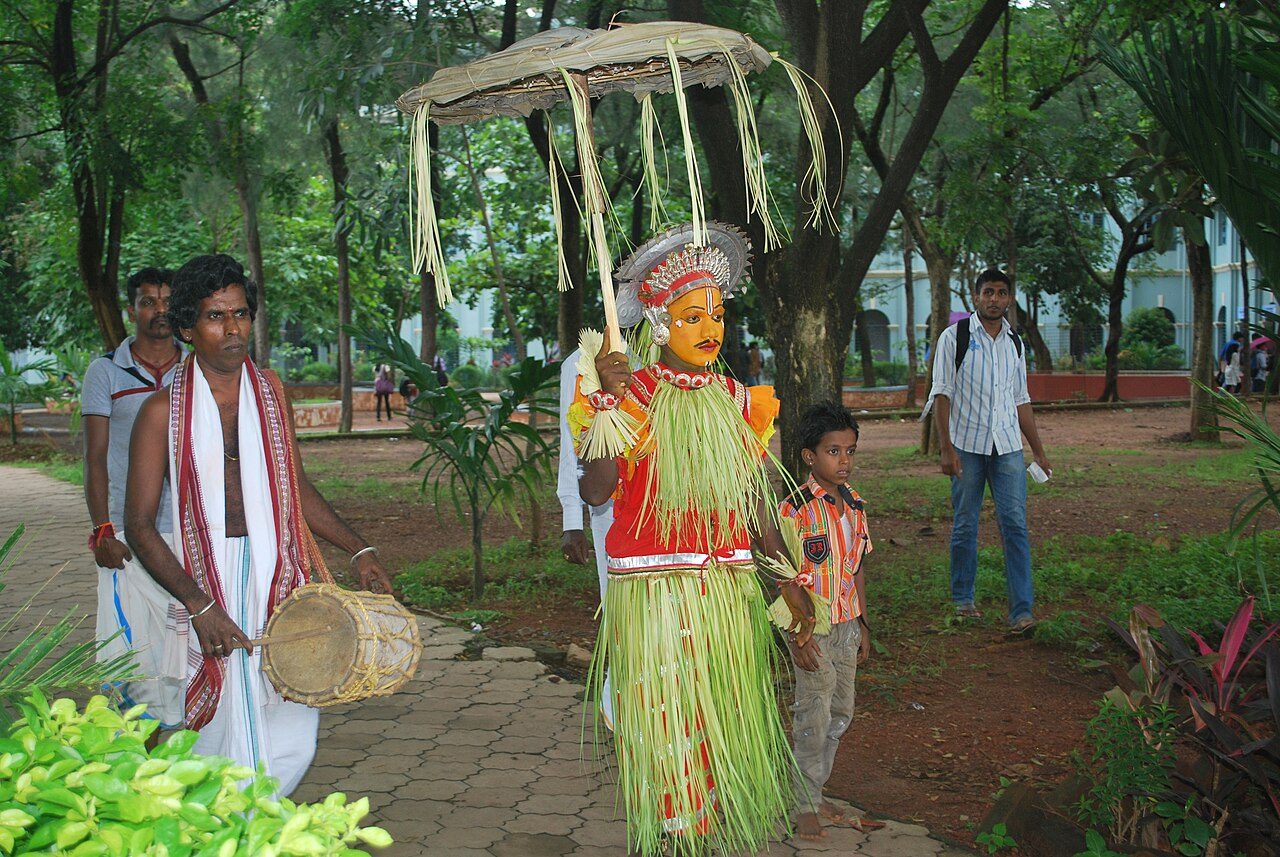
Classical Indian musical theatre is a group of theatrical forms in which the performer presents a narrative via stylized gesture, an array of hand positions, and miming to play different characters, actions, and landscapes. Recitation, music, and even percussive footwork sometimes accompany the performance. The Natya Shastra, an ancient treatise on theatre by Bharata Muni, mentions silent performance, or mukabhinaya. In Kathakali, stories from Indian epics are told with facial expressions, hand signals and body motions. Performances are accompanied by songs narrating the story while the actors act out the scene, followed by actor detailing without background support of narrative song.. The Japanese Noh tradition has greatly influenced many contemporary mime and theatre practitioners including Jacques Copeau and Jacques Lecoq because of its use of mask work and highly physical performance style. Butoh, though often referred to as a dance form, has been adopted by various theatre practitioners as well. 1
In film
Before the work of Étienne Decroux there was no major treatise on the art of mime, and so any recreation of mime as performed prior to the twentieth century is largely conjecture, based on interpretation of diverse sources. However, the twentieth century also brought a new medium into widespread usage: the motion picture. The restrictions of early motion picture technology meant that stories had to be told with minimal dialogue, which was largely restricted to intertitles. This often demanded a highly stylized form of physical acting largely derived from the stage. Thus, mime played an important role in films prior to advent of talkies (films with sound or speech). The mimetic style of film acting was used to great effect in German Expressionist film. Silent film comedians like Charlie Chaplin, Harold Lloyd, and Buster Keaton learned the craft of mime in the theatre, but, through film, they had a profound influence on mimes working in live theatre decades after their deaths. Indeed, Chaplin may be the best-documented mime in history. Harpo Marx, of the Marx Brothers comedy team, continued the mime tradition in the sound film era, his silent persona working in counterpoint to the verbal comedy of his brothers Groucho and Chico. The famous French comedian, writer, and director Jacques Tati achieved his initial popularity working as a mime, and his later films had only minimal dialogue, relying instead on many subtle expertly choreographed visual gags. Tati, like Chaplin before him, would mime out the movements of every single character in his films and ask his actors to repeat them. 1
The text above is adapted from the Wikipedia article “Mime artist”, available under the Creative Commons Attribution-ShareAlike 4.0 licence. 1
mime is theatrical genre, performance art, according to the structured record cited below. This entry was generated automatically from that record and has not yet been reviewed by a person familiar with the tradition. 2
The source record links this tradition to 25 external registers, which can be verified through the citation. 2
mime Global Archive की पारंपरिक नृत्य और लोक नाट्य से जुड़ी एक जीवित परंपरा है। यह प्रलेख फ़ोकरूम (folkroom) सार्वजनिक अभिलेखागार में CC BY-SA 4.0 के अंतर्गत उपलब्ध है।
mime என்பது Global Archive பகுதியைச் சேர்ந்த பாரம்பரிய நடனம் மற்றும் சடங்கு நாடகம் மரபாகும். folkroom பொது ஆவணக் காப்பகத்தில் (CC BY-SA 4.0) ஆதாரங்களுடன் பதிவு செய்யப்பட்டுள்ளது.
mime হলো Global Archive অঞ্চলের ঐতিহ্যবাহী নৃত্য ও লোকনাট্য ধারার একটি জীবন্ত ঐতিহ্য। ফোকরুম (folkroom) উন্মুক্ত আর্কাইভে (CC BY-SA 4.0) প্রামাণ্য সূত্রসহ সংরক্ষিত।
mime es una tradición viva de danza tradicional y teatro ritual documentada en Global Archive. Registro público de acceso abierto en folkroom (CC BY-SA 4.0).
mime est une tradition vivante de danse traditionnelle et théâtre rituel originaire de Global Archive. Dossier documentaire en libre accès sur folkroom (CC BY-SA 4.0).
mime adalah tradisi hidup tari tradisional dan teater ritual yang terdokumentasi di Global Archive. Arsip publik akses terbuka di folkroom (CC BY-SA 4.0).