The tradition & historical record
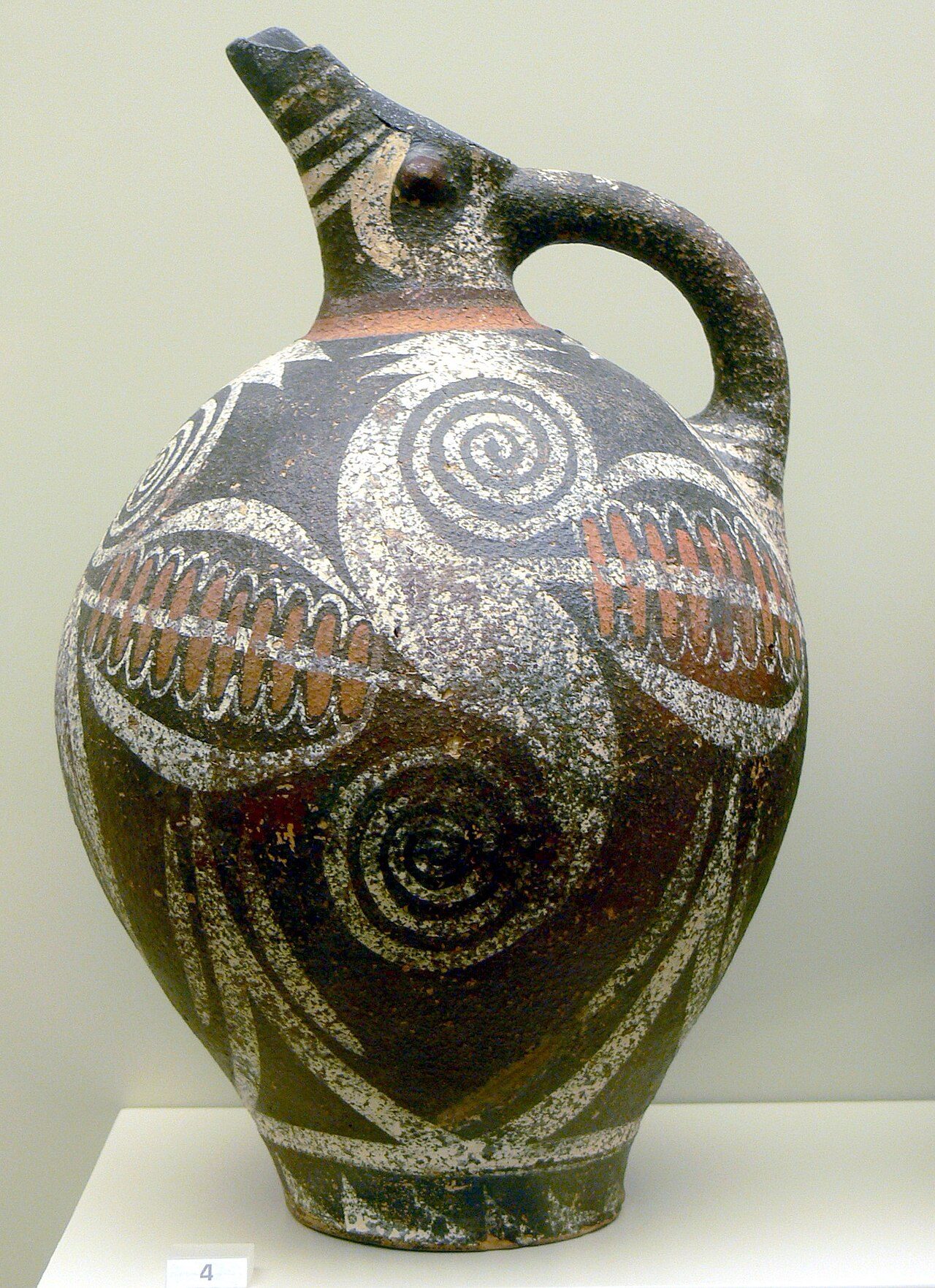
6 min read · 2 sourcesMinoan art is the art produced by the Bronze Age Aegean Minoan civilization from about 3000 to 1100 BC, though the most extensive and finest survivals come from approximately 2300 to 1400 BC. It forms part of the wider grouping of Aegean art, and in later periods came for a time to have a dominant influence over Cycladic art. Since wood and textiles have decomposed, the best-preserved (and most instructive) surviving examples of Minoan art are its pottery, palace architecture (with frescos which include "the earliest pure landscapes anywhere"), small sculptures in various materials, jewellery, metal vessels, and intricately-carved seals. It was influenced by the neighbouring cultures of Ancient Egypt and the ancient Near East, which had produced sophisticated urban art for much longer, but the character of the small but wealthy mercantile Minoan cities was very different, with little evidence of large temple-based religion, monarchs, or warfare, and "all the imaginative power and childlike freshness of a very young culture". All these aspects of the Minoan culture remain rather mysterious. Sinclair Hood described an "essential quality of the finest Minoan art, the ability to create an atmosphere of movement and life although following a set of highly formal conventions". The largest and best collection of Minoan art is in the Heraklion Archaeological Museum ("AMH") near Knossos, on the northern coast of Crete. 1
Subjects and style
Minoan art has a variety of subject-matter, much of it appearing across different media, although only some styles of pottery include figurative scenes. Bull-leaping appears in painting and several types of sculpture, and is thought to have had a religious significance; bulls' heads are also a popular subject in terracotta and other sculptural materials. There are no figures that appear to be portraits of individuals, or are clearly royal, and the identities of religious figures is often tentative, with scholars uncertain whether they are deities, clergy or devotees. Equally, whether painted rooms were "shrines" or secular is far from clear; one room in Akrotiri has been argued to be a bedroom, with remains of a bed, or a shrine. Animals, including an unusual variety of marine fauna, are often depicted; the "Marine Style" is a type of painted palace pottery from MM III and LM IA that paints sea creatures including octopus spreading all over the vessel, and probably originated from similar frescoed scenes; sometimes these appear in other media. Scenes of hunting and warfare, and horses and riders, are mostly found in later periods, in works perhaps made by Cretans for a Mycenaean market, or Mycenaean overlords of Crete. 1
While Minoan figures, whether human or animal, have a great sense of life and movement, they are often not very accurate, and the species is sometimes impossible to identify; by comparison with Ancient Egyptian art they are often more vivid, but less naturalistic. However. 1
Painting
Several frescoes have been found, on Crete normally in partial fragments which require a good deal of reconstruction; sometimes only 5% of a reconstructed section is original. Surviving figurative examples date from MM III onwards, the same technique having been used earlier for plain colours and simple patterns. They were probably inspired by Syrian or Egyptian examples, the former perhaps more likely. The most important sites are Knossos and on Santorini, and they were found both in the large "palaces" of the cities (but not all of them) and in "villas" and larger city houses. The frescos include many depictions of people, with the sexes distinguished by a "violent contrast" of colour that is more extreme than the equivalent in Egypt; the men's skin is reddish-brown, and the women's white. Probably the most famous fresco is the bull-leaping fresco. Other well-known sections are the female fragment known as La Parisienne (from the "Camp Stool Fresco"), and the Prince of the Lilies (mostly restored), both from Knossos, and the Akrotiri Boxer Fresco, but there are many others, both from Crete itself and related Aegean sites. Arthur Evans, the first archaeologist to excavate Minoan Knossos, hired the Swiss artist Emile Gilliéron and his son, Émile, as the chief fresco restorers at Knossos. The restorations have been often criticised subsequently; and are now viewed with a "healthy skepticism" as "overconfident" by specialists. In one important case a figure of a monkey was turned into a boy; in fact human figures do not usually appear in "landscape" fresco scenes. Spyridon Marinatos excavated the ancient site at Akrotiri, then capital of Santorini, which included the Wall Paintings of Thera, frescoes which make it the second-most famous Minoan site. 1
Relief and miniature frescos
A different type of fresco is the relief fresco, also called "painted stuccos", where the plaster has been formed into a relief of the main subject before it is painted, probably in imitation of Egyptian stone reliefs. The technique is mostly, but not exclusively, used at Knossos, between MM II and LM I. The figures are large, and include humans, bulls, griffins and a lion seizing prey; the few fragments worked up into the so-called Prince of the Lilies (AMH) are of this type. There may also have been ceiling reliefs of patterns of ornament; the Minoans also painted some floors with "normal" frescos, and the well-known scene of dolphins from Knossos may have been a floor-painting. There are also a few "miniature frescos" where, rather than the usual few large figures, there are scenes with large numbers of small figures. The small figures represented as woven designs on the clothes of large figures are covered by the same term. Because of the large groups shown, and sometimes the wider landscape (as in the Ship Procession marine landscape from Akrotiri mentioned above), the miniature frescos include some of the most interesting scenes. The very late limestone Hagia Triada sarcophagus, is uniquely elaborately painted and generally very well preserved. It records funerary ceremonies at a time when Crete was probably ruled by the Mycenaeans. 1
Sculpture
Minoan large stone sculptures are very rare, in notable contrast to the contemporary mainland cultures, and later Ancient Greek art. However, this may partly be explained by the lack of suitable stone, as there are smaller sculptures and some "evidence for the existence of large wooden and even metal statues in Crete", which may well have been acrolithic and brightly painted. The Palaikastro Kouros is an all but unique find of a chryselephantine statuette of a male (kouros) that may have been a cult image. The body is made of hippopotamus tooth covered with gold foil, the head of serpentine stone with rock crystal eyes and ivory details. Standing roughly 50 cm (19.5 in) talI, it was deliberately smashed when the city was pillaged in the LM period, and has been reconstructed from many tiny pieces. 1
Small sculpture of a number of types was often very finely made. 1
Pottery
Many different styles of … 1
The text above is adapted from the Wikipedia article “Minoan art”, available under the Creative Commons Attribution-ShareAlike 4.0 licence. 1
Minoan art is art produced by the Minoan civilization, according to the structured record cited below. This entry was generated automatically from that record and has not yet been reviewed by a person familiar with the tradition. 2
The source record links this tradition to 11 external registers, which can be verified through the citation. 2