The tradition & historical record
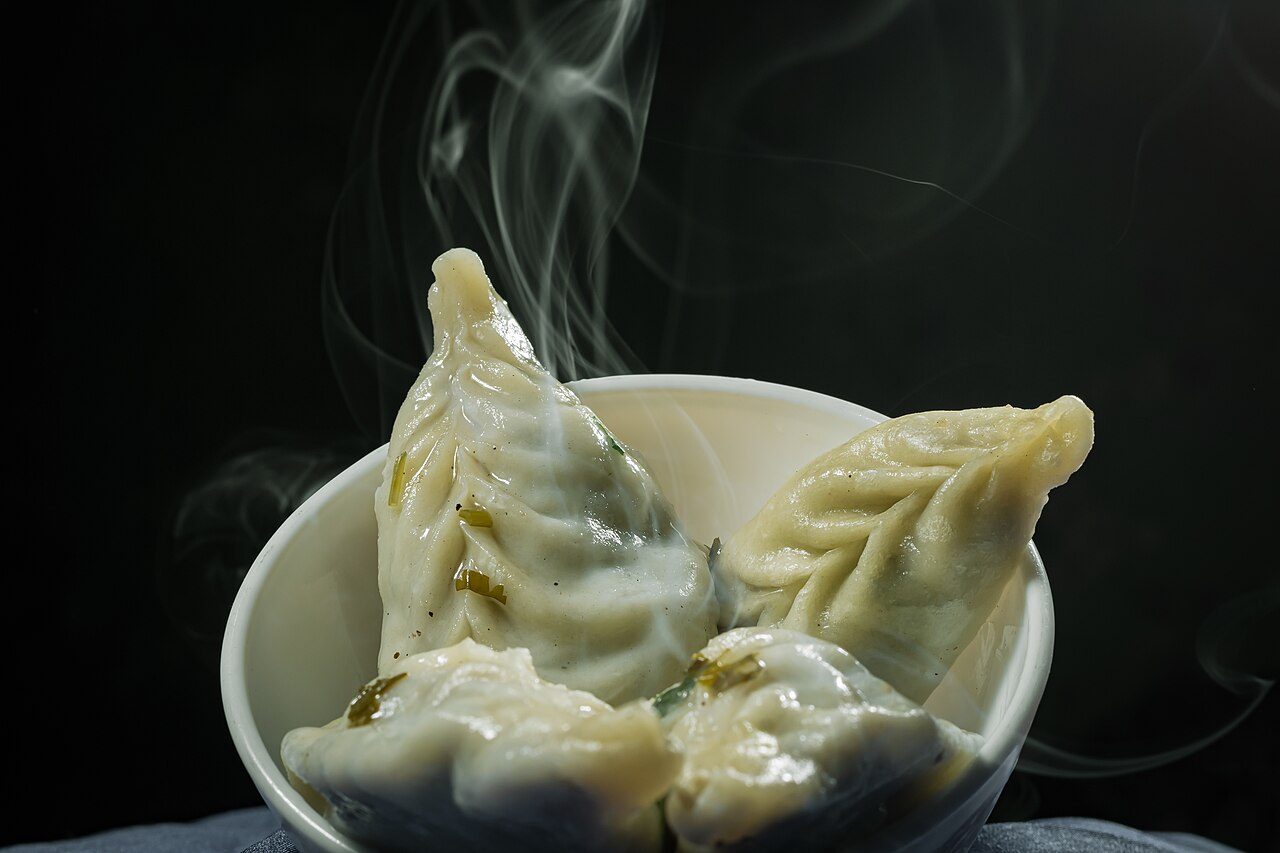
5 min read · 2 sourcesMomos are a type of steamed, filled dumpling in Nepalese and Tibetan cuisine, also popular in neighbouring Bangladesh, Bhutan, and India. They are usually served with a dipping sauce known as achar or chutney. They can also be served in soup, such as jhol momo or mokthuk. 1
Names
In Nepali, they are called मम (mama, IPA: [mʌmʌ]) as well as मःम (ma:ma), मःमः (ma:ma:), ममः (mama:), मोमो (momo), मोःमो (mo:mo), मोःमोः (mo:mo:), मोमोः (momo:), and ममो (mamo). In the Newar language, they are known as ममचा (mamacha). In Tibetan, they are called མོག་མོག (mog mog, IPA: [mo˩˨.mo˥˨]). The Tibetan word may have been borrowed from the Chinese momo (馍馍), a name traditionally used in northwestern Chinese dialects for steamed wheat buns and bread. The word mo (馍) itself means wheat-flour food products or mantou (馒头)—steamed buns. Historically, Chinese names for steamed buns did not distinguish between those with or without fillings until the term baozi (包子) emerged during the Song dynasty, between the 10th and 13th centuries. However, in eastern regions of China, such as Jiangsu and Shanghai, mantou continues to carry both meanings. The history of dumplings in China shows that they were popular during the Northern and Southern dynasties (420–589 AD). Dumplings dated to between 499 AD and 640 AD have been found in the Astana Cemetery in northwestern China. 1
Origin
One legend states that the 7th-century Nepali princess Bhrikuti, who introduced Buddhism to Tibet, also introduced momos there. Historically speaking, it is generally believed that dumplings were brought from China by the Mongols in the 13th century. Debate exists about whether momos spread from the Kathmandu Valley of Nepal to Tibet or the other way around. As the dish was initially popular among the Newar community, one prevalent belief is that traveling Nepali Newar merchants took the recipe from Tibet, where they traded, and brought it to Nepal. After arriving in the Indo-Gangetic Plains, the most common meat in momos was chicken, and vegetable momos were introduced to feed the large population of vegetarian Hindus. A large number of Tibetans emigrated to India following the 1959 Tibetan uprising, bringing their recipes for momos with them. 1
Preparation
The earliest Tibetan dumplings were made of highland barley flour as the outer covering, and beef and mutton as the filling. Nowadays, a simple white-flour-and-water dough is preferred to make the outer covering of momos. Sometimes, a little yeast or baking soda is added to give a more doughy texture to the finished product. Traditionally, momos are prepared with ground/minced meat, potatoes, and leek filling. Nowadays, the fillings have become more elaborate, and momos are prepared with virtually any combination of ground meat, vegetables, tofu, mushrooms, paneer cheese, soft chhurpi cheese, and vegetable and meat combinations. 1
Meat: Different types of meat fillings are popular in different regions. In Nepal, Tibet, Sikkim, and Bhutan, common meat fillings include pork, chicken, goat, and water buffalo. In the Himalayan regions of Nepal and India, lamb and yak meat are more common. Minced meat is combined with any or all of the following: onions/shallots, garlic, ginger, and cilantro/coriander. Some people also add finely puréed tomatoes and soy sauce. Vegetables: Finely chopped cabbage, carrot, soy granules, potato, flat bean, or chayote are used as fillings in Nepal. Cheese: Usually fresh paneer or traditional soft chhurpi is used. This variety is common in Eastern Nepal. Khoa: Momos filled with milk solids mixed with sugar are popular as a dessert in the Kathmandu Valley. The dough is rolled into small circular flat pieces. The filling is enclosed in the circular dough cover, either in a round pocket or a half-moon or crescent shape. Fatty meat is preferred, because it produces flavourful, juicy momos. A little oil is sometimes added to the lean ground/minced meat to keep the filling moist. 1
Variations
Momos are traditionally steamed but can also be deep-fried or pan-fried and cooked in soup. They are usually served with chilli garlic sauce and pickled daikon in Tibet. In Nepal, popular dipping sauces include tomato-based chutneys or sesame or peanut or soybean-based sauces called achar. Sauces can be thick or thin in consistency, depending on the eatery. 1
Momos may also be served in a thin sauce or broth, known as jhol. Jhol momo (Nepali: झोल मोमो) is a Nepali preparation in which momos are served in a thin, spiced jhol rather than with a separate dipping achar. The composition of the jhol varies: it may be sesame- or tomato-based, while street-style versions may derive their body from roasted soybeans, peanuts, and sesame seeds and be flavoured with mustard oil, onion, garlic, ginger, green chillies, coriander, and a souring ingredient such as lapsi or lime juice. The jhol is typically thin enough to pour freely over the momos, while retaining enough body to cling lightly to them. Mokthuk, from Tibet, is a variation of the thukpa soup, using small momos. Other variations of momos include: 1
C-momo, steamed or fried, then served in chili sauce. Dhapu momo, from Chinese da bao (大包), or "big bun", also known as "Tibetan momo", a Nepali dumpling that is typically larger and flatter than other versions. This was possibly introduced to Nepal via two routes. 1
The text above is adapted from the Wikipedia article “Momo (food)”, available under the Creative Commons Attribution-ShareAlike 4.0 licence. 1
momo is dumpling of a style typical in or near Nepal, according to the structured record cited below. This entry was generated automatically from that record and has not yet been reviewed by a person familiar with the tradition. 2
The source record links this tradition to 2 external registers, which can be verified through the citation. 2