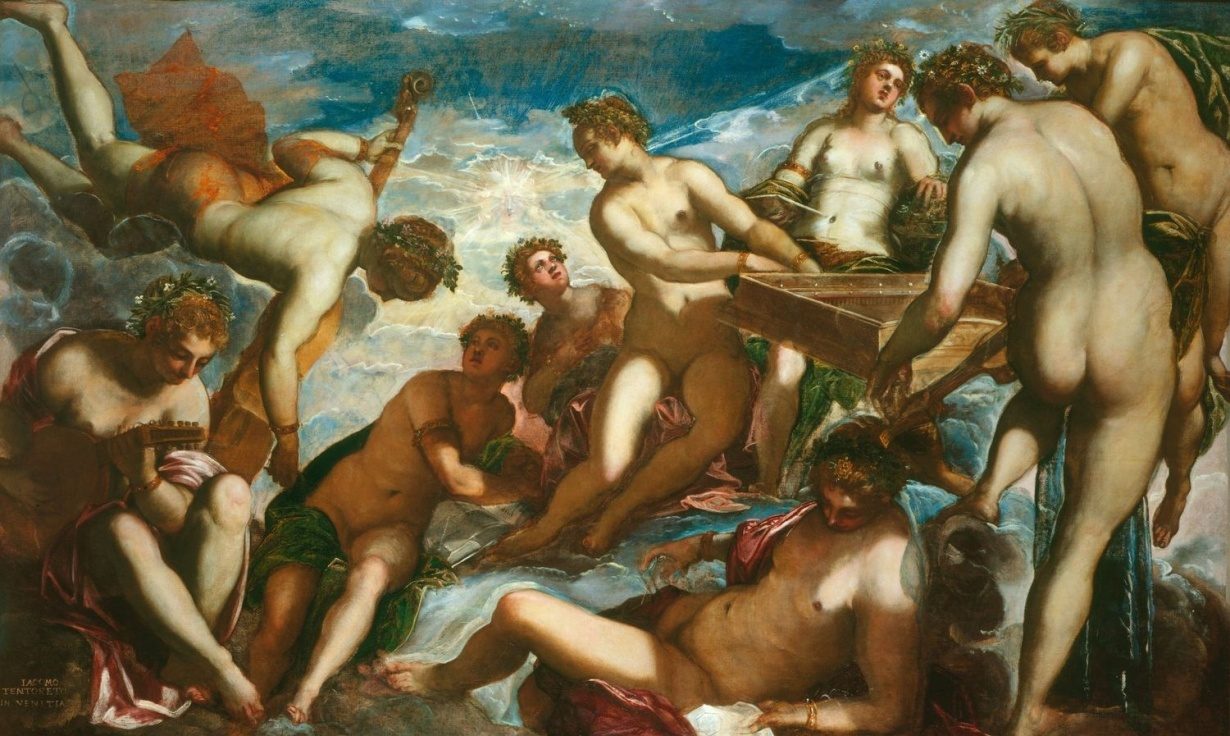
The tradition & historical record
6 min read · 2 sourcesIn ancient Greek religion and mythology, the Muses (Ancient Greek: Μοῦσαι, romanized: Moúsai, [ˈmuː.sai̯]; singular: Μοῦσα, Moúsa, [ˈmuː.sa]; Greek: Μούσες, romanized: Múses, [ˈmuː.ses]) were the inspirational goddesses of literature, science, and the arts. They were considered the source of the knowledge embodied in the poetry, lyric songs, and myths that were related orally for centuries in ancient Greek culture. The number and names of the Muses differed by region, but from the Classical period the number of Muses was standardized to nine, and their names were generally given as Calliope, Clio, Polyhymnia, Euterpe, Terpsichore, Erato, Melpomene, Thalia, and Urania. In modern figurative usage, a muse is a person who serves as someone's source of artistic inspiration. 1
Etymology
The word Muses (Ancient Greek: Μοῦσαι, romanized: Moûsai) perhaps came from the o-grade of the Proto-Indo-European root *men- (the basic meaning of which is 'put in mind' in verb formations with transitive function and 'have in mind' in those with intransitive function), or from root *men- ('to tower, mountain') since all the most important cult-centres of the Muses were on mountains or hills. R. S. P. Beekes rejects the latter etymology and suggests that a Pre-Greek origin is also possible. 1
Number and names
The earliest known records of the Muses come from Boeotia (Boeotian muses). Some ancient authorities regarded the Muses as of Thracian origin. In Thrace, a tradition of three original Muses persisted. In the first century BC, Diodorus Siculus, in his Library of History (Bibliotheca Historica), cited Homer and Hesiod to the contrary, observing: 1
Writers similarly disagree also concerning the number of the Muses; for some say that there are three, and others that there are nine, but the number nine has prevailed since it rests upon the authority of the most distinguished men, such as Homer and Hesiod and others like them. Diodorus additionally states that Osiris first recruited the nine Muses, along with the satyrs, while passing through Aethiopia, before embarking on a tour of all Asia and Europe, teaching the arts of cultivation wherever he went. According to Hesiod's account in his Theogony (c. 700 BC), generally followed by the writers of antiquity, the Nine Muses were the nine daughters of Zeus and Mnemosyne (i.e., "Memory" personified), figuring as personifications of knowledge and the arts, especially poetry, literature, dance and music. The Roman scholar Varro (116–27 BC) relates that there are only three Muses: one born from the movement of water, another who makes sound by striking the air, and a third who is embodied only in the human voice. They were called Melete ("Practice"), Mneme ("Memory") and Aoide ("Song"). 1
Mythology
According to Hesiod's Theogony (seventh century BC), they were daughters of Zeus, king of the gods, and Mnemosyne, Titan goddess of memory. Hesiod narrates that the Muses brought to people forgetfulness, that is, the forgetfulness of pain and the cessation of obligations. For Alcman and Mimnermus, they were even more primordial, springing from the early deities Uranus and Gaia. Gaia is Mother Earth, an early mother goddess who was worshipped at Delphi from prehistoric times, long before the site was rededicated to Apollo, possibly indicating a transfer to association with him after that time. Sometimes the Muses are referred to as water nymphs, associated with the springs of Helicon and with Pieris. It was said that the winged horse Pegasus touched his hooves to the ground on Helicon, causing four sacred springs to burst forth, from which the Muses, also known as pegasides, were born. Athena later tamed the horse and presented him to the Muses (compare the Roman inspiring nymphs of springs, the Camenae, the Völva of Norse mythology and also the apsaras in the mythology of classical India). Classical writers set Apollo as their leader, Apollon Mousēgetēs ('Apollo Muse-leader'). In one myth, the Muses judged a contest between Apollo and Marsyas. They also gathered the pieces of the dead body of Orpheus, son of Calliope, and buried them in Leibethra. Pausanias records a tradition of two generations of Muses; the first are the daughters of Ouranos and Gaia, the second of Zeus and Mnemosyne. 1
Children
Calliope had two sons, Ialemus and Orpheus, with Apollo. In another version of the story, the father of Orpheus was the Thracian king Oeagrus, but Apollo adopted him and taught him the skill of lyre while Calliope trained him in singing. Linus was said to have been the son of Apollo and one of the Muses, either Calliope or Terpsichore or Urania. Rhesus was the son of Strymon and Calliope or Euterpe. The Sirens were the children of Achelous and Melpomene or Terpsichore. Kleopheme was the daughter of Erato and Malos. Hyacinth was the son of Clio, according to an unpopular account. Hymenaeus was assigned as Apollo's son by one of the Muses, either Calliope, or Clio, or Terpsichore, or Urania. Corybantes were the children of Thalia and Apollo. 1
Contests
Several myths describe contests between the Muses and their challengers. Thamyris was a poet and musician known for his skill in singing and playing the cithara. He challenged the Muses to a musical contest, boasting that he could overcome them in song and that his voice was better than theirs. According to some accounts, he agreed that if he won he would sleep with all the Muses, but if he lost they could deprive him of whatever they wished. The Muses defeated him and, in their anger, took away his gift of song, made him forget his music, and deprived him of his sight. The sirens also challenged the Muses. In the sanctuary of Hera in Coroneia was a statue created by Pythodorus of Thebes, depicting Hera holding the sirens. According to the myth, Hera persuaded the sirens to challenge the Muses to a singing contest. After the Muses won, they are said to have plucked the sirens' feathers and used them to make crowns for themselves. According to Stephanus of Byzantium, the sirens, overwhelmed by their loss, cast off their feathers from their shoulders, turned white and then threw themselves into the sea. As a result, the nearby city was named Aptera ("featherless") and the nearby islands were called the Leukai ("the white ones"). John Tzetzes recounts that after defeating the sirens, the Muses crowned themselves with the sirens' wings, except for Terpsichore who was their mother, adding that the city of Aptera named after this event. Furthermore, in one of his letters, Julian the Emperor mentions the Muses' victory over the sirens. In other stories, nine daughters challenged the Muses. 1
The text above is adapted from the Wikipedia article “Muses”, available under the Creative Commons Attribution-ShareAlike 4.0 licence. 1
Muse is goddess of the inspiration of literature, science and the arts, according to the structured record cited below. This entry was generated automatically from that record and has not yet been reviewed by a person familiar with the tradition. 2
The source record links this tradition to 54 external registers, which can be verified through the citation. 2