The tradition & historical record
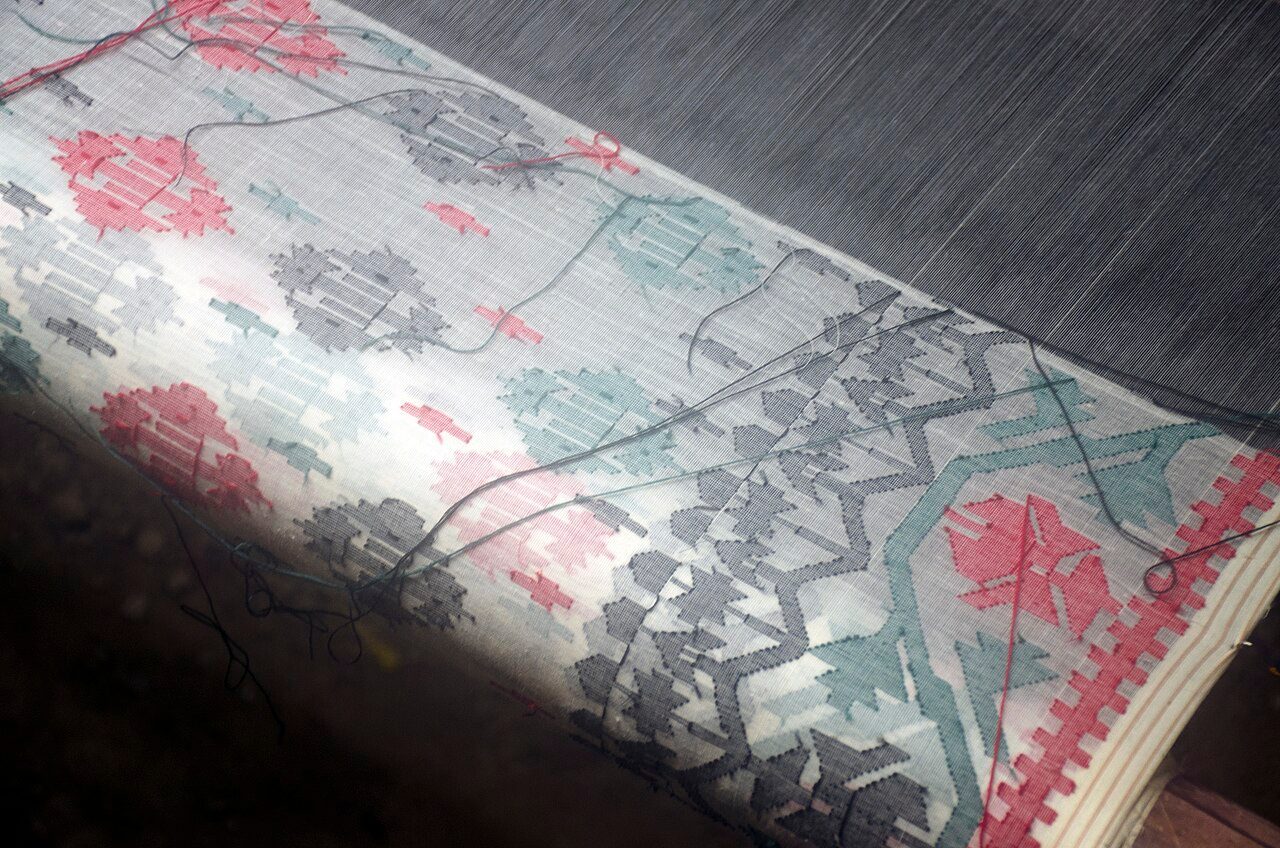
6 min read · 2 sourcesMuslin () is a cotton fabric of plain weave. It is made in a wide range of weights from delicate sheers to coarse sheeting. Muslin was produced in different regions of South Asia; the Bengal region was the main manufacturing area. While there were several cotton production centers in Bengal, the cloth produced in Sonargaon, 15 miles from east of Dhaka, was of the highest quality in the subcontinent. As Dhaka became the capital of Mughal Bengal following its conquest by the Mughals, the Muslin produced around Dhaka became more accessible to distant markets, including Central Asia where fine muslin was known as "Daka". The muslin produced at Dhaka, Sonargaon and its surrounding areas was of excellent quality, which is popularly known as Dhaka muslin. Muslin was made in Dhaka (Sonargaon) from very fine yarn, which is made from a cotton called phuti carpus, endemic to Bangladesh. A minimum of 300-count yarn was used for the muslin, making the muslin as transparent as glass. There were about 28 varieties of muslin, of which jamdani is still widely used. During the 17th and 18th centuries, Mughal Bengal emerged as the foremost muslin exporter in the world, with Dhaka as capital of the worldwide muslin trade. 1
Etymology
It is commonly believed that it gets its name from the city of Mosul, Iraq. The dictionary Hobson Jobson published by two Englishmen named S. C. Burnell and Henry Yule mentions that the word muslin comes from 'Mosul'—a famous trading center and city in Iraq. Mosul produced a very fine cloth, which became known as muslin in Europe. Some scholars suggest the name may have derived from Masulipatnam, India. Masulipatnam (modern Machilipatnam, Andhra Pradesh) is a prominent port town on the Coromandel Coast of India that was a major center for cotton textile production and export from the early medieval period. Masulipatnam was well known to Arab, Persian, and later European traders—particularly the Portuguese, Dutch, and English—for its fine cotton fabrics, including lightweight plain-woven cloths comparable to what later came to be called muslin in Europe. Some scholars have suggested that European merchants may have derived the term muslin from the name of this port, in a manner similar to other textlile names such as calico (from Calicut) and denim (from de Nîmes), reflecting a common practice of naming fabrics after their principal places of trade rather than their sites of manufacture. 1
Early period
A medieval Indian kingdom called 'Ruhma' is found in the writings of Sulaiman al-Tajir, a 9th century Arab merchant who visited Bengal under the Pala Empire. He described it as a place where fine cotton fabric was produced. There were cotton fabrics so fine and delicate that a single piece of cloth could be easily moved through the ring. Very fine cotton cloth was made in Mosul in the 12th century and later. Arab traders carried it to Europe as a commodity, and enchanted Europeans called it muslin. In 1298 AD, Marco Polo described in his book The Travels that muslin is made in Mosul, Iraq. Ibn Battuta, a Moroccan traveler who came to Bengal in the middle of the 14th century, praised the cotton cloth made in Sonargaon in his book The Rihla. Chinese writers who came to Bengal in the fifteenth century praised its cotton cloth. 1
Mughal period
The muslin industry flourished in Bengal between the sixteenth and eighteenth centuries. The main muslin production centers in Bengal during this period were Dhaka and its surrounding areas. The 16th-century English traveller Ralph Fitch lauded the muslin he saw in Sonargaon. He visited India in 1583, described Sonargaon, "as a town ... where there is the best and finest cloth made in all India". During the reign of Mughal Emperor Jahangir, Islam Khan Chishti shifted the capital from Rajmahal to Dhaka in 1610 AD, Dhaka gained prominence as the center of trade and commerce of Bengal. During this period the muslin produced in Dhaka achieved excellence, and the muslin produced here became world famous as Dhaka muslin. Mughal Emperor Akbar's courtier, Abul Fazal, praised the fine cotton fabric produced in Sonargaon (near Dhaka). Abul Fazl wrote "the Sarkar of Sonargaon produces a species of muslin very fine and in great quantity". European traders began arriving in the Bengali capital of Dhaka in the early 17th-century, and these traders procured cotton cloth and muslin from Bengal for export to Europe. During the 17th and 18th-centuries, Mughal Bengal emerged as the foremost muslin exporter in the world, with Mughal Dhaka as capital of the worldwide muslin trade. It became highly popular in 18th-century France and eventually spread across much of the Western world. Dhaka muslin was first showcased in the UK at The Great Exhibition of the Works of Industry of All Nations in 1851. 1
Decline under Company rule
During the period of Company rule, the East India Company imported British-produced cloth into the Indian subcontinent, but became unable to compete with the local muslin industry. The Company administration initiated several policies in an attempt to suppress the muslin industry, and muslin production subsequently experienced a period of decline. It has been alleged that in some instances Indian weavers were rounded up and their thumbs chopped off, although this has been refuted by historians as a misreading of a report by William Bolts from 1772. Many of the threatened weavers fled East Bengal and settled in the eastern districts of West Bengal, these districts were famous for the cotton products of Bengal. The quality, fineness and production volume of Bengali muslin declined as a result of these policies, continuing when India transitioned from Company rule to British Crown control. 1
Bangladesh
In the second decade of the 21st century, a scheme called Bangladesh Golden Heritage Muslin Yarn Manufacturing Technology and Muslin Cloth Restoration was undertaken to restore and develop the muslin production system in Bangladesh. Under this project, samples of muslin from different countries including India and Britain were inspected and data collected. Old maps of the Meghna River were examined and combined with modern satellite imagery to identify possible locations – where phuti carpus plants could still be found. From there, the genetic sequences of the recovered cotton plants were made and compared with the original ones. After testing, a carpus plant was identified, which was 70 percent identical to the phuti carpus. An island in the Meghna, 30 km north of Dhaka, was selected for the production of this carpus, where some seeds were sown experimentally in 2015, and the first cotton was harvested that year. But at that time there were no skilled spinners in Bangladesh to produce fine yarn. On the other hand, Indian spinners were able to produce 200-300-400-500 count fine yarn from cotton. As a result, in a joint venture with Indian spinners, a hybrid yarn of 200 and 300 count was produced by combining common and phuti carpus cotton. 1
The text above is adapted from the Wikipedia article “Muslin”, available under the Creative Commons Attribution-ShareAlike 4.0 licence. 1
muslin is cotton fabric of plain weave, according to the structured record cited below. This entry was generated automatically from that record and has not yet been reviewed by a person familiar with the tradition. 2
The source record links this tradition to 16 external registers, which can be verified through the citation. 2