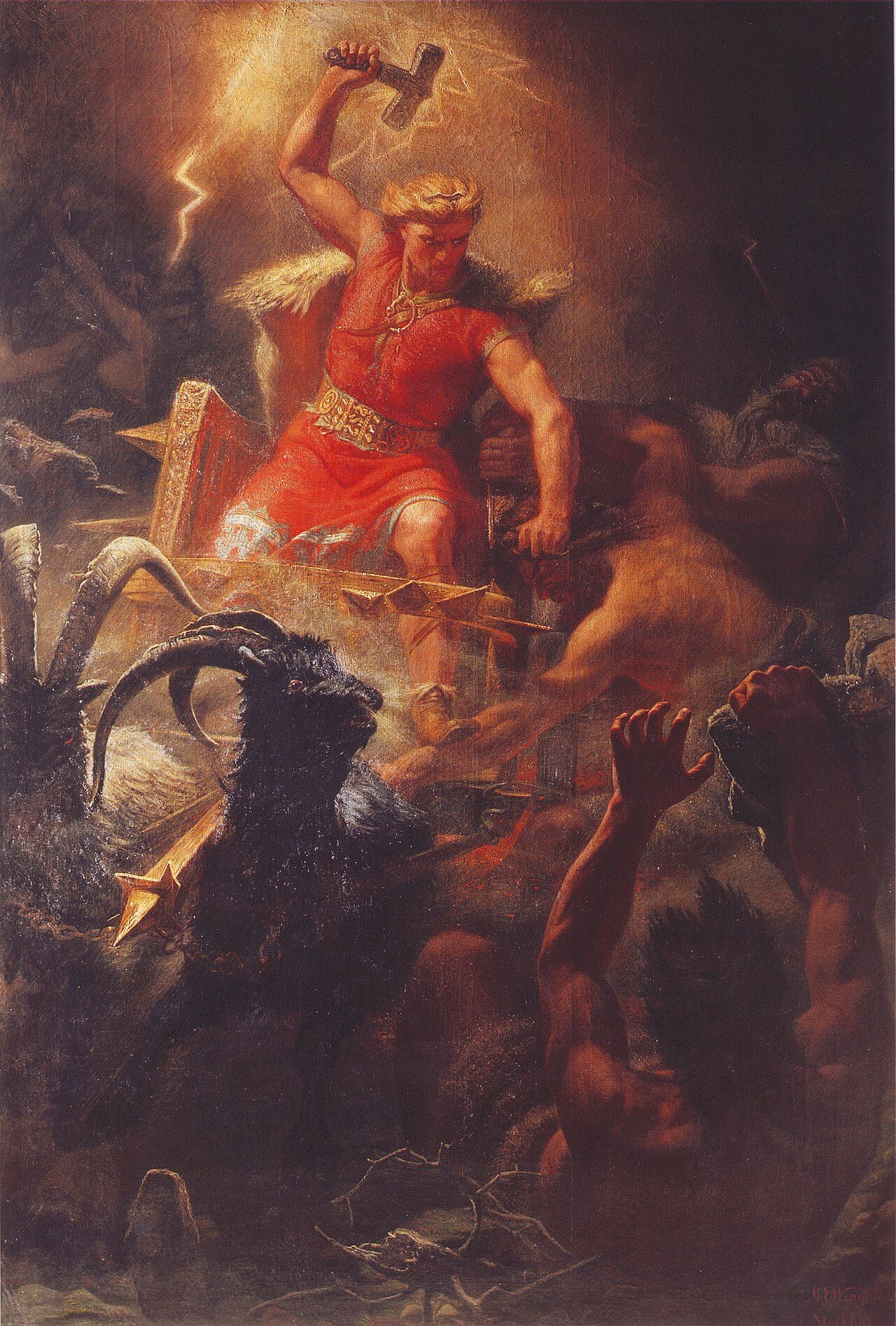
The tradition & historical record
6 min read · 2 sourcesMyth is a genre of folklore consisting primarily of narratives that play a fundamental role in a society. For scholars, this is different from the ordinary sense of the term myth, meaning a belief that is not true, as the veracity of a piece of folklore is entirely irrelevant to determining whether it constitutes a myth. Myths are often endorsed by religious and secular authorities, and may be natural or supernatural in character. Many societies group their myths, legends, and history together, considering myths and legends to be factual accounts of their remote past. In particular, creation myths take place in a primordial age when the world had not achieved its later form. Origin myths explain how a society's customs, institutions, and taboos were established and sanctified. National myths are narratives about a nation's past that symbolize the nation's values. There is a complex relationship between recital of myths and the enactment of rituals. 1
Etymology
The word myth comes from Ancient Greek μῦθος (mȳthos), meaning 'speech', 'narrative', or 'fiction'. In turn, Ancient Greek μυθολογία (mythología 'story', 'legends', or 'story-telling') combines the word mȳthos with the suffix -λογία (-logia 'study'). Accordingly, Plato used mythología as a general term for fiction or story-telling of any kind. This word was adapted into other European languages in the early 19th century, in a much narrower sense, as a scholarly term for "[a] traditional story, especially one concerning the early history of a people or explaining a natural or social phenomenon, and typically involving supernatural beings or events." The Greek term mythología was then borrowed into Late Latin, occurring in the title of Latin author Fabius Planciades Fulgentius' 5th-century Mythologiæ to denote what is now referred to as classical mythology—i.e., Greco-Roman etiological stories involving their gods. Fulgentius's Mythologiæ explicitly treated its subject matter as allegories requiring interpretation and not as true events. The Latin term was then adopted in Middle French as mythologie. Whether from French or Latin usage, English adopted the word mythology in the 15th century, initially meaning 'the exposition of a myth or myths', 'the interpretation of fables', or 'a book of such expositions'. The word is first attested in John Lydgate's Troy Book (c. 1425). From Lydgate until the 17th or 18th century, mythology meant a moral, fable, allegory or a parable, or collection of traditional stories, understood to be false. It came eventually to be applied to similar bodies of traditional stories among other polytheistic cultures around the world. Thus mythology entered the English language before myth. 1
Protagonists and structure
The main characters in myths are usually non-humans, such as gods, demigods, and other supernatural figures. Others include humans, animals, or combinations in their classification of myth. Stories of everyday humans, although often of leaders of some type, are usually contained in legends, as opposed to myths. Myths are sometimes distinguished from legends in that myths deal with gods, usually have no historical basis, and are set in a world of the remote past, very different from that of the present. 1
Definitions
Definitions of myth vary to some extent among scholars, though Finnish folklorist Lauri Honko offers a widely-cited definition: 1
Myth, a story of the gods, a religious account of the beginning of the world, the creation, fundamental events, the exemplary deeds of the gods as a result of which the world, nature and culture were created together with all parts thereof and given their order, which still obtains. A myth expresses and confirms society's religious values and norms, it provides a pattern of behavior to be imitated, testifies to the efficacy of ritual with its practical ends and establishes the sanctity of cult. Professor José Manuel Losada defines myth as "a functional, symbolic and thematic narrative of one or several extraordinary events with a transcendent, sacred and supernatural referent; that lacks, in principle, historical testimony; and that refers to an individual or collective, but always absolute, cosmogony or eschatology". According to the holistic myth research by assyriologist Annette Zgoll and classic philologist Christian Zgoll, "A myth can be defined as an Erzählstoff [narrative material] which is polymorphic through its variants and – depending on the variant – polystratic; an Erzählstoff in which transcending interpretations of what can be experienced are combined into a hyleme sequence with an implicit claim to relevance for the interpretation and mastering of the human condition." Scholars in other fields use the term myth in varied ways. In a broad sense, the word can refer to any traditional story, popular misconception or imaginary entity. Though myth and other folklore genres may overlap, myth is often thought to differ from genres such as legend and folktale in that neither are considered to be sacred narratives. 1
Mythology
In present use, mythology usually refers to the collection of myths of a group of people. For example, Greek mythology, Roman mythology, Celtic mythology and Hittite mythology all describe the body of myths retold among those cultures. "Mythology" can also refer to the study of myths and mythologies. 1
Mythography
The compilation or description of myths is sometimes known as "mythography", a term also used for a scholarly anthology of myths or of the study of myths generally. Key mythographers in the Classical tradition include: 1
Ovid (43 BCE – 17/18 CE), whose tellings of myths have been profoundly influential; Fabius Planciades Fulgentius, a Latin writer of the late-5th to early-6th centuries, whose Mythologies (Latin: Mitologiarum libri III) gathered and gave moralistic interpretations of a wide range of myths; the anonymous medieval Vatican Mythographers, who developed anthologies of Classical myths that remained influential to the end of the Middle Ages; and Renaissance scholar Natalis Comes, whose ten-book Mythologiae became a standard source for classical mythology in later Renaissance Europe. Other prominent mythographies include the thirteenth-century Prose Edda attributed to the Icelander Snorri Sturluson, which is the main surviving survey of Norse Mythology from the Middle Ages. Jeffrey G. Snodgrass (professor of anthropology at the Colorado State University) has termed India's Bhats as mythographers. 1
The text above is adapted from the Wikipedia article “Myth”, available under the Creative Commons Attribution-ShareAlike 4.0 licence. 1
myth is type of traditional narrative, according to the structured record cited below. This entry was generated automatically from that record and has not yet been reviewed by a person familiar with the tradition. 2
The source record links this tradition to 59 external registers, which can be verified through the citation. 2