The tradition & historical record
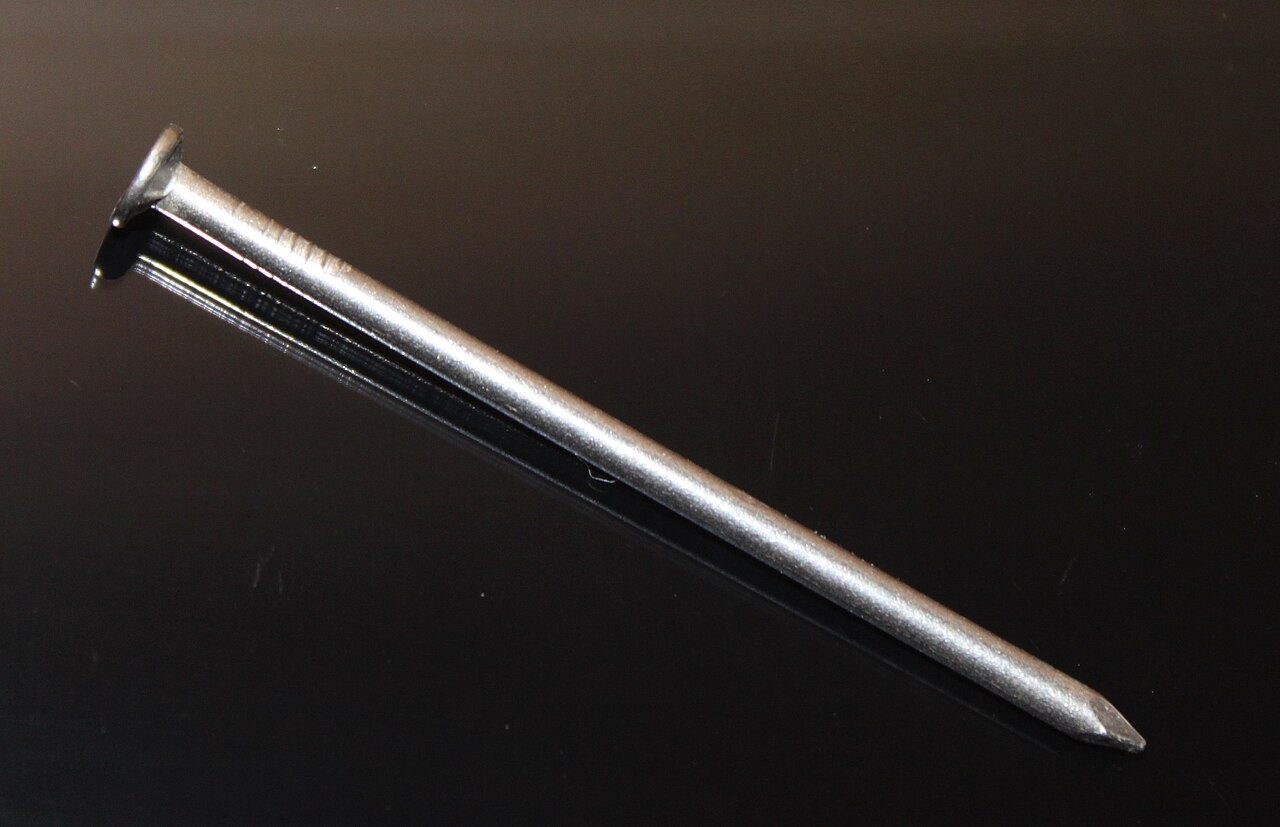
7 min read · 2 sourcesIn woodworking and construction, a nail is a small object made of metal (or wood, called a tree nail or "trunnel") which is used as a fastener, as a peg to hang something, or sometimes as a decoration. Usually, nails have a sharp point on one end and a flattened head on the other, but headless nails are available. Nails are made in a great variety of forms for specialized purposes. The most common is a wire nail. Other types of nails include pins, tacks, brads, spikes, and cleats. Nails are typically driven into the workpiece by a hammer or nail gun. A nail holds materials together by friction in the axial direction and shear strength laterally. The point of the nail is also sometimes bent over or clinched after driving to prevent pulling out. 1
History
The history of the nail is divided roughly into three distinct periods: 1
Hand-wrought (forged) nail (pre-history until 19th century) Cut nail (roughly 1800 to 1914) Wire nail (roughly 1860 to the present) From the late 1700s to the mid-1900s, nail prices fell by a factor of 10; since then nail prices have increased slightly, reflecting in part an upturn in materials prices and a shift toward specialty nails. 1
Hand wrought
In hand-working of nails, a smith works an approximately conical iron pin tapering to a point. This is then inserted into a nail-header (also known as a nail-plate), essentially a plate of iron with a small hole in it. The broad end of the pin is slightly wider than the hole of the nail-header: the smith fits the pin into the hole of the nail-header and then hammers the broad end of the pin. Unable to advance through the hole, the broad end is flattened against the nail-header to create a nail-head. In at least some metalworking traditions, nail-headers might have been identical to draw-plates (a plate bored with tapering holes of different sizes through which wire can be drawn to extrude it to increasingly fine proportions). The Bible provides a number of references to nails, including the story in Judges of Jael the wife of Heber, who drives a nail (or tent-peg) into the temple of a sleeping Canaanite commander; the provision of iron for nails by King David for what would become Solomon's Temple; and in connection with the crucifixion of Jesus Christ. The Romans made extensive use of nails. The Roman army, for example, left behind seven tons of nails when it evacuated the fortress of Inchtuthil in Perthshire in Scotland in 86 to 87 CE. The term "penny", as it refers to nails, probably originated in medieval England to describe the price of a hundred nails. 1
Cut
The slitting mill, introduced to England in 1590, simplified the production of nail rods, but the real first efforts to mechanise the nail-making process itself occurred between 1790 and 1820, initially in England and the United States, when various machines were invented to automate and speed up the process of making nails from bars of wrought iron. Also in Sweden in the early 1700s Christopher Polhem produced a nail cutting machine as part of his automated factory. These nails were known as cut nails because they were produced by cutting iron bars into rods; they were also known as square nails because of their roughly rectangular cross section. The cut-nail process was patented in the U.S. by Jacob Perkins in 1795 and in England by Joseph Dyer, who set up machinery in Birmingham. The process was designed to cut nails from sheets of iron, while making sure that the fibres of the iron ran down the nails. The Birmingham industry expanded in the following decades, and reached its greatest extent in the 1860s, after which it declined due to competition from wire nails, but continued until the outbreak of World War I. Cut nails were one of the important factors in the increase in balloon framing beginning in the 1830s and thus the decline of timber framing with wooden joints. Though still used for historical renovations, and for heavy-duty applications, such as attaching boards to masonry walls, cut nails are much less common today than wire nails. During the time when the settlers were annexing Texas, the Salish were in the Pacific Northwest using the nail. The nail they used was made of wood, cedar, and copper. They made the wooden ones using a form of carving. The copper nails were made from melting copper and shaping it into a nail form. 1
Wire
Wire nails are formed from wire. Usually coils of wire are drawn through a series of dies to reach a specific diameter, then cut into short rods that are then formed into nails. The nail tip is usually cut by a blade; the head is formed by reshaping the other end of the rod under high pressure. Other dies are used to cut grooves and ridges. Wire nails were also known as "French nails" for their country of origin. Belgian wire nails began to compete in England in 1863. Joseph Henry Nettlefold was making wire nails at Smethwick by 1875. Over the following decades, the nail-making process was almost completely automated. Eventually the industry had machines capable of quickly producing huge numbers of inexpensive nails with little or no human intervention. With the introduction of cheap wire nails, the use of wrought iron for nail making quickly declined, as more slowly did the production of cut nails. In the United States, in 1892 more steel-wire nails were produced than cut nails. In 1913, 90% of manufactured nails were wire nails. Nails went from being rare and precious to being a cheap mass-produced commodity. Today almost all nails are manufactured from wire, but the term "wire nail" has come to refer to smaller nails, often available in a wider, more precise range of gauges than is typical for larger common and finish nails. Today, many nails are made using the modern rotary principle nail machine, which allows wire feeding, wire cutting and nail head forming to take place in one continuous process of rotating movements. 1
Materials
Nails were formerly made of bronze or wrought iron and were crafted by blacksmiths and nailors. These crafts people used a heated square iron rod that they forged before they hammered the sides which formed a point. After reheating and cutting off, the blacksmith or nailor inserted the hot nail into an opening and hammered it. Later new ways of making nails were created using machines to shear the nails before wiggling the bar sideways to produce a shank. For example, the Type A cut nails were sheared from an iron bar type guillotine using early machinery. This method was slightly altered until the 1820s when new heads on the nails' ends were pounded via a separate mechanical nail heading machine. In the 1810s, iron bars were flipped over after each stroke while the cutter set was at an angle. Every nail was then sheared off of taper allowing for an automatic grip of each nail which also formed their heads. Type B nails were created this way. 1
The text above is adapted from the Wikipedia article “Nail (fastener)”, available under the Creative Commons Attribution-ShareAlike 4.0 licence. 1
nail is sharp object of hard metal used as a fastener, according to the structured record cited below. This entry was generated automatically from that record and has not yet been reviewed by a person familiar with the tradition. 2
The source record links this tradition to 35 external registers, which can be verified through the citation. 2