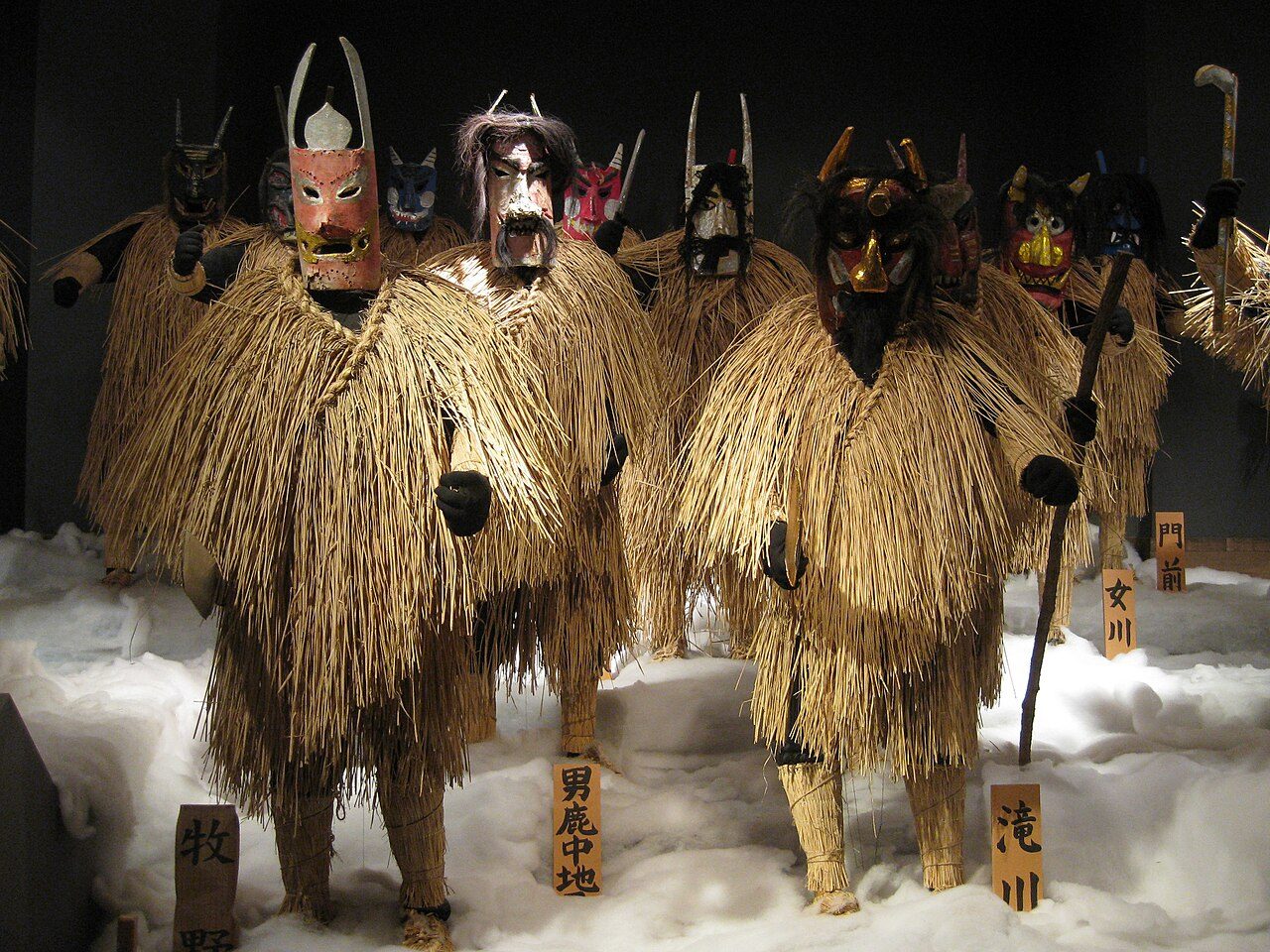
The tradition & historical record
4 min read · 2 sourcesThe Namahage (生剥げ, なまはげ) are demonlike beings portrayed by men wearing hefty oni (ogre) masks and traditional straw capes (mino) during a New Year's ritual, in local northern Japanese folklore of the Oga Peninsula area of Akita Prefecture. 1
General description
Namahage are portrayed by men who don oni masks and dress in long straw coats or mino, which are locally called kede or kende. They are equipped with deba knives (usually fakes made of wood or papier-mâché) and a teoke (手桶, "hand pail" made of wood). Marching in small groups of two or three, the namahage go door-to-door between people's homes, admonishing children who may be guilty of laziness or bad behavior by yelling phrases like "Are there any crybabies around?" (泣く子はいねがぁ, Nakuko wa inee gā?) or "Are naughty kids around?" (悪い子はいねえか, Waruiko wa inee ka?) in the pronunciation and accent of the local dialect. Traditionally, the namahage have worn painted wooden masks, sometimes made of wood bark, and primarily painted red. In recent years, however, masks are manufactured using cardboard material, flattened metal canisters, or other recycled materials, atop a frame made from bamboo strainers. One example from the hamlet of Yumoto (incorporated into the city of Oga) features namahage who travel in pairs, one red-faced, the other blue-faced. The straw attire are often described as a mino (standard Japanese), but these are considered particular items of clothing known locally as kede (or kende; kedashi). 1
Etymology
The namahage's purpose was to admonish laggards, who sit around the fire idly and do nothing useful. One of the refrains used by the namahage in the olden days was "Blisters peeled yet?" (なもみコ剝げたかよ, namomi ko hagetaka yo). Namomi signifies heat blisters, or more precisely hidako (火だこ, hidako) (Erythema ab igne or EAI), which in Japanese is dairisekiyō hihan (大理石様皮斑), but hidako is glossed as onnetsusei kōhan (温熱性紅斑) in medical literature, which corresponds to Erythema ab igne. Folklorist literature such as Ine mention hidako, but not the precise medical term for it. A rashlike condition is caused by overexposure to fire from sitting around the dugout irori hearth. Thus "fire rash peeling" is generally believed to be the derivation of the name namahage. 1
Tradition
Although the namahage are nowadays conceived of as a type of oni or ogre, it was originally a custom where youngsters impersonated the kami who made visitations during the New Year's season. It is therefore a kind of toshigami. The practice has shifted over the years, as according to 20th century descriptions, the namahage would typically receive mochi (rice cakes) from the households they visited, with newlywed couples being required to host them in full formal attire, and offer them sake and food. The namahage still receive hospitality in a similar manner during the New Years, but in a reversal of roles, the namahage distribute mochi to visitors (tourists) during the Namahage sedo matsuri (なまはげ柴灯まつり, Namahage Sedo Festival) held in February. 1
Season
Being a New Year's ritual, the namahage visits currently take place on New Year's Eve of the Gregorian calendar, though in the past they were held on the "Little New Year" (小正月, Koshōgatsu), or the first full moon of the year. This is the 15th day of the first lunar calendrical month, which does not equate to January 15; it usually falls around mid-February, exactly two weeks after the Chinese New Year (Japanese: Kyūshogatsu). The aforementioned Namahage Sedo Festival, which was not established until 1964, is held annually on the second weekend of February (roughly coinciding with the "Little New Year"), at the Shinzan Shrine. 1
Dialogue or phraseology
Some of the namahage's other spoken lines of old were "Knife whetted yet?" (包丁コとげたかよ, hōchōko togetaka yo) and "Boiled adzuki beans done yet?" (小豆コ煮えたかよ, azuki ko nietaka yo). The knife apparently signified the instrument to peel the blisters, and it was customary to have azuki gruel on the "Little New Year". 1
The text above is adapted from the Wikipedia article “Namahage”, available under the Creative Commons Attribution-ShareAlike 4.0 licence. 1
Namahage is Japanese folklore character associated with new year's ritual, according to the structured record cited below. This entry was generated automatically from that record and has not yet been reviewed by a person familiar with the tradition. 2
The source record links this tradition to 6 external registers, which can be verified through the citation. 2