The tradition & historical record
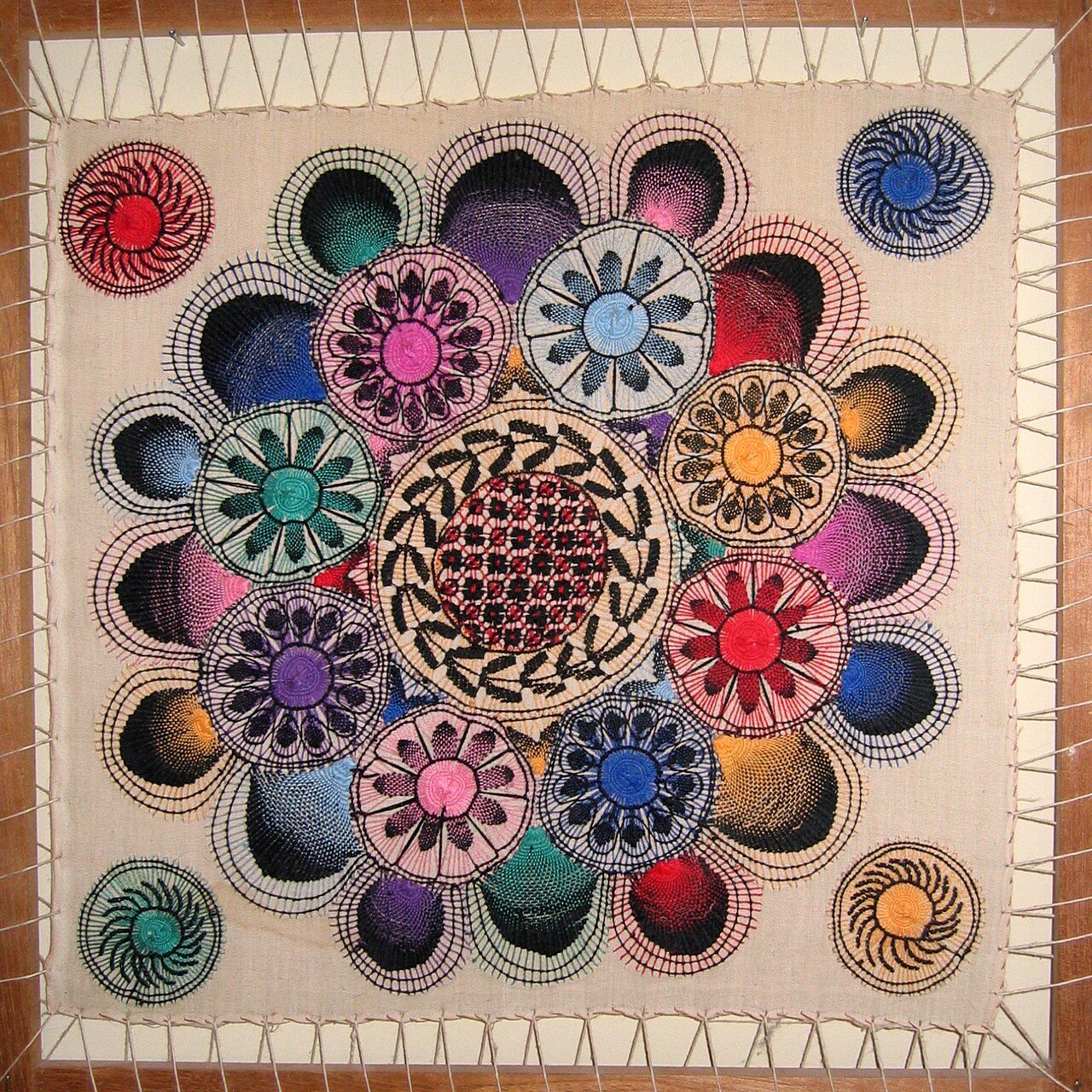
3 min read · 2 sourcesÑandutí is a traditional Paraguayan lace. The name means "spider web" in Guaraní, the official, indigenous language of Paraguay. The lace is worked on fabric which is stretched tightly in a frame. The pattern is drawn on the fabric and the threads, which go to-and-fro across the circular motif and are either taken through running stitches worked along the pattern lines or stitched directly through the fabric. When finished, the motifs are released by either cutting the running stitches or cutting away the backing fabric. While single motifs can be worked like this, it is more usual to work the whole item as one piece - the pattern for the complete mat or collar is drawn on the fabric and the wheels are linked together as the radial threads are laid down. 1
Technique
Ñandutí is woven with a needle and threads of cotton or silk. Its most notable characteristic is a matrix of squares, rectangles, or circles, usually about 2 inches (5 cm) across, with a radiating warp. To make ñandutí a quadrangular frame of adequate size is needed according to the piece being made. The four sides of the frame are tied to each other at the corners with twine. On this frame a piece of fabric will be stretched, also with twine, to support the needlework. The lacemaker recognizes three stages in the making of ñandutí, each identified by the object she uses: a pencil, a needle, and a pair of scissors. With the pencil she traces a design previously drawn on a piece of paper, which she puts under the fabric that is stretched on the frame. The needle stage begins when the lacemaker starts building the warp (armaje) of the first disc. Following the outline of the circle, a stitch is made at the top and one at the bottom exactly on the diameter, working clockwise. From 120 to 150 rays per disc are thus stretched. From that moment on, no other stitches will be attached on the fabric. Once the warp has been laid out, the lacemaker will make two rounds of darning stitches around the center of the disc to firmly fasten the threads of the rays that have been superimposed on each other. The center thus formed is called the “apyte”. If the lacemaker intends to make only one large flower or a star motif within a disc, she will form the petals or points of the star starting from that center. 1
The text above is adapted from the Wikipedia article “Ñandutí”, available under the Creative Commons Attribution-ShareAlike 4.0 licence. 1
ñandutí is traditional Paraguayan embroidered lace, according to the structured record cited below. This entry was generated automatically from that record and has not yet been reviewed by a person familiar with the tradition. 2
The source record links this tradition to 2 external registers, which can be verified through the citation. 2